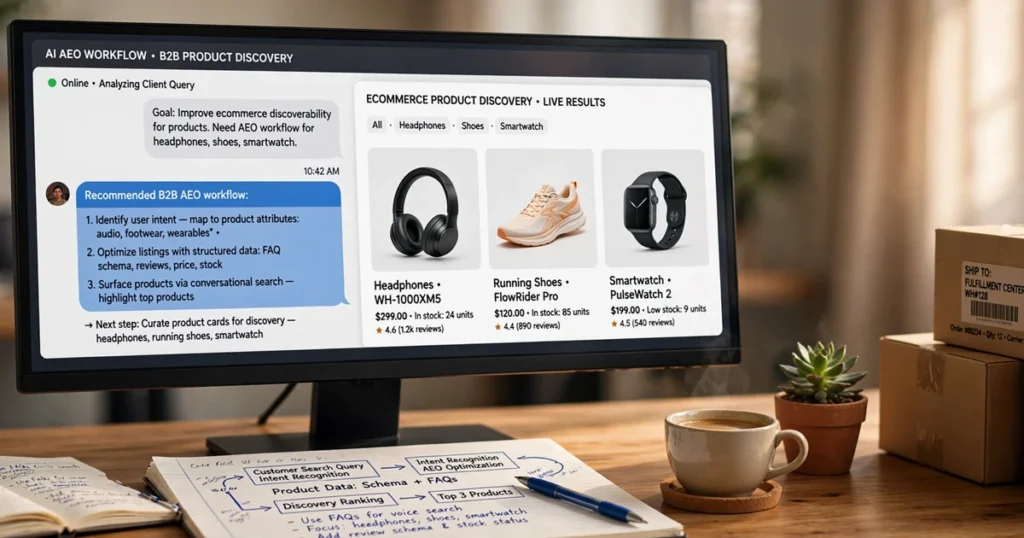
The rest of this week’s SEO news is about AI search growing up. While Google rolled out the September spam update, two quieter developments matter more for your 2026 strategy: B2B teams are turning AEO into an operational workflow built around buying committees, and ecommerce discovery is moving upstream into product feeds and structured data. Here is what changed, and how to respond.
What does a mature B2B AEO workflow look like?
Semrush published new B2B AEO guidance this week. The core idea: stop treating AI search as a single keyword list. Map prompts to individual buying-committee roles instead. The economic buyer, the technical evaluator, and the end user ask different questions, and each deserves content built for their prompts.
The content prescription is specific. Structure your content so each heading addresses one question, and make the first sentence under each heading answer that question directly. Keep sections self-contained so an answer engine can lift any one of them without losing meaning.
HubSpot’s recent AI search playbook lands in the same place. Map multi-turn buyer questions. Audit your high-priority prompts across several answer engines, not just one. Track citations, brand mentions, and share of voice over time. Its content principle is passage-level extractability: direct answers, self-contained paragraphs, clear entity names, and consistent technical signals.
A note of caution, because vendor playbooks deserve scrutiny: Semrush and HubSpot sell tools and software. Do not treat every formatting prescription as proven causation for citations. The defensible operational takeaway is narrower. Organize content around real decision questions, make claims easy to isolate and verify, name entities explicitly, cite credible evidence, and measure AI visibility with a stable prompt set you control. For the deeper framework, see my full GEO framework for AI citations and what actually gets you AI citations.
How do you measure AI search performance?
If AEO is becoming a workflow, it needs a measurement stack. Search Engine Land’s five-layer framework is the best structure I have seen:
Access. Verify AI crawler activity, crawl coverage, and blocked resources. If bots cannot reach a page, nothing else matters. A technical SEO checklist built for AI crawlability belongs at the base of every AEO program.
Visibility. Track mentions, citations, cited URLs, prominence, sentiment, and competitor share of voice. This is the layer most teams skip, and it is the one that tells you whether your content actually surfaces in answers.
Demand. Watch branded search movement and assisted discovery signals. AI-influenced journeys often start with a brand impression long before a click.
Referral quality. Measure engaged sessions, conversions, and revenue from AI sources, not just session counts.
Business outcome. Tie it all to pipeline, sales, retention, or qualified actions.
The key insight: do not treat AI referral sessions as the entire value of AEO. Much of the journey happens before a website click ever occurs. If you only count referrals, you will underinvest in the work that creates them. Learn how to track AI visibility beyond rankings, including AI traffic in GA4.
Why is ecommerce discovery shifting upstream?
For ecommerce, the week’s biggest signal is architectural. Product feeds, structured data, and crawlable product attributes increasingly determine whether AI systems can understand and recommend your products. Discovery is moving upstream, away from the product page alone and into the data that describes it.
Google’s guidance is explicit. Supply product information through Product structured data, Merchant Center feeds, or both. Using both maximizes eligibility and helps Google understand and verify your data across surfaces. Merchant listing markup communicates price, availability, shipping, returns, and ratings, and Google may combine your webpage markup with Merchant Center data.
The emerging AI shopping workflow raises the cost of inconsistency. One wrong price between your feed and your page does not just confuse shoppers. It can disqualify you from AI recommendations entirely. Treat Merchant Center data and Product markup as one synchronized product-information system, not as separate paid and organic assets.
Run these checks this week:
- Compare price and availability across rendered HTML, Product and Offer JSON-LD, Merchant Center, and checkout. All four must agree.
- Validate GTIN, MPN, brand, variant, category, shipping, and return-policy completeness.
- Keep specifications in crawlable HTML, and use clean tables where comparison matters.
- Audit image quality, multiple angles, filename and alt-text relevance.
- Monitor SKU-level disapprovals, warnings, feed lag, and stale inventory.
For the broader playbook, see my ecommerce SEO guide for 2026.
Your action plan for this week
- Map your top buyer questions to buying-committee roles, and assign one question per heading.
- Rewrite key sections so the first sentence answers the heading’s question directly.
- Build a fixed prompt set grouped by funnel stage and persona, and run it across ChatGPT, Perplexity, and AI Overviews. If you want your content in those answers, study how to get cited by ChatGPT and how to rank in Google AI Overviews.
- Reconcile one product category: price and availability across HTML, JSON-LD, Merchant Center, and checkout.
- Add citation and mention tracking to your SEO reporting without dropping clicks, conversions, and revenue.
Also this week on failonoben.com
Catch up on the rest of this week’s news: the September 2026 spam update rollout, Search Console’s new multimodal reporting filter, and Google’s VideoObject documentation changes.
AI search is moving from tactics to operations. The teams that win will be the ones with workflows: prompt sets by persona, measurement in layers, and product data that agrees with itself everywhere. If you want help building that system, get in touch.