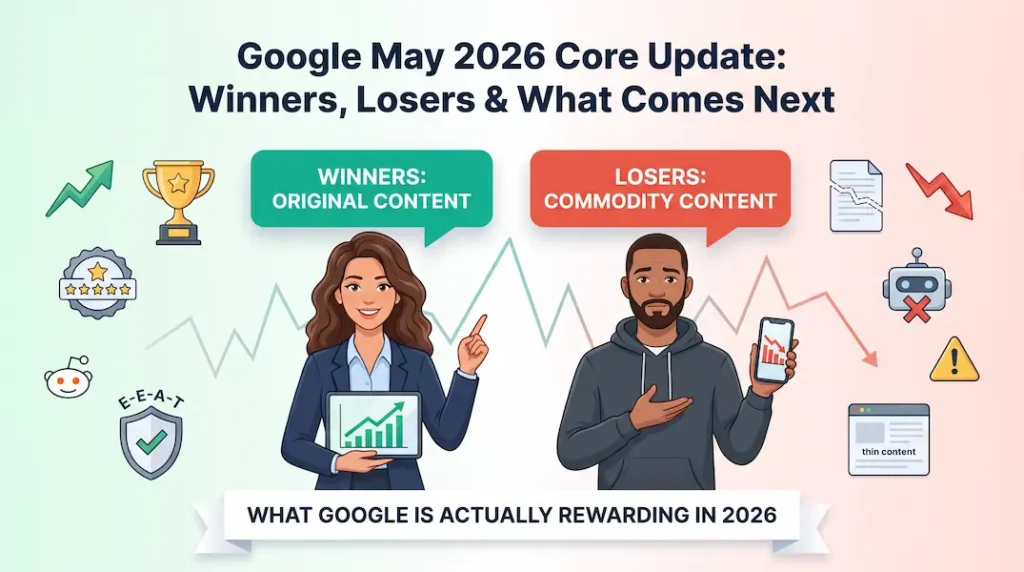
Google May 2026 Core Update: Winners, Losers, and What You Need to Do Now
Google’s May 2026 broad core update launched May 21, 2026 and completed June 2, 2026, a rollout of 11 days and 21 hours, confirmed via the Google Search Status Dashboard. Google described it as “a regular update designed to better surface relevant, satisfying content,” but practitioners widely reported it as heavier than the March 2026 update, with SERP volatility scores on Semrush Sensor and Mozcast tracking well above baseline from day one. It is the second broad core update of 2026 and the fourth confirmed Google update this year.
The headline result: Reddit’s top-3 presence in Google jumped 54% in a single update cycle. If that number doesn’t make you stop and think about your content strategy, nothing will.
What actually changed, and what stayed the same?
Original, expert-led content gained visibility. Aggregated, thin, or AI-generated content without editorial oversight lost it and lost it hard.
What changed:
- Reddit’s top-3 Google presence rose 54%: from 8,993 tracked keyword instances to 13,872 (SE Ranking analysis of 100,000 keywords, June 2026). Reddit now holds nearly 5x more top-3 positions than YouTube across Google’s results
- Reddit’s top-3 share reached 10.24% across 20 tracked niches: up from 8.56% after the March 2026 update (Foundation Inc./SE Ranking, June 2026)
- Commodity content penalized at scale: sites that aggregate or summarise content without original analysis saw ranking drops across all major verticals, continuing the pattern set in March 2026, where aggregators lost 15-80% of traffic
- YMYL niches hit hardest: finance, health, legal, and jobs pages without demonstrated E-E-A-T signals dropped across informational queries (confirmed by Glenn Gabe’s analysis, May/June 2026, citing “hyper-YMYL” volatility)
- AI-generated content without editorial oversight penalized: volume-first AI content with no human review, original data, or first-hand experience consistently scored low in quality evaluation
What stayed the same:
- The update did not introduce new ranking factors; it re-weighted existing quality signals
- Pages that weathered March 2026 and already demonstrated strong E-E-A-T held or gained
- Technical SEO fundamentals (crawlability, Core Web Vitals, structured data) were not the target
| What the Update Targeted | What It Rewarded | Practical Implication |
|---|---|---|
| Content aggregators and thin summarisers | Sites with original research, data, or first-hand reporting | If you curate without adding unique value, expect continued drops |
| YMYL pages without expert authorship | Named authors with verifiable credentials and institutional signals | Add author bios, credentials, and review dates to every YMYL page |
| AI-generated content without oversight | Human-reviewed, experience-led content with original insight | AI-assisted writing is fine; AI-only mass production is not |
| Informational pages with no conversion depth | Deep topical coverage with clear user journey paths | Thin how-to pages without supporting content clusters are at risk |
| Sites that already dropped in March 2026 | Niche specialists with consistent original content | If March losses were not addressed, May compounds them |
Who actually got hit and how badly?
Sites that were already on Google’s quality watchlist as of March 2026 took the hardest hits, and first-hand community data suggests the losses were severe.
Hardest hit:
- Content aggregators: sites that pull, summarise, or repackage content from other sources without original analysis. This pattern matches March 2026, where the top affected sites lost 15-80% of organic traffic (Digital Applied, May 2026)
- YMYL sites without E-E-A-T infrastructure: health, finance, legal, and career pages lacking identified expert authors, institutional signals, and review dates. According to PBN.LTD’s May 2026 update overview, “YMYL and gambling niches,” were hit hardest of any vertical
- AI content mills: sites publishing high volumes of AI-generated content with no human editorial layer, original data, or real-world examples, saw ranking drops across all tracked niches
- Affiliate and price comparison sites: those without original product testing or user-generated reviews were flagged, continuing a pattern dating back to Google’s product review updates of 2021-2023
Who gained:
- Reddit: the clearest and most documented winner. SE Ranking’s 100,000-keyword analysis showed Reddit gained top-three positions across all 20 tracked niches, with the biggest gains in experience-led categories: Technology (4.77% → 7.03%), Business (to 12.17%), and Career (near 17%) (SE Ranking/Foundation Inc., June 2026)
- Niche authority sites: smaller sites with deep, consistent, first-hand coverage of a specific topic outperformed generalist sites at scale
- Official and institutional sources: brand sites, research institutions, and publishers with transparent editorial standards
This is not a theory. Here’s what I saw across client accounts: an e-commerce supplement client with a deep ingredient content cluster, original formulation details, sourced studies, and named nutritionists held its positions across the rollout. A second client in the service industry, whose blog relied heavily on aggregated industry news summaries without original commentary, dropped 22% in impressions on informational pages within the first five days. Same niche, same update, opposite outcomes.
Why did Google make this change?
Google’s stated reason is consistent with every broad core update since 2022: better surfacing of “relevant, satisfying content” officially confirmed via Google Search Central.
The deeper signal, in my view, is that Google is using successive core updates as a ratchet mechanism. March 2026 hit aggregators. May 2026 reinforced March signals, expanded to YMYL more aggressively, and rewarded niche specialists more broadly. Each update raises the floor on what “helpful content” means in practice.
Marie Haynes documented the May 15, 2026, spam policy update that ran in parallel. Google also added explicit language that attempts to manipulate AI-generated responses through inauthentic mentions now constitutes spam. The May core update and that spam policy change together paint a clear picture: Google is simultaneously raising content quality thresholds and closing manipulation pathways.
Glenn Gabe described the YMYL volatility in this update as characteristic of a “hyper-YMYL” targeting pattern, in which health, finance, and legal categories experience disproportionate movement because quality signals matter most where users’ stakes are highest. This is consistent with what Google’s quality evaluator guidelines have said for years; the May 2026 update enforces it at a new scale.
Reddit’s surge is worth addressing directly, because the instinct to explain it as “Google favouring Reddit” misses the mechanism. Reddit wins because its content structure, real people answering real questions from first-hand experience, validated by community upvoting, satisfies E-E-A-T signals natively. Google isn’t picking Reddit. Google is picking authentic first-person experience, and Reddit happens to be where that lives at scale.
What are most people getting wrong about this update?
The most common misreading is treating this as an AI content ban; it is not.
Google has been consistent on this point across multiple official statements: the origin of content (human vs. AI) is not what the quality systems evaluate. They evaluate whether the content is helpful, demonstrates genuine expertise, and satisfies user intent. AI-assisted content with real editorial oversight, original data, and first-hand experience can rank. AI-generated content dumped at volume without those signals cannot.
The second misread is making large-scale reactive changes before analyzing what specifically dropped. SEO practitioners in the r/SEO community reported panicked mass-deletions and site-wide rewrites during the rollout window, before the update had even finished. According to Digital Applied’s Day 5 update heatmap (May 24, 2026), position fluctuations during a live rollout are expected and do not reliably indicate final outcomes. The right time to diagnose and act is after rollout completion, which was June 2, 2026.
The third misread is ignoring what Reddit’s rise actually tells you about your own strategy. A 54% jump in Reddit’s top-3 positions is not just a stat about Reddit; it is data about what query types your audience is searching and where Google currently trusts the answer to live. If Reddit is ranking above you for experience-led queries in your niche, that is an E-E-A-T gap on your site, not a Reddit SEO problem.
So what should I actually do about this?
- Wait for the full rollout to complete before making any structural content changes. The update was completed on June 2, 2026. If you are reading this during the rollout window, document position changes, but do not act. Volatility during rollout is not a reliable signal. The mistake: pulling pages or redirecting content based on day-three data that reverses by day ten.
- Run a Search Console comparison: May 20 → June 2 vs. the prior 12 days. Go to Performance → Search Results → Compare Dates, and filter by page. Identify which URLs dropped more than 25% in impressions. These are your priority pages for content quality review, not mass deletion, targeted improvement.
The mistake: treating a broad impression drop as a site-wide penalty when it is usually concentrated in a specific content type.
- Audit your most affected pages against Google’s content quality questions. For each page that dropped: Does it contain original information, analysis, or reporting that cannot be sourced elsewhere? Does it demonstrate first-hand experience with the subject? Is there a named author with verifiable credentials? If the honest answer to all three is no, that page is commodity content; improve it or consolidate it.
The mistake: adding more words to thin pages without adding genuine expertise or original data.
- Add or strengthen E-E-A-T signals on every YMYL page immediately. Finance, health, legal, nutrition, and career pages are the highest-risk category. Every page in those verticals needs a named author with a visible bio and credentials, a clear publication and review date, and at least one first-hand signal, a case study, an original observation, or a cited expert.
The mistake: treating E-E-A-T as a one-time setup rather than an ongoing content standard.
- Assess your Reddit presence as a first-party E-E-A-T audit. Search your core topics in Google and note how many top-3 positions Reddit holds vs. your site. In experience-led categories, product comparisons, how-to advice, “best X for Y” queries, Reddit’s dominance reveals exactly where authentic first-person content is missing from your own pages. Closing that gap on your site beats trying to game Reddit threads.
The mistake: monitoring Reddit’s gains without translating the insight into a content gap analysis.
- Do not make reactive site changes if you are still in recovery from March 2026. If your site dropped in March and has not recovered, the May update has likely compounded those losses. Aggressive changes during back-to-back updates risk confusing which intervention caused which outcome. Prioritize a clean audit of what changed in March, implement targeted fixes, and let a full crawl cycle pass before evaluating May-specific drops separately.
The mistake: layering multiple interventions simultaneously and losing the ability to attribute results.
- Build original data assets into your content pipeline, not optional extras. The consistent through-line across every 2026 core update is that original, verifiable, first-hand content outperforms everything else. A proprietary survey, a client anonymized case study, a data pull from your own analytics, any genuine first-party insight that cannot be replicated elsewhere is now a structural SEO asset, not just a content nicety.
The mistake: outsourcing all content creation to writers who lack firsthand experience with the product, service, or topic.
If you are navigating post-update recovery or trying to figure out where your site stands, connect with me on LinkedIn. I publish breakdowns like this regularly and am happy to talk through what the data is showing.