
How to track your AI visibility (and why it matters more than rankings)
AI visibility tracking measures how frequently and favourably language models mention and cite your brand across platforms like ChatGPT, Claude, Copilot, Gemini, Perplexity, and Google AI Overviews. Unlike standard rank tracking that monitors a static position on a search engine results page, AI visibility tracks dynamic brand mentions, sentiment, citations, and conversational market share. Tracking AI presence gives you a clear picture of whether generative engines are recommending your business or handing your customers directly to competitors.
I have been working in SEO for over a decade, and watching marketers obsess over traditional keyword rankings while ignoring AI answers is like polishing the deck chairs on a ship that has already docked at a different port. Google AI Overviews now show up on nearly half of all Canadian search queries, so if you are not tracking your AI presence, you are flying completely blind.
What is AI visibility and why does it matter more than traditional rankings?
AI visibility is the total presence and influence your brand commands inside generative search engine responses.
Standard keyword rank tracking tells you where your website sits on a list of blue links. Generative models do not just list links; they synthesize full answers from dozens of web sources. Recent data shows that AI Overviews trigger on roughly 48% to 50% of US search queries. When an AI summary appears, organic clicks to traditional search results drop by 34.5% to 58%. However, brands cited directly inside AI Overviews see a 120% boost in organic click-throughs compared to uncited brands. If you only measure standard ranks, you miss whether artificial intelligence recommends your brand or ignores it.
How does traditional SEO rank tracking compare to AI visibility monitoring?
Traditional SEO rank tracking measures static URL positions for specific keywords, while AI visibility monitoring tracks multi-platform brand mentions, sentiment, and cited sources across dynamic answers.
Standard rank trackers pull data from fixed search engine results pages. Generative models construct answers on the fly using retrieval-augmented generation. Ahrefs analyzed 4 million AI Overview URLs and discovered that only 38% of cited pages rank in Google’s top 10 organic blue links. That means ranking number one on Google no longer guarantees that ChatGPT or Gemini will mention your brand.
| Feature | Traditional SEO Rank Tracking | AI Visibility Monitoring | Best For |
| Primary Focus | Fixed URL rank positions (1 to 100) | AI Share of Voice, mentions, and citations | Benchmarking search engine rankings |
| Data Unit | Target keyword and single domain URL | Conversational prompts and brand entities | Tracking real buyer discovery |
| Key Output | Organic search traffic volume | Sentiment, position, and citation share | Measuring AI search influence |
| Result Stability | High consistency across standard searches | High variance based on prompt context | Understanding dynamic model outputs |
| Source Reach | Direct indexed web pages | Multi-surface web, video, and social UGC | Identifying full brand footprint |
What key AI metrics should you track to measure brand presence?
You must track AI Share of Voice, brand sentiment, LLM position, citation rate, and AI referral traffic to properly evaluate your generative search presence.
Tracking AI presence requires looking beyond a single rank metric. Here are the five core numbers every marketing team needs to monitor:
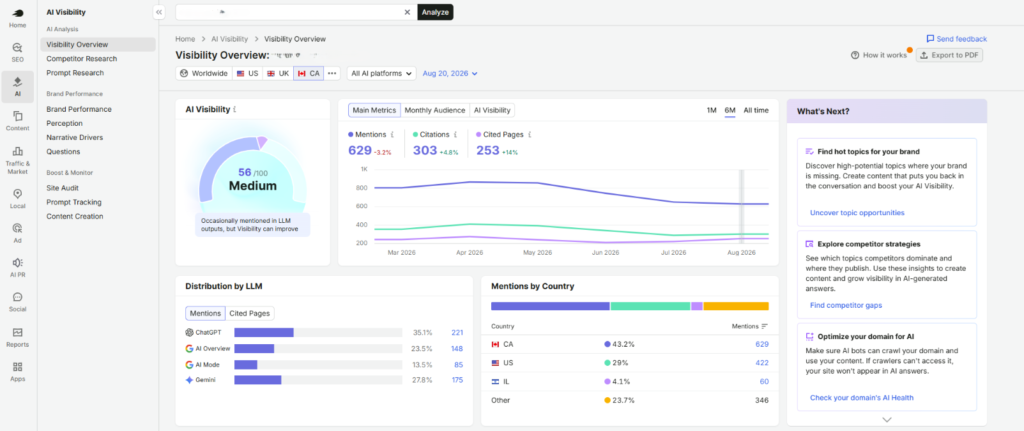
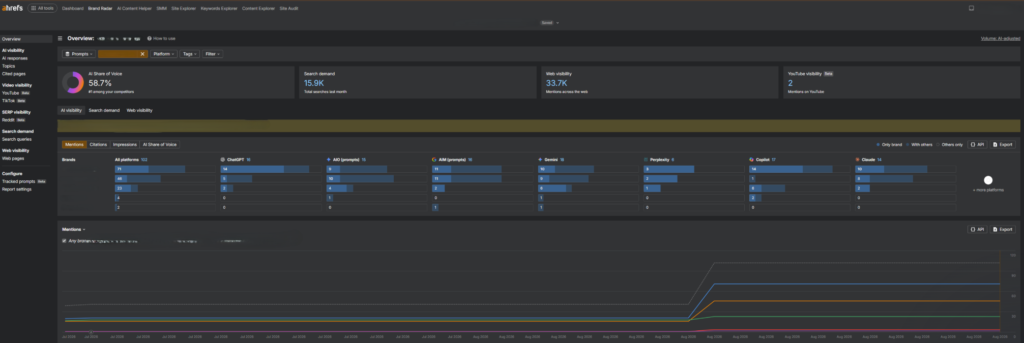
- AI Share of Voice (SOV): AI Share of Voice measures the proportion of total AI responses in your category that mention your brand compared to competitors. If an AI tracking tool tests 100 industry prompts across ChatGPT, Gemini, Copilot, and Claude, and your brand appears in 58 of those answers, your AI SOV is 58%. Studies reveal that brands in the top quartile for web mentions earn 10 times as many AI Overview mentions as lower-tier brands.
- Brand Sentiment in AI Responses: Sentiment tracks whether language models describe your brand with positive praise, neutral factual statements, or negative criticism. Generative tools pull perceptions from review sites, blogs, and customer forums. If a model repeatedly links your product to words like “expensive” or “unreliable,” your conversion rate will crater before the user ever hits your site.
- LLM Position and Ranking: LLM position measures where your brand appears inside an AI-generated list or summary. Being named first in a recommended product list yields significantly higher visibility than being buried at positions 6 or 7. Research shows that 8.64% of AI Overview citations appear below the top spot, meaning placement within the summary directly affects user attention.
- Citation Rate and Source Distribution: Citation rate measures how frequently language models link to your owned domain versus third-party sources. Brand-managed websites account for about 31% of AI Overview citations, while platforms like YouTube, Reddit, and Wikipedia capture over 60% of citations. You need to know which external sites the AI trusts so you can get featured on them.
- AI Referral Traffic: AI referral traffic tracks direct website visits originating from links inside generative answers. While 26% of AI search sessions end without a click, visitors who do click through from AI citations convert at a much higher rate because the model has already pre-qualified them.
How do you track your AI visibility step by step?
You track AI visibility by defining high-intent buyer prompts, running regular manual audits, and using automated AI visibility software.
Building an AI tracking process takes consistency rather than complex setups. Here is the step-by-step workflow I use with my clients:
- Build a core prompt library: Gather 25 to 100 conversational questions your customers ask during their buying journey. Include non-branded prompts, such as “what are the best supplements for workout recovery,” alongside direct comparison queries.
- Run manual prompt checks weekly: Test your core prompts across ChatGPT, Gemini, Perplexity, and Claude to note brand mentions. Record whether the model lists your brand, summarizes your product features correctly, or recommends a competitor instead.
- Analyze cited sources and external domains: Click the citations attached to AI answers to see where the model gets its facts. Take note of third-party review sites, YouTube channels, and Reddit threads that feed information to the AI.
- Deploy dedicated AI visibility software: Use tools such as the Semrush AI Visibility Toolkit or the Ahrefs Brand Radar to automate tracking at scale. These platforms track Share of Voice trends, highlight prompt opportunities, and alert you when competitors steal your visibility.
A pattern I kept seeing across audits was that top-ranking ecommerce brands were losing massive sales because AI answers relied on third-party review roundups rather than official product pages. In a recent consultation with a specialized health brand, we discovered that while their store ranked number two on Google, their AI Share of Voice was stuck at 12% across ChatGPT and Copilot. By securing inclusions in top-cited editorial sites and updating structured data, we lifted their AI Share of Voice to 58% in just under five months. You can check out my detailed case studies to see how we structure these campaigns, or explore my core SEO services for tailored strategy support.
What are the biggest mistakes marketers make when measuring AI search?
The biggest mistake marketers make is assuming that strong Google organic rankings guarantee high visibility inside AI responses.
Over 60% of web pages cited in Google AI Overviews do not even rank in the top 10 standard search results. Relying solely on traditional rank trackers creates a massive false sense of security.
Something that catches a lot of people off guard is ignoring brand mentions on third-party websites. Generative models heavily favour user-generated content and authoritative news sites. YouTube accounts for 23.3% of AI Overview citations, while Reddit accounts for 21%. If you only optimize your own domain and ignore off-page brand authority, language models will simply cite someone else.
What actions should you take after analyzing your AI metrics?
After analyzing your AI metrics, you should optimize page structure for AI extraction, build third-party mentions, and refine landing pages for conversion.
Tracking metrics without taking action is just expensive window shopping. Here are the exact steps you should take once you know your AI visibility numbers:
- Structure content for immediate extraction: Place direct answers, bullet points, and core definitions in the top 30% of your web pages. Data from SparkToro shows that 44.2% of AI Overview citations extract text from the upper third of a page.
- Expand digital PR and off-page mentions: Get your brand featured on popular industry roundups, review blogs, and news sites. Brands in the top quartile for web mentions receive ten times more AI recommendations than lesser-known competitors.
- Engage on high-authority user platforms: Maintain an active presence on YouTube and Reddit to directly influence AI source material. YouTube and Reddit combine for over 44% of total AI citation volume in key industries.
- Optimize landing pages for incoming AI traffic: Streamline sign-up forms, display social proof, and add quick FAQ blocks on key conversion pages. Visitors arriving from AI citations have high commercial intent, so removing friction maximizes your revenue. You can read more actionable guides on my SEO blog to keep your search strategy ahead of algorithmic shifts.
Connect with me on LinkedIn to talk about generative engine optimization, tracking frameworks, and AI search strategies. Let us analyze your brand’s AI Share of Voice and build a strategy that gets your business cited where it matters most. Head over to my LinkedIn Profile to start a conversation today.