Google Search Console Now Shows AI Impressions, And Lets You Opt Out Entirely
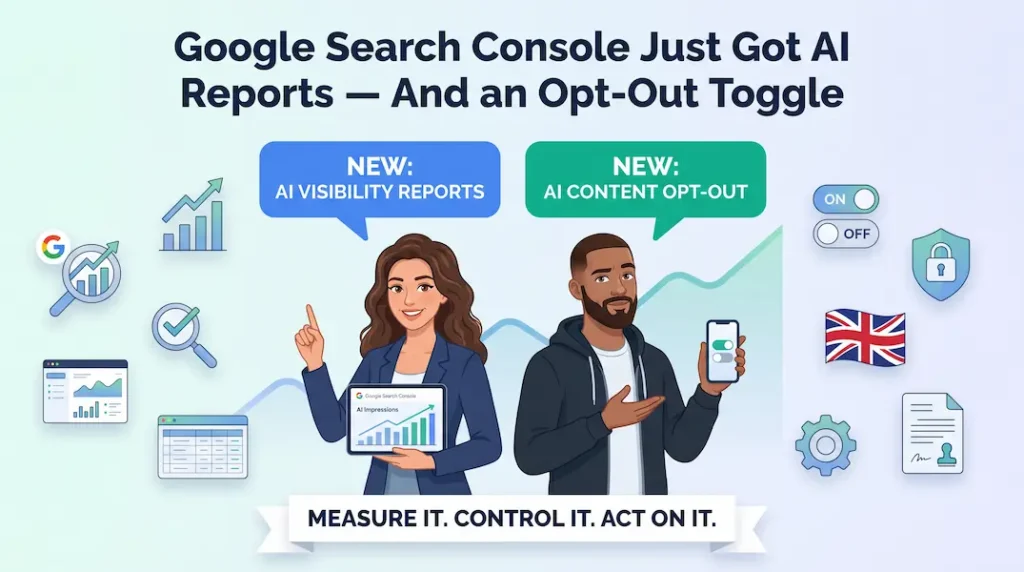
On June 3, 2026, Google launched dedicated Generative AI Performance Reports inside Search Console. The first time SEOs can see natively how often their pages appear inside AI Overviews, AI Mode, and generative Discover features, confirmed via the Google Search Central Blog. Alongside the report, Google simultaneously introduced a toggle that lets site owners remove their content from all AI features entirely with no organic ranking penalty, confirmed explicitly by Google. Both features began rolling out to a subset of UK site owners and are expanding globally, with no fixed date announced for full availability as of June 2026.
The data starts from May 18, 2026. There is no historical backfill. If you want a before/after comparison, you are building it from scratch, starting now.
Google didn’t volunteer this willingly. The UK’s Competition and Markets Authority issued a legally binding conduct requirement on June 3, 2026, forcing Google to hand publishers both the data and the controls. Regulatory pressure delivered what years of practitioner requests didn’t.
What does the new GSC AI performance report actually show you?
The report shows AI impressions of how often your URLs appeared in AI features, broken down across five dimensions, nothing more.
What it gives you:
- Impressions by page: which specific URLs are surfacing in AI Overviews and AI Mode
- Impressions by country: geographic breakdown of AI visibility
- Impressions by device: desktop vs. mobile (Search report only)
- Impressions by date: hourly, daily, weekly, and monthly granularity
- Two separate surfaces: one report for generative AI features in Google Search (AI Overviews + AI Mode), one for generative AI features in Google Discover
What it does not give you:
- No click data: Google confirmed this is absent, with more metrics “expected to follow” (no date given)
- No CTR: impressions are currently the measurement ceiling
- No query-level breakdown: you cannot see which search terms triggered your AI appearances
- No data before May 18, 2026: zero historical backfill
| Dimension | Available Now | Coming Later |
|---|---|---|
| AI Impressions | Yes | – |
| Click data | No | Confirmed as planned (no date) |
| CTR | No | Follows click data |
| Query breakdown | No | Unconfirmed |
| Average position | No | Unconfirmed |
| Historical data pre-May 18 | No | Not available |
One important note that most coverage has missed: the AI impressions data was already inside your standard Performance report all along. Google confirmed this. The new report is a separate, cleaner view of data that already existed. Your total historic impression numbers are unchanged.
What is the AI opt-out toggle, and should you use it?
The toggle lets you remove your content from AI Overviews, AI Mode, and generative Discover features entirely, and Google has confirmed it will not be used as a ranking signal for regular Search results.
To access it: Google Search Console → Settings → AI Search Controls → toggle “Allow my content in AI Overviews” to off. There is also a technical implementation path: adding User-agent: googlebot-ai with Disallow: / to your robots.txt achieves the same result at the crawl level.
The opt-out is a clean instrument. Previous methods for blocking AI feature inclusion were blunt, opting out risked collateral damage to standard search visibility. According to the UK CMA conduct requirement (June 3, 2026), this separation is now legally mandated: the opt-out must carry no downranking penalty in standard search. Google has complied.
Here’s my honest take on whether to use it: for most SEO clients, the answer is no, at least not yet. Here’s why. With 68% of U.S. searches now ending without a click (SparkToro + Similarweb, 2026), the citation you earn inside an AI Overview is often the only brand exposure you get from that query. Opting out removes your content from that exposure entirely. Unless your content monetization model is directly harmed by AI surfacing your answers without driving clicks. Think premium paywalled content, news publishers, or subscription sites, the trade-off almost certainly favours staying in.
The exception worth testing: high-value transactional or conversion-oriented pages where AI Overview exposure is generating impressions but no downstream clicks or conversions. Opting those specific pages out while keeping informational content opted in is a nuanced strategy worth exploring once the toggle reaches global rollout.
Who does this affect, and how badly?
Every site owner who has been flying blind on AI search visibility gets an upgrade, but the data gap means “less blind,” not “fully sighted.”
Most affected positively:
- SEO agencies and consultants who have been manually testing SERPs to estimate AI citation rates, this replaces guesswork with first-party data
- E-commerce brands with informational content strategies can now see which educational pages are generating AI impressions and whether they are the same pages driving traditional rankings
- Publishers considering AI opt-out now have the data to make an evidence-based decision instead of an ideological one
Most affected by the data gaps:
- Performance marketers expecting click-level attribution, the report currently cannot close the loop from AI impression to conversion
- Any site measuring ROI on content investment, without CTR or query data, the report tells you that you appeared, not whether it mattered
Here’s something I noticed firsthand: before this report launched, the closest thing to AI visibility tracking in Search Console was a manual workaround: exporting query data from the standard Performance report and filtering for long, conversational queries likely to trigger AI Overviews, then cross-referencing it with third-party tools like Semrush’s AI Overviews tracker. It worked, but it required manual effort every single month. That workaround is now obsolete for impression tracking. The report does in seconds what took an hour to approximate.
Why did Google build this now, and why is the CMA involved?
Google built this because regulators ordered it to. The stated reason from Google’s announcement is framed as giving publishers “more transparency and control,” but the mechanism was the UK Competition and Markets Authority’s legally binding conduct requirement issued on June 3, 2026.
According to the CMA order (confirmed via GOV.UK, January 2026 proposals → June 2026 enforcement), Google must provide publishers with: a clean opt-out from AI features without ranking penalties, clear attribution links in AI-generated results, and Search Console performance data showing which pages appear in AI responses and in which countries. The CMA also mandated click and CTR data as a forthcoming requirement; full compliance is due by December 2026 at the page-level controls stage, with the final attribution standards phasing through to March 2027.
In my view, the click data absence is the honest tell here. Google launched impressions first because impressions are the least commercially sensitive metric; they show visibility without exposing the CTR collapse that the zero-click data would make undeniable. When click data arrives (mandated by December 2026 under CMA rules), every site owner will be able to see exactly how often AI answers their queries without sending a click. That number is going to be uncomfortable, and Google knows it.
Barry Schwartz covered the announcement for Search Engine Roundtable on June 4, 2026, noting the rollout alongside the completion of the Google May 2026 Core Update, a busy news week that likely diluted the industry attention this deserved.
What are most people getting wrong about this report?
The most common misread is treating impression data as equivalent to the traffic data you already track, and making strategic decisions based on it in the same way.
AI impressions and organic clicks measure fundamentally different things. An AI impression means your URL was cited inside an AI-generated answer. It does not mean the user read the citation, visited your site, or associated your brand with the answer. A page generating 50,000 AI impressions and zero direct traffic referrals from AI features is performing very differently from a page generating 50,000 organic clicks.
The second misread is mass-opting out of AI features in a panic. Early community discussion following the launch showed several site owners treating the opt-out as a defensive move without first checking their impression data. According to AI-SEO-Hacker’s analysis (June 2026), AI crawler traffic grew 300% year-over-year in 2026, and news media blocking en masse means the sites choosing to stay in the AI ecosystem are gaining share of citation by default. Blanket opt-outs without data are self-defeating.
The third misread is treating this as a finished product. The CMA compliance timeline confirms the report will look materially different by December 2026, when click data must be included. What you are seeing now is version one of a regulated reporting product; the roadmap is already written.
So what should I actually do about this?
- Check whether the Generative AI category has appeared in your Search Console today. Go to Performance → Search Results and look for the Generative AI filter. The rollout is phased; not every account has access yet. If you do not see it, audit your crawler access (confirm googlebot-ai is not blocked in your robots.txt), and build a manual baseline using third-party tools in the meantime.
The mistake: assuming you have no AI visibility just because the report hasn’t appeared yet.
- Pull your first AI impressions snapshot and save it immediately as a dated CSV. Data begins May 18, 2026; that is your only baseline. There is no backfill. The longer you wait to export a monthly snapshot, the less trend data you will have when click data arrives in December 2026. Set a calendar reminder to export on the same date each month.
The mistake: waiting until the report is “more complete” before starting to track.
- Cross-reference your AI impression pages against your standard performance data. Pull the pages generating the most AI impressions and compare them to your top-performing pages by clicks. Are they the same pages? Different pages? Pages with high AI impressions and low clicks are earning brand exposure without driving traffic; these need a conversion-path audit, not an opt-out.
The mistake: treating every high-impression, low-click page as broken content.
- Do not make opt-out decisions without at least 30 days of impression data. The toggle is real, and the no-penalty guarantee is legally binding, but opting out without understanding your current citation volume is a premature call. For most sites, especially those without paywalled or monetised content, the evidence strongly favours staying in AI features.
The mistake: reactive opt-outs based on principle rather than data.
- Build a proxy measurement framework for AI ROI while click data is unavailable. Since CTR is not yet in the report, build indirect signals: track direct traffic trends for content categories with high AI impression volume, monitor brand search volume month-over-month, and run customer acquisition surveys asking “how did you first hear about us?” These proxies give you a commercial signal even while Google’s reporting catches up.
The mistake: declaring AI impressions unmeasurable and abandoning the channel entirely.
- Add a googlebot-ai review step to every technical SEO audit. Check whether googlebot-ai is intentionally handled in your robots.txt. Many sites have blanket bot rules that accidentally block AI crawlers. If your pages are invisible to AI crawlers, they cannot appear in AI Overviews regardless of how strong your traditional ranking is. Fix accidental blocks before optimising content.
The mistake: skipping crawler access as a step because it feels “too basic.”
- Brief your clients on what the report does and does not show, before they see it themselves. The impressions-only limitation will confuse anyone expecting a standard performance report. A simple three-line brief: baseline impression volume, month-over-month trend, and the confirmed roadmap to click data by December 2026 sets the right expectations and positions you as ahead of the curve.
The mistake: waiting for clients to ask rather than proactively framing the new metric.
Got questions about what your AI impression data is actually telling you? Connect with me on LinkedIn. I post breakdowns like this regularly and am always up for a conversation.