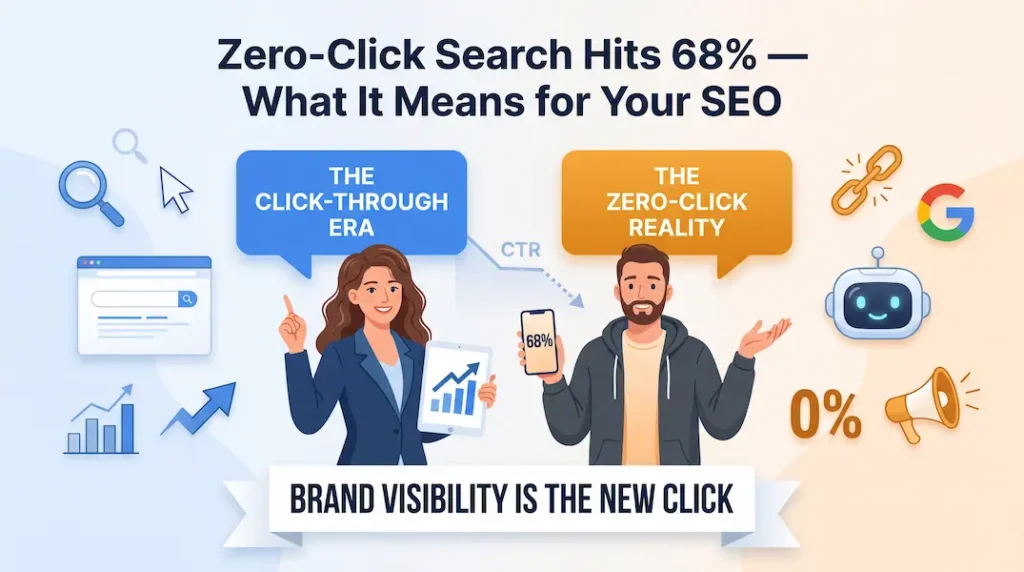
68% of Google Searches Now End Without a Click, Here’s What That Actually Means for SEO
SparkToro, using Similarweb clickstream data, confirmed that 68.01% of all U.S. Google searches ended without a click during the first four months of 2026, up sharply from 60.45% in 2024, a 7.56-point jump in just two years. A separate study by Digital Applied puts the figure at 64.82%, documenting a steady climb from roughly 50% in 2019. Both studies point to the same driver: AI Overviews now appear on 20–25%+ of U.S. searches, and click-through rates collapse wherever they show up.
That leaves roughly 232 clicks for every 1,000 U.S. Google searches reaching any website outside Google’s own ecosystem. Less than one-third. Not a blip, a structural shift.
If your content strategy is still optimized purely for traffic volume, you’re measuring the wrong thing.
What actually changed, and what stayed the same?
The click is dying. The search is not. Google processes more queries than ever; what changed is where the answer stays.
What is confirmed and new:
- 68.01% zero-click rate in the U.S. (SparkToro + Similarweb, January-April 2026), the highest ever recorded
- 64.82% rate confirmed independently by Digital Applied (April 2026), tracking growth from 50% in 2019
- AI Overviews now appear on 20-25%+ of U.S. searches (Similarweb, 2026), and queries with AI Overviews show an 83% zero-click rate (Ahrefs, via PikaSEO, February 2026)
- Organic CTR has dropped 58% on queries where AI Overviews appear (Ahrefs data, 2026)
- Of every 1,000 U.S. searches, only ~232 clicks reach the open web, down from ~400 two years ago
What has not changed:
- Ranking still matters; you cannot be cited in an AI Overview without first being indexed and ranking competitively in standard search
- E-E-A-T signals still govern quality and citation eligibility
- Technical SEO fundamentals (crawlability, Core Web Vitals, structured data) are unchanged
| Metric | 2019 | 2024 | 2026 |
|---|---|---|---|
| Zero-click rate | ~50% | 60.45% | 68.01% (SparkToro) / 64.82% (Digital Applied) |
| Clicks per 1,000 searches reaching open web | ~500 | ~396 | ~232 |
| Searches with AI Overviews | 0% | ~13% | 20–25%+ |
| CTR drop on AI Overview queries | N/A | N/A | -58% (Ahrefs) / -83% zero-click rate |
Who does this affect, and how badly?
Every site running an informational content strategy built around traffic volume takes a direct hit, but the damage is not equal across all content types.
Sites most exposed:
- Informational content sites (news, how-to guides, explainers) are the query types AI Overviews target most heavily
- E-commerce sites with educational blog strategies built to funnel informational traffic to product pages, the top of the funnel is compressing
- Publishers and media: Google Search Console data showing 0.15% CTR on pages with 100,000+ impressions is already being reported in the SEO community (SEO-Kreativ, April 2026)
- Any site measuring success by sessions or pageviews alone, those dashboards now tell an incomplete story
Who is comparatively protected:
- Transactional and navigational queries, “buy running shoes” and “[BRAND] login” still drive clicks, because AI does not replace intent
- Branded search: users looking for you specifically still click
- Sites earning citations inside AI Overviews: Seer Interactive data shows cited brands earn 35% more organic clicks and 91% more paid clicks than non-cited competitors
Here’s something I noticed firsthand: when I pulled impression data for a supplement e-commerce client over Q1 2026, pages covering ingredients (informational intent) had CTRs below 0.5% despite ranking in the top five. The same site’s transactional and category pages held CTR above 3%. The informational traffic didn’t disappear from the search; it disappeared from the click. Google answered the query before the user needed to leave.
Why did this happen, and why won’t Google reverse it?
Google built AI Overviews to answer queries faster, and the financial data confirms the strategy is working exactly as intended.
According to the SparkToro analysis (June 2026), Google’s stock performance and ad revenue growth both improved in the same period that zero-click rates accelerated. In plain terms, Google is not losing money by keeping users on-SERP. It is making more of it. That removes the financial incentive to reverse course.
The technical mechanism is straightforward. AI Overviews use retrieval-augmented generation (RAG); they pull from indexed content, synthesize an answer, and present it at the top of the SERP without requiring the user to visit any source. The result: the cited page provides the answer, but Google collects the engagement.
Rand Fishkin, whose SparkToro study broke this story on June 8, 2026, framed it plainly: “Google is becoming a walled garden.” The data supports it, and Google’s own guidance confirms its AI features are built on the same core index, meaning the trajectory is locked in by design, not by accident.
In my view, the bigger story is what this does to how we define “ranking.” A position-one result that earns zero clicks because an AI Overview sits above it is a visibility win with no downstream value. That makes citation share inside the AI Overview more valuable than traditional rank position for informational queries, a genuine inversion of how SEO ROI has been measured for 20 years.
What are most people getting wrong about this?
The most common misread is treating zero-click as a pure loss, and responding by abandoning informational content entirely.
That is the wrong move. Here is why.
First, informational content is still the primary vehicle for earning AI Overview citations, and citations drive downstream value even when no direct click occurs. According to Seer Interactive’s 2026 data, brands cited in AI Overviews earned 35% more organic clicks and 91% more paid clicks than competitors who were absent from the answer. The brand association created by appearing in an AI answer influences later purchasing decisions, even when the user never visits the site during that session.
Second, the zero-click rate varies dramatically by query type. Ahrefs data shows that transactional queries like “best creatine supplement” and “Toronto condo for rent” still drive meaningful click rates because AI Overviews appear on them far less frequently. Abandoning all informational content means abandoning citation eligibility without gaining any transactional advantage.
Third, zero-click is not the same as zero-value. With brand recall from SERP exposure, the user sees your name, reads your stat, and registers your authority, which has a measurable influence on brand search volume and direct traffic. SparkToro has called this “zero-click marketing” and documented reach multipliers of up to 10x for unlinked content compared to linked content on social platforms (SparkToro Blog, 2025). The same principle is now active on the SERP.
The mistake to avoid: pulling informational pages because they show declining CTR in Search Console without first checking whether those same pages are generating AI Overview citations. One metric is falling; the other may be rising.
So what should I actually do about this?
- Segment your content by query intent in Search Console today. Pull your top 50 pages and tag each as informational, navigational, transactional, or commercial investigation. Informational pages with falling CTR are not automatically broken; they may be generating AI Overview appearances that GSC’s new Generative AI Performance report will start showing. The mistake: mass-deleting informational content based on CTR data alone before checking citation visibility.
- Check whether your informational pages are being cited in AI Overviews. Open Chrome in incognito Mode and manually run your top 10 informational head terms. Is your site appearing inside the AI Overview box? If yes, that content is working, even if CTR looks flat. If not, that content may need a citation-optimization pass: a cleaner answer-first structure, more specific data, and stronger E-E-A-T signals.
- Restructure informational content for citation extraction, not just ranking. Google’s AI surfaces answers at the passage level. The answer your page is most likely to be cited for should appear in the first 100 words, in a clean declarative sentence, before supporting paragraphs. Add specific data points, named sources, and dates. Structured facts are what AI pulls, not keyword-dense prose.
- Double down on transactional and commercial-intent content. These pages still drive clicks. If your blog-to-page funnel relied on informational traffic converting, rebuild it around commercial investigation content (“X vs. Y,” “best X for Y use case,” “how to choose X”); these query types earn clicks and are more defensible against AI Overview saturation.
- Invest in brand visibility metrics alongside traffic metrics. Add branded search volume, direct traffic, and AI citation tracking to every monthly report. If zero-click is the new reality, brand recall from SERP exposure is a real return on content investment, but it just doesn’t show up in pageviews. Tools like SparkToro, Semrush’s AI Overviews tracker, and manual SERP checks are your new baseline.
- Earn third-party mentions on the sites AI already cites. Rand Fishkin’s zero-click era guidance is direct: if AI systems are not associating your brand with your target topic, your first move is securing mentions on the third-party sources that those AI systems already quote. For SEO clients, this means digital PR, industry roundups, partner blogs, and expert commentary placements, not more blog posts on your own domain.
- Export your Search Console click and impression data quarterly as a historical baseline. GSC only retains 16 months of data. As AI Overview citations become trackable in the new Generative AI Performance reports (rolling out as of June 2026, confirmed by John Mueller), you will want pre-AI-era click benchmarks to measure the true trade-off. Start the archive now before the window closes.
If this is useful, connect with me on LinkedIn; I post regular SEO and AI search breakdowns there, usually without the spin.