GEO in 2026: The Full Framework for Getting Your Brand Into AI Answers
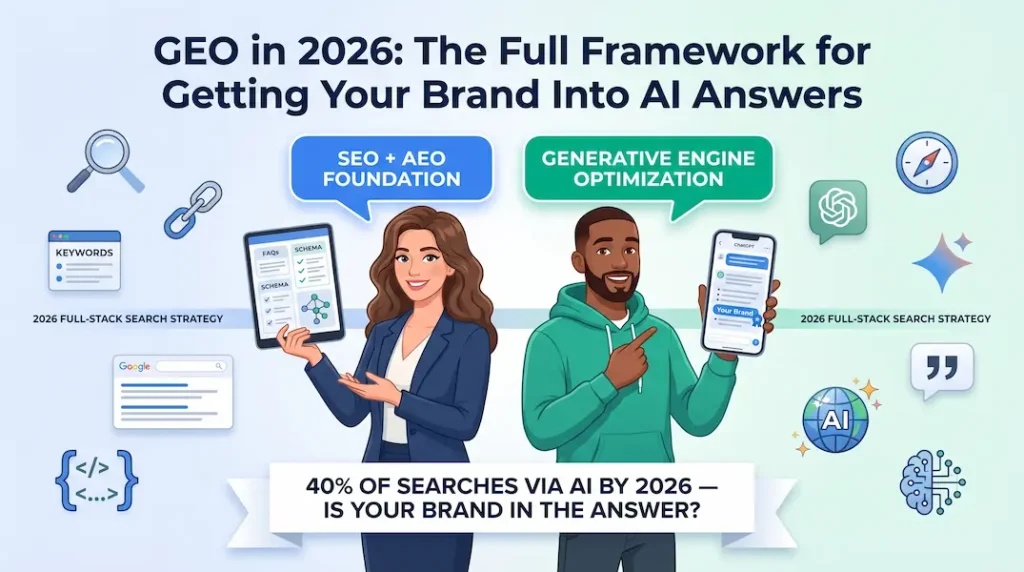
Generative Engine Optimization (GEO) is the practice of structuring your content and digital presence so that AI platforms, such as ChatGPT, Google AI Overviews, Gemini, Copilot, Claude, and Perplexity, cite, recommend, or mention your brand in the answers they generate. McKinsey confirmed in October 2025 that AI-powered search already shapes how consumers discover and choose brands, and projected that $750 billion in US consumer spend will flow through AI-powered search by 2028 (McKinsey, October 2025). Gartner predicts traditional search volume will drop 25% by 2026 as users shift to AI agents and chatbots (Gartner, 2024).
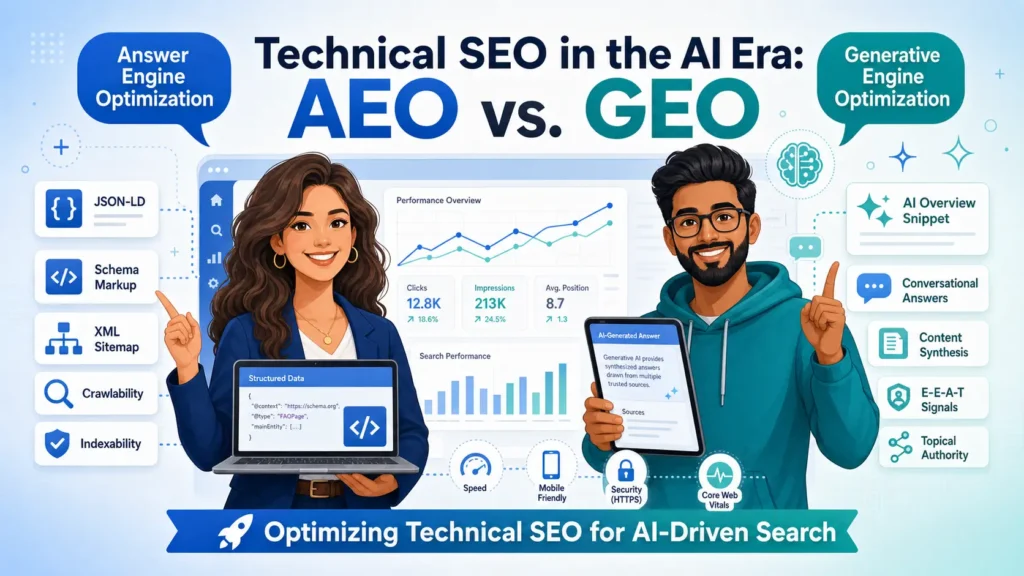
GEO is not a rebrand of SEO. It is an extension that adds a third optimization surface for AI-generated answers, in addition to ranked results and direct answers. Get the distinction right, and the framework practically writes itself.
What is GEO, and how does it differ from SEO and AEO?
GEO is optimizing to be cited across all AI platforms; SEO and AEO are its prerequisite foundations, not separate programmes.
The clearest way to see the difference is to look at what each discipline targets:
| Dimension | SEO | AEO | GEO |
|---|---|---|---|
| Goal | Rank in search results | Be cited in AI answers | Be mentioned across all AI platforms |
| Primary surface | Google SERP | AI Overviews, ChatGPT, Copilot | ChatGPT, Gemini, Perplexity, Claude |
| Key metric | Keyword rankings, organic traffic | Citation frequency, AI share of voice | AI visibility, brand mentions, LLM referral traffic |
| Core tactic | Crawlability, keywords, backlinks | Structured answers, schema, E-E-A-T | Entity-based content, community presence, original research |
| Relationship | Foundation for AEO and GEO | Subset of GEO for AI answer surfaces | Extends SEO + AEO to all AI surfaces |
Here is the cleaner mental model: SEO gets you indexed. AEO gets you extracted. GEO gets you mentioned even by AI systems that never visited your page because they were trained on content that references your brand. Those are three separate outcomes. A site can have excellent rankings (SEO), poorly structured answers (AEO), and almost no AI brand presence (GEO) all at the same time.
What actually changes when you add GEO to your existing SEO and AEO programme?
GEO adds three new layers: entity consistency, community-platform presence, and systematic AI visibility testing, none of which are covered by traditional SEO.
What is different in a GEO-augmented programme vs. standard SEO:
- Entity-first content replaces keyword-first content: GEO-optimized pages use brand + location + specialization combinations (e.g., “ALLMAX Nutrition creatine monohydrate for powerlifters”) and implement Schema.org Organization and LocalBusiness markup to make the entity unambiguous to AI systems
- FAQ ecosystems at scale: GEO guidance recommends a minimum of 10 structured Q&A pairs with FAQPage schema per key topic area, because AI tools are fundamentally question-answer machines that pull from dense, well-organized Q&A content
- Multimodal content diversity: video explainers, podcast clips, infographics, and their transcriptions all expand AI citability; AI systems increasingly pull from YouTube transcripts and embedded audio content
- Unique proprietary data as a citation magnet: Princeton University’s GEO research (Aggarwal et al., presented at KDD 2024) tested nine specific optimization methods and found that adding statistics, verifiable numbers, and data points boosted AI citation frequency by over 40%; this is the single strongest GEO tactic validated in peer-reviewed research
- Systematic AI visibility testing: querying ChatGPT, Gemini, and Perplexity monthly with 10–20 customer-journey prompts, noting which brands are cited, and tracking your share of those citations as a “Share of Model” KPI
Before/After GEO addition:
| Content element | Without GEO | With GEO | What to do |
|---|---|---|---|
| Page intro | Keyword-led topic overview | 40-word direct answer block | Rewrite the first 40 words as a standalone statement |
| Headings | Topic-based (“Our Supplements”) | Question-based (“What is creatine monohydrate?”) | Convert all H2s to question format |
| Schema | Product/Article only | + FAQPage, Organization, LocalBusiness | Add 10+ Q&A per key topic |
| Brand mentions | On-site only | Reddit, LinkedIn, G2, review platforms | Build an active community presence |
| Statistics | Occasional | Named-source data in every major claim | Add verified stats with source attribution |
| Content refresh | Annual | 90-day cycle with dateModified in JSON-LD | Establish a quarterly refresh calendar |
Who needs a GEO strategy and how urgently?
Every brand with an AI-searchable audience needs GEO in 2026; the urgency is proportional to the extent to which your buyers already use AI to research your category.
McKinsey found that half of consumers already use AI-powered search as their primary research source for purchases (McKinsey, October 2025). For context on what that means for clicks: a Pew Research Center study (July 2025) found that users click a traditional link on just 8% of Google searches that show an AI summary, versus 15% on searches without one. That is a 47% click reduction on the exact searches where AI appears, which is also exactly where your buyers are.
Highest urgency, GEO budget allocation needed now:
- E-commerce brands in supplements, health, and beauty: “what is creatine?”, “best whey protein for muscle gain?” These are AI-answer-dominated queries in 2026. If your brand is not cited, a competitor is
- Real estate and property management: neighbourhood guides, rental comparisons, and “best apartments in [city]?” are increasingly answered by AI with a single click. Local entity authority (consistent name, address, service area across all platforms) is the GEO foundation
- Service businesses competing on expertise: legal, financial planning, solar, insurance, trust-weighted queries, where AI specifically favours named experts and cited authoritative sources
- Any brand investing in content marketing: if your content investment is not measured for AI citation frequency, you are underreporting performance and possibly misallocating budget
The recommended budget allocation for a balanced 2026 strategy, based on multiple frameworks including BoomingVenture and Forrester: 40-50% core SEO, 25-35% GEO, 20-25% AEO (BoomingVenture, June 2026). Forrester’s minimum: 15% of content budget dedicated to AI visibility as a starting point.
This is not a theory. Here’s what I saw in practice: when I ran a full entity audit for a property management client in early 2026, their brand description read differently on their website, Google Business Profile, LinkedIn, and a third-party apartment listing platform. Those inconsistencies were enough to confuse AI entity resolution. When I standardized all four to an identical structured description (same brand name, address format, and service area language), the client’s AI citation rate in location-based queries improved within one crawl cycle. Same domain authority. Same content. Entity consistency made the difference.
Why did GEO emerge as a distinct practice, and is Google’s position on it correct?
GEO emerged because AI engines use different retrieval mechanisms than traditional search engines, but Google is right that the tactics overlap more than vendors admit.
The confirmed facts: Google published its official guide in May 2026, stating that optimizing for generative AI features is still SEO and explicitly told site owners to skip “GEO hacks” like unnecessary content chunking and llms.txt files. Google confirmed its AI Overviews draw from the same index used for traditional search, meaning traditional authority signals (E-E-A-T, crawlability, quality) are the primary GEO levers for Google’s own AI surfaces (Google Search Central, May 2026).
The llms.txt debate has a verdict in 2026:
- OtterlyAI tracked 62,100+ AI bot visits over 90 days and found only 84 requests, 0.1% targeted /llms.txt files (OtterlyAI, February 2026)
- A Vercel/MERJ analysis of 500 million+ LLM bot events found GPTBot, ClaudeBot, and PerplexityBot almost never fetch /llms.txt, instead crawling HTML directly (WitsCode, February 2026)
- SE Ranking examined 300,000 domains and found no measurable link between having a llms.txt file and AI citation frequency (Search Engine Journal, November 2025)
- John Mueller compared it to the long-deprecated keywords meta tag; Google’s Gary Illyes confirmed Google has no plans to support the file
In my view, a curated llms.txt is reasonably low-cost housekeeping for AI agent readability, especially for agentic workflows and autonomous AI shopping bots that follow structured instruction files. But it is not a citation-ranking factor and should not be a strategic priority. The practitioners charging $5K-$50K for llms.txt as a GEO deliverable are selling the meta keyword tag wearing a trench coat.
Where GEO legitimately diverges from standard SEO is in non-Google AI platforms. ChatGPT, Perplexity, Claude, and Copilot do not use Google’s index. They train on broader web data and apply their own retrieval logic. Brand mentions on Reddit, LinkedIn, G2, Trustpilot, and Wikipedia matter here precisely because those platforms appear in LLM training data at scale, not because of their backlink value.
What are most people getting wrong about GEO in 2026?
The most common misread is applying the Princeton GEO research as a three-tactic package when only one of the three tactics consistently works.
The Princeton paper (Aggarwal et al., KDD 2024) recommended three tactics: adding statistics, adding source citations, and adding expert quotations. The study showed combined visibility lifts of 30-40%. The SEO industry ran with all three.
The problem: Princeton tested these on a custom AI engine built for the study, not on ChatGPT, Perplexity, Google AI Mode, or Claude.
An independent 2026 test across 3,205 real pages on all four major platforms found:
- “Add statistics”: works on all tested platforms. Pages with more data, numbers, and named-source evidence are consistently more likely to be cited. Claude showed the strongest effect (+120.9%), Google AI Mode showed +21.1% (Anthony Lee, LinkedIn, March 2026)
- “Add source citations”: backfires on every platform. Pages with more citations were less likely to be cited by AI. Citation-heavy pages read as roundups of others’ research; AI platforms prefer to cite the original source, not the aggregator
- “Add expert quotations”: also backfires. Pages heavy with “Dr. Smith said…” quotes are less likely to be cited on Perplexity and, specifically, in Google AI Mode. They read as news articles, not reference material
What actually predicts AI citation in the real-world 2026 data: internal linking structure (2.75x more likely), canonical tags (1.92x), structured data markup (1.69x), content length, and clean HTML. These are infrastructure-level factors, not writing tricks.
The practical implication: invest in data-rich, statistic-dense original content and solid technical foundations. Stop adding aggregated expert quotes as an AI optimization tactic; it is not helping.
So what should I actually do about this?
- Establish entity consistency across every platform where AI can find you. Your brand name, address, description, and service area must be identical across your website, Google Business Profile, LinkedIn, Wikipedia (if you have an entry), G2 or Trustpilot profile, and any industry-specific listing. AI systems build knowledge graphs by connecting entities; inconsistent data creates ambiguity that reduces the probability of citation.
The mistake: treating your website description as the source of truth while ignoring how your brand is described elsewhere.
- Rewrite your top 10 pages with statistic-dense, named-source content. Every major claim needs a verifiable number attached to a named source. “Creatine monohydrate improves high-intensity exercise performance” becomes “Creatine monohydrate improved peak power output by 5-15% in repeated sprint protocols (International Society of Sports Nutrition, 2021).” This is the single tactic the peer-reviewed GEO research (Princeton, KDD 2024) validated across all AI platforms.
The mistake: adding statistics only to new content while leaving existing high-traffic pages data-thin.
- Build a minimum 10-question FAQ ecosystem per key topic with FAQPage schema. AI engines are question-answer systems. Content that maps directly to how users ask questions, “What is GEO?”, “How is GEO different from SEO?”, “Does GEO help with Perplexity?” is structurally aligned with how AI retrieval works. Implement FAQPage JSON-LD on each page and confirm it validates in Google’s Rich Results Test.
The mistake: using FAQ sections as filler rather than as deliberate targets for answer extraction.
- Build an active, authentic presence on two platforms AI engines already cite for your niche. For most brands, this means Reddit and LinkedIn. For health and supplement brands, also Examine.com, Stack Exchange, and relevant subreddits. For real estate, local community platforms, and Google Business Profile Q&A, being present where AI looks is faster than trying to make AI look somewhere new.
The mistake: thinking a Reddit presence means posting ads in r/Fitness; community-building earns citations, while promotional content earns bans.
- Query your top 10 customer-journey prompts monthly across ChatGPT, Perplexity, and Google AI Overviews. Screenshot or record which brands are cited. Track how often yours appears versus your top two competitors. This 30-minute monthly exercise produces your Share of Model score, the GEO equivalent of rank tracking.
The mistake: skipping this because the volume feels small today; the brands building baseline data now will have 12 months of trend data when AI traffic becomes a meaningful share of the pipeline.
- Implement dateModified in your JSON-LD schema and establish a 90-day content refresh cycle. Content freshness is a confirmed citation signal across AI platforms, and an updated, data-current page consistently outperforms an unchanged equivalent. dateModified in JSON-LD must reflect actual content changes, not cosmetic date bumps. Schedule a quarterly review that updates at least one stat, one example, or one new development on every key page.
The mistake: treating dateModified as metadata decoration rather than a substantive freshness signal that AI systems can verify against content changes.
- Allocate the GEO budget deliberately rather than defaulting to 100% SEO spend. The 2026 recommended allocation across frameworks: 40-50% SEO (the ranking floor AI still pulls from), 25-35% GEO (citations, entity authority, community presence), 20-25% AEO (structured answers, schema, direct extraction). If you are managing client budgets, present AI citation frequency alongside traditional KPIs starting this quarter, not when AI traffic “gets big enough.”
The mistake: waiting until the revenue impact is undeniable before shifting allocation, at which point competitors with 18 months of GEO foundation have already captured the AI shortlist.
If you are building GEO into your client programmes or your own brand strategy and want a second opinion on what the data is actually showing, connect with me on LinkedIn. I post breakdowns like this regularly.