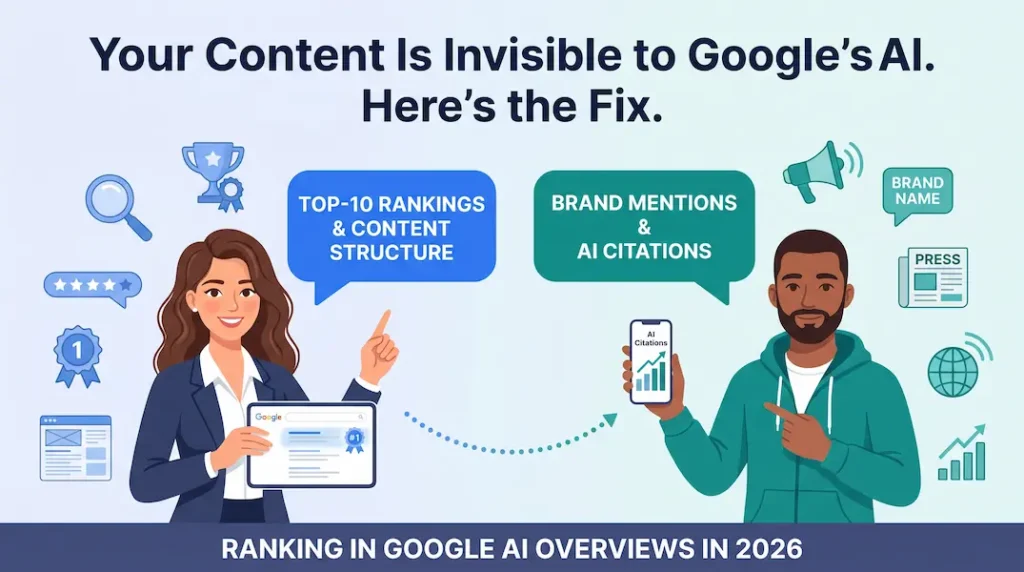
Your Content Is Invisible to Google’s AI, And Here’s the Fix
To rank in Google AI Overviews, you need to do four things well: hold a top-10 organic ranking, earn brand mentions across the open web, structure content into short extractable chunks, and win featured snippets. That’s the whole playbook. Everything else is noise.
I know that sounds deceptively simple. But I’ve audited dozens of sites that tick every traditional SEO box; strong backlinks, clean technical health, solid keyword targeting and still don’t appear in a single AI Overview. The gap isn’t keywords. It is structure and reputation. Let’s fix both.
What are Google AI Overviews and why should you care?
Google AI Overviews (AIOs) are AI-generated summaries that appear above organic results and synthesize answers from multiple sources at once.
Unlike a featured snippet, which pulls a block of text from one page, an AI Overview reads several pages and writes its own answer. Then it cites two to five sources underneath. Those citations are the real estate worth targeting.
Here’s why the stakes are high. According to Semrush’s analysis of 10 million keywords, AI Overviews now appear in 15.69% of all searches, and they cut organic click-through rates by 61% for the pages beneath them. If you’re not cited inside the AIO, you’re getting crushed by it.
The good news: AI Overviews pull from a short list of sources. Get on that list, and you become part of the answer, not just another result underneath it.
What you’ll need before starting:
- Google Search Console access (to monitor impressions and AI Overview appearances)
- A keyword list of your top informational queries
- Schema markup capability (Yoast, RankMath, or manual JSON-LD)
- 2–3 hours per page for a proper restructure
Does ranking in the top 10 still matter for AI Overviews, or is that outdated?
Yes, top-10 organic rankings still matter, but they matter less than they used to.
Here’s the honest picture. A 2026 Ahrefs study of 863,000 keywords and 4 million AI Overview URLs found that only 38% of cited pages also ranked in the top 10 for that query. That’s down from 76% in an earlier version of the same study. The overlap is shrinking.
Translation: being in the top 10 gives you a better shot, but it’s no longer a reliable predictor of getting cited. Google’s AI is increasingly pulling from sources it trusts, regardless of where those pages rank.
Think of it like a dinner party. The host (Google’s AI) doesn’t just invite whoever lives closest. They invite the people they trust to say something useful. Rankings get you on the guest list. Reputation determines whether you get to speak.
That said, I still prioritise top-10 rankings as the foundation. Here’s what I actually do for every client:
- Identify the informational queries where AI Overviews currently appear, use Search Console’s “Search type: AI Overviews” filter or a tool like SE Ranking’s AIO tracker
- Confirm the page ranks in positions 1–15 for that query before restructuring
- Restructure the page for extractability (more on that below)
- Monitor AIO impressions in Search Console under the AI Overviews filter, which has been available since late 2025
POV: Go to Google Search Console → Search Results → Filter by “Search Appearance: AI Overviews.” If you’re already getting AIO impressions, those pages are your highest-leverage starting point. Restructure those first.
Do brand mentions or backlinks matter more for Google AI Overviews?
Brand mentions across the open web now correlate 3x more strongly with AI Overview citations than backlinks do.
This is the finding that genuinely surprised me when I first saw it. An Ahrefs study of 75,000 brands found a correlation of 0.664 between brand mentions and AI visibility, compared with just 0.218 for backlinks (Ahrefs, 2026). Hallam Agency’s independent research confirmed the same ratio: brand mentions are up to three times more influential than links for AI-driven visibility.
For two decades, SEO meant earning backlinks. Now it means getting talked about. The shift makes sense when you understand how Google’s AI actually works. It’s not counting links. It’s reading the web like a researcher and forming opinions about which brands keep showing up in trustworthy contexts.
Here’s the comparison:
| Signal | Backlinks | Brand Mentions |
|---|---|---|
| What it measures | Sites linking to you | Sites talking about you |
| Correlation with AIO visibility | 0.218 | 0.664 |
| Best for | Traditional organic rankings | AI Overview citations |
| How to earn it | Link-building, digital PR | Earned media, guest content, press |
| Speed | Months | Weeks to months |
| Still necessary? | Yes, for rankings | Yes, for AI authority |
The answer isn’t backlinks or brand mentions. It’s both, but the weight has shifted.
Here’s something I saw first-hand. A real estate client I worked with had a strong domain authority DR 58, a solid backlink profile, but almost zero AI Overview appearances for local queries. When I audited their off-page presence, they had almost no unlinked brand mentions. Local press: none. Industry directories: bare minimum. After a six-week push to get them featured in three local business publications and two industry roundups, their AI Overview citations appeared for the first time on their core “real estate agent [city]” queries.
How to build brand mentions that move the needle:
- Guest articles on industry publications: no link required, the mention is the signal
- Local and trade press: especially for local businesses where geographic entity signals matter
- Podcast appearances: transcripts index and create mentions at scale
- Roundup features: “best X in [city]” lists from third-party sites
- PR for original data: publish a stat no one else has, journalists cite you
POV: Search Google for “[your brand name]” -site:[yourdomain.com]. Count the results. That’s your current mention footprint. If it’s under 20 results, brand mention building is your highest-leverage move right now.
How should you structure content to get extracted by AI Overviews?
Structure every section as a self-contained 45–75 word answer block directly under a question-based heading and strip all links out of the answer itself.
Google’s AI doesn’t read your page top to bottom. It scans for chunks it can lift and verify. If your answer is buried inside a 400-word paragraph, it won’t be found. If it’s sitting cleanly under a question heading in 60 focused words, it becomes an extraction target.
How do I use question-based H2s to match what AI is looking for?
Write every H2 and H3 as the exact question your target reader would type or say aloud and make it specific, not generic.
“What is SEO?” is a generic heading. “How does Google AI decide which pages to cite in AI Overviews?” is a question-based heading that mirrors natural language. That specificity is what gets you matched to the right query.
Use People Also Ask (PAA) boxes on your target keywords as a free heading generator. Those questions are real. Google pulled them from actual search behaviour. If a question appears in PAA for your keyword, turn it into an H2 and write a direct 45–75 word answer block underneath it.
How do I write the answer block itself?
Write the first sentence as a direct, complete answer, then expand with one to three supporting sentences and stop.
The block should be self-contained. It should make sense if someone reads only that paragraph. No setup. No “as mentioned above.” No internal links inside the block.
Here’s the format I use for every page I restructure:
- H2 or H3: Question-based heading (mirrors natural language search)
- Sentence 1: Direct answer under 25 words, states the answer plainly
- Sentences 2–3: One supporting stat or mechanism, one practical implication
- Stop. Links and further detail go below the block, not inside it
According to GetGenie’s content chunking research, answer-first chunks of 40–120 words produce the highest AI extraction rates because they balance completeness with precision. Too short and you lose context. Too long and the signal gets diluted.
Do featured snippets still overlap with AI Overview sources in 2026?
Yes, winning a featured snippet still significantly increases your chances of being cited in AI Overviews, with a 61.79% overlap between the two (Semrush, 2025).
More than six in ten pages that appear in AI Overviews also hold a featured snippet for the same query. That’s not a coincidence. Both signals reward the same thing: a clean, direct answer that Google’s systems can verify and surface confidently.
The overlap is shrinking slightly as AI Overviews expand into broader query types, but it remains the single strongest proxy signal for AIO readiness. If I had to pick one metric to track as a proxy for AI citation potential, it would be featured snippet ownership.
How do you add schema markup to reinforce AI extractability?
Add FAQPage, HowTo, and Article schema to every page targeting informational queries. These are the three schema types Google’s AI actively uses to verify content structure.
Schema markup doesn’t directly cause an AI Overview citation. What it does is make your content easier for Google’s AI to read, categorize, and trust. Think of it as labelling your containers before putting them in the fridge. Google’s AI will still find the food without labels. But labelled containers get grabbed first.
Here’s the schema stack I apply to informational blog posts:
- Article schema: declares the page as a piece of content, with author, datePublished, headline, and publisher all mapped to your entity graph
- FAQPage schema: wraps your Q&A sections so Google can identify extractable question-answer pairs machine-readably
- HowTo schema: for any step-by-step sections; each HowToStep becomes an individual extraction target
All three can be implemented in one JSON-LD block in a Custom HTML section. Do not paste raw JSON into the WordPress visual editor; it will render as visible text on the front end. Use a Custom HTML block or implement via wp_head in functions.php.
Should you add an llms.txt file to rank in Google AI Overviews?
No, Google Search has explicitly confirmed that llms.txt has no effect on AI Overview or AI Mode citations.
Google’s Gary Illyes said it plainly: to appear in AI Overviews, do normal SEO. Google’s May 2026 AI optimization guide went further, explicitly listing llms.txt alongside “AI-specific rewriting” and “special schema” as tactics that do not help with Google AI visibility (Google Search Central, 2026).
An independent SE Ranking analysis of 300,000 domains found no measurable relationship between having an llms.txt file and AI citation frequency (Search Engine Journal, 2025). The file has zero statistical impact at scale.
Where llms.txt does have a role: ChatGPT, Claude, and Perplexity use it for agent-to-agent context. If your goal is citation across those platforms, it’s worth considering. But for Google AI Overviews, specifically the most visited AI search surface on the planet, it does nothing.
The most expensive mistake I see in 2026 is teams spending hours building and maintaining llms.txt files while their H2 structure is a mess and their brand mention footprint is nonexistent. Fix the content. Build the mentions. The file can wait.
What do most people get wrong about ranking in AI Overviews?
Most SEOs treat AI Overviews like featured snippets: one page, one answer, one win. AI Overviews don’t work that way.
Featured snippets pull from a single page. AI Overviews synthesize from many. That means you don’t need to be the best answer for a query. You need to be a trustworthy answer that adds something Google’s AI can use as one piece of a larger response.
This changes the strategy entirely. Instead of trying to own a query with one definitive page, I now build coverage across multiple related questions within a topic cluster. Each page targets a narrower slice of the query space, and each one is a potential citation source for any AI Overview that covers the broader topic.
According to BrightEdge, AI Overviews average 3.6 cited sources per summary. That means there are usually three to four slots available per query, not one. The brands winning AI citations in 2026 aren’t just optimizing one flagship page. They’re building a portfolio of extractable answer blocks across an entire topic.
The pages that consistently get left out share three traits:
- No question-based headings: the content is structured for human skimming, not AI extracting
- Answer buried in paragraph three: the opening paragraph is branding or context, not the answer
- Zero brand mention presence: Google’s AI can’t verify the brand exists beyond the page itself
Fix those three things, and you’re ahead of the majority of sites competing for AI Overview citations right now.
If you want to walk through how your site is positioned for AI Overview citations, connect with me on LinkedIn, I’m always happy to take a look.