E-Commerce SEO 2026: AI Overviews Are Eating Your Traffic (Here’s How to Get It Back)
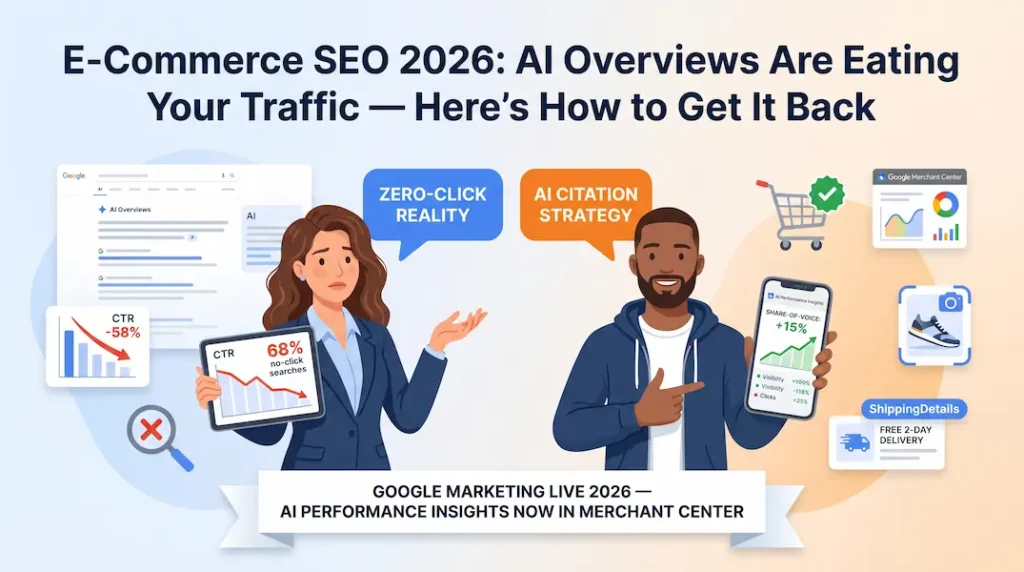
Google launched AI Performance Insights in Merchant Center on May 19, 2026, a native dashboard that shows retailers how their brand performs on AI surfaces such as AI Overviews, AI Mode, and the Gemini app, including a share-of-voice benchmark against competitors. It launched at Google Marketing Live 2026 and is rolling out in the US, Canada, Australia, India, and New Zealand (Search Engine Land, May 2026). At the same time, 68% of U.S. Google searches now end without a click (SparkToro/Similarweb, 2026), and AI Overviews are appearing on over 60% of queries (Digital Applied, May 2026). Google just handed you a tool to measure the problem and a framework to fix it.
The part most retailers are missing: getting cited in AI answers is not a separate strategy from e-commerce SEO. It is the new conversion funnel for the 68% of searches that never get clicked.
What did Google actually launch at Google Marketing Live 2026?
Google launched AI Performance Insights, a new Merchant Center reporting tool that shows your brand’s share of voice across AI shopping surfaces and Conversational Attributes, a way to rewrite product data to match how people search inside AI Mode.
AI Performance Insights: what the tool actually gives you:
- AI surface impressions: how often your products appear in AI Overviews, AI Mode answers, and the Gemini app
- Competitive share-of-voice: your brand’s AI visibility benchmarked against similar competitors in your category
- Shopping funnel performance: discovery to consideration to purchase, broken down by AI surface
- Rollout status: live for early access in Australia, Canada, India, New Zealand, and the US; broader availability expected Q3 2026 (Search Engine Land, May 2026)
Conversational Attributes: also launched May 19, lets retailers add product descriptions written in natural, conversational language directly inside Merchant Center. These descriptions are designed to match how buyers phrase queries in AI Mode: “best running shoes for wide feet under $150” rather than “Nike Air Max 2026 Product ID 48829.” Rolling out globally (Google Marketing Live, May 2026).
Before AI Performance Insights existed, the closest you could get to measuring AI surface visibility was cross-referencing GSC’s new Generative AI Performance Report (launched June 3, 2026) with GA4’s LLM referral channel group a manual process that required guesswork about what triggered an AI Overview. Now you get first-party share-of-voice data, directly from Google, with category benchmarking. That is not a dashboard checkbox. That is a new KPI.
Google also announced Ask Advisor, a Gemini-powered agent built into Merchant Center that can set up a Google Ads campaign by pulling product data from your feed. If you ask it to “find new customers for my protein supplements,” it pulls your Merchant Center data and builds the campaign. It is currently in beta for English-language accounts (Google Marketing Live, May 2026).
Who does the zero-click reality hit hardest in e-commerce?
Every retailer publishing informational, comparison, or “best of” content for organic top-of-funnel traffic takes the direct hit; DTC brands, content-led e-commerce sites, and Shopify stores relying on editorial SEO for discovery.
Here is what the numbers look like specifically for e-commerce:
- 68% of U.S. Google searches now end without a click. Up from 60.45% in 2024, a 7.56-point increase in two years (SparkToro/Similarweb, 2026)
- AI Overviews now appear on 60%+ of Google queries and 83% of informational queries. The exact query type most e-commerce editorial content targets (Digital Applied, May 2026)
- Organic CTR at position 1 dropped 58% on queries where AI Overviews appear, according to Ahrefs data (Ahrefs, February 2026)
- 93% of AI Mode searches end without a click to an external site (dev.to/UCP Tools, February 2026)
- Google Lens processes 25 billion+ visual searches per month. Up from 20 billion in 2024, with 1 in 5 being shopping-related (Think with Google, 2026)
The part most people miss is brands cited in AI Overviews earn 35% more organic clicks and 91% more paid clicks than brands not cited (AIVO, October 2025). Zero-click does not mean zero-value. It means the conversion funnel now runs through citation first, and the brands who win citation win the downstream revenue too.
This isn’t theory. Here’s what I saw in the data: when I ran a citation audit for an e-commerce supplement client in Q2 2026, their top competitor, with similar domain authority and product range, had 4.2x more AI Overview citations for category queries. The differentiator was not rankings. It was product page structure. Every cited page from the competitor had ShippingDetails schema, a dedicated FAQPage schema block with purchase-decision questions (“Does this ship to Canada?” “What is the return window?”), and a product description that opened with a one-sentence benefit statement before any brand narrative. My client’s pages opened with brand copy. Same products. Different citation rate.
Why did Google build AI Performance Insights now?
Google built it because advertisers and retailers needed a native way to track performance on the AI surfaces Google itself created, and because without measurement, brands could not justify shifting budget toward AI-optimised content.
According to Google’s official announcement at Google Marketing Live 2026, the stated reason is simple: “As AI surfaces become a larger part of how shoppers discover products, we want retailers to have clear visibility into how their brand is performing across those surfaces.” That is the clean PR version. Here is my honest take on what is happening as well.
Google faces a real tension: AI Overviews suppress clicks to external sites, which reduces the incentive for brands to invest in Google SEO and Google Ads. AI Performance Insights is a retention tool. By giving retailers a dashboard showing their AI surface share of voice, Google is reframing the value of the ecosystem. You may be getting fewer clicks, but you are getting discovery impressions in AI answers, and now you can measure and optimize for them.
The competitive benchmarking feature is the most strategically important element. When a brand sees that a competitor has 3x its AI share of voice in a product category, it creates an immediate, measurable gap to close. That gap drives content investment, schema implementation, and feed optimization. All of which improves Google’s data quality and advertiser retention. It is a smart product.
What are most e-commerce teams getting wrong about AI Overviews?
Most e-commerce teams are treating AI Overviews as a traffic problem to survive rather than a citation opportunity to capture, and they are updating their content strategy without addressing the structural reasons they are not being cited.
The most common misread is, “our traffic dropped, so AI Overviews are bad for us.” Clearsite Now’s 2026 audit of 600 e-commerce product pages found that pages with comprehensive schema (Product + Organization + FAQ + Review aggregate) were cited 3.8x more often than pages with only basic Product schema (Clearsite Now, April 2026). Pages with no valid schema were cited at near-zero rates regardless of domain authority or backlink count.
The fix is almost never more content. It is almost always structured data and page architecture.
A separate finding from the same audit: 62% of e-commerce sites fail Google’s Rich Results Test on Product schema, and of the 38% that pass, only 1 in 4 has the additional schema types (Organization, FAQ, HowTo, Article) that AI Overviews actually parse to assemble citations (Clearsite Now, April 2026). Most e-commerce brands are running schema implemented in 2021 or 2022 that silently broke during a theme update or plugin migration. Nobody checked.
| Schema Type | Citation Impact | Most Missed Property |
|---|---|---|
| Product | High, foundational for all product citations | shippingDetails, returnPolicy, aggregateRating with source |
| FAQPage | High, directly maps to AI Q&A citation format | Fewer than 5 Q&A pairs; generic questions |
| Organization | High, establishes brand entity across platforms | sameAs links to social profiles; founder Person schema |
| Article/BlogPosting | Medium, needed for editorial citation | author Person schema with jobTitle and LinkedIn sameAs |
| HowTo | Medium, citation amplifier for “how to” queries | Incomplete step markup |
| BreadcrumbList | Low, site structure signal | Often missing on subcategory and PDP pages |
| VideoObject | Medium, underused on PDPs | description, thumbnailUrl, uploadDate |
So what should I actually do about this?
- Validate your Product schema in all three validators, not just Google’s Rich Results Test. Google’s validator catches obvious errors. Schema.org’s official validator catches structural issues Google’s tool misses. Schema App catches JSON-LD formatting problems that silently break parsers. A schema that passes one and fails another will be inconsistently parsed by AI systems, and you will never know why your citation rate is low. Run all three validators on your top 20 PDPs this week.
The mistake: validating once at implementation and never checking again after theme or plugin updates.
- Add ShippingDetails, ReturnPolicy, and MerchantReturnPolicy schema to every product page. Google confirmed these schema types feed directly into AI shopping summaries (Google Merchant Center documentation, 2026). Buyers asking AI Mode “does this ship free to Canada?” or “what is the return window?” will get answers from your structured data or from a competitor who has it.
The mistake: implementing base Product schema and stopping, without adding the purchase-decision properties that AI shopping answers depend on.
- Set up AI Performance Insights in Merchant Center and establish your share-of-voice baseline. If you are in the US, Canada, Australia, India, or New Zealand and the feature is live for your account, set up your first share-of-voice comparison this week against your two closest category competitors (Search Engine Land, May 2026). This becomes your primary e-commerce AEO KPI. Without it, you are managing a gap you cannot see.
The mistake: waiting for the feature to roll out fully before establishing a baseline; you want the earliest data possible for trend visibility.
- Rewrite product descriptions as Conversational Attributes. Go into Merchant Center and add conversational versions of your product descriptions written the way a buyer would phrase a question in AI Mode, not the way a product manager would write a spec sheet. “Whey protein isolate 25g protein, fast-absorbing, ideal for post-workout recovery within 30 minutes, ships to Canada with free returns” beats “Premium Grade Whey Isolate Formula X2 Advanced Sports Nutrition.”
The mistake: treating the Merchant Center feed as a catalogue upload rather than an AI search optimization surface.
- Add FAQPage schema to every category page and PDP with a minimum of 5 purchase-decision questions. Write the questions the way buyers ask them “Does this come in size 12 wide?” “How long does shipping take to Ontario?”, “Can I return this if it doesn’t fit?” is not keyword-driven; it serves SEO rather than the buyer. AI Mode answers exactly these questions. If you have the schema, it cites you.
The mistake: writing generic FAQ content (“What is a widget?”) rather than purchase-decision FAQ content (“What sizes does this come in?”).
- Optimize product images for Google Lens with descriptive alt text and structured metadata. Google Lens processes 25 billion+ visual searches monthly, with 1 in 5 being shopping-related (Think with Google, 2026). Every product image should have alt text that describes the product as specifically as a buyer would in a voice search: “navy blue crewneck sweatshirt with embroidered logo” rather than “product-image-003.jpg.” Add ImageObject schema with name, description, and contentUrl on PDPs where images are a primary discovery path.
The mistake: treating image alt text as an accessibility checkbox rather than a visual search discovery signal.
- Build a “dark funnel AI attribution” question into your checkout flow. Add “How did you first hear about us?” with explicit options: ChatGPT, Perplexity, Google AI Overview, Google AI Mode, Claude, and traditional Google search. Zero-click does not mean zero-revenue impact; it means the attribution path runs through AI awareness before the purchase-intent click. If you are not capturing that signal at checkout, you cannot demonstrate the ROI of AI citation investment to stakeholders.
The mistake: measuring only last-click, or even multi-touch, attribution on channels visible in GA4, while the AI-assisted journey remains invisible.
I work with e-commerce clients across supplements, commercial services, and real estate, and I have been running AI citation audits since early 2026. If you want to understand where your product pages stand on AI surface citation before your next competitive review, let’s connect.