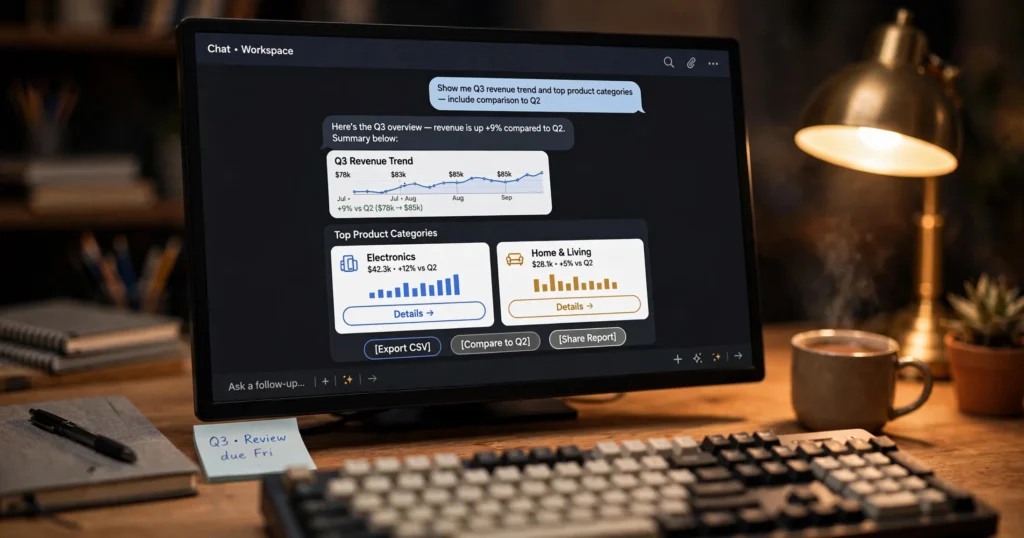
OpenAI announced on October 7 that GPT-6 is rolling out to every ChatGPT user, and the headline is not the model itself. It is Intelligent UI, a new capability that lets ChatGPT decide when an answer should be more than text. A travel plan can arrive with a map and suggested stops attached. A recipe can show the cooking timeline alongside the steps. A complex topic can become an interactive diagram where you change an input and watch the result shift. Users can even ask ChatGPT to build small tools on the spot, like a savings calculator, a bill splitter, or a game that runs inside the conversation.
The rollout mechanics are straightforward. Paid tiers get GPT-6 Sol, while Free and Go users get GPT-6 Luna, which OpenAI describes as tuned for everyday conversation. Plus, Pro, Business and Enterprise subscribers see it first, with Free and Go tiers following the next day. The release targets the more than 1.2 billion people OpenAI says use ChatGPT each week, which makes this one of the largest changes to how answers are presented since conversational search went mainstream. Behind the feature sits a library of native, streamable components and a compiler that builds the interface while the model generates it, so the interactive elements appear progressively rather than after the full response finishes.
OpenAI also claims GPT-6 is better at deciding when it needs to search the web and at finding information that supports its answers, and it is trained to recognise and communicate the limits of its own capabilities. That last detail matters for the practitioner reading this, because a model that searches more deliberately and knows when it lacks the information to answer is a model whose citation behaviour is worth studying closely.
Why this changes the AI visibility conversation
- Answers are becoming destinations instead of signposts, which means the unit of visibility is shifting from being cited in text to being embedded in an interface.
- When ChatGPT builds a comparison as a side-by-side layout or turns a recipe into a timeline, the brands and sources it pulls into those components are getting a new kind of prominence that text citations never offered.
- The brands that win in this layer will be the ones whose structured information the model can reach for, because an interactive answer needs clean, retrievable facts the way a text answer needs quotable sentences.
Failon’s POV: optimise for the interface, not just the answer
I keep saying that tracking AI visibility is a discipline now, not a curiosity, and Intelligent UI just added a dimension most trackers are not measuring. When answers become interactive, the question stops being whether your brand got mentioned and becomes whether your brand got placed inside the map, the comparison chart, or the tool the user actually clicked. That placement is decided by structure, and structure is something you can build for. Clean schema, consistent entity information, and pricing and feature data the model can actually use are what get a brand pulled into a generated interface, which is the same logic I apply in my answer engine optimization work. The people treating this as a UX curiosity are missing the point. Every interactive answer is a new surface where some brand is present and another is not, and the window to get your data into that surface is open right now.