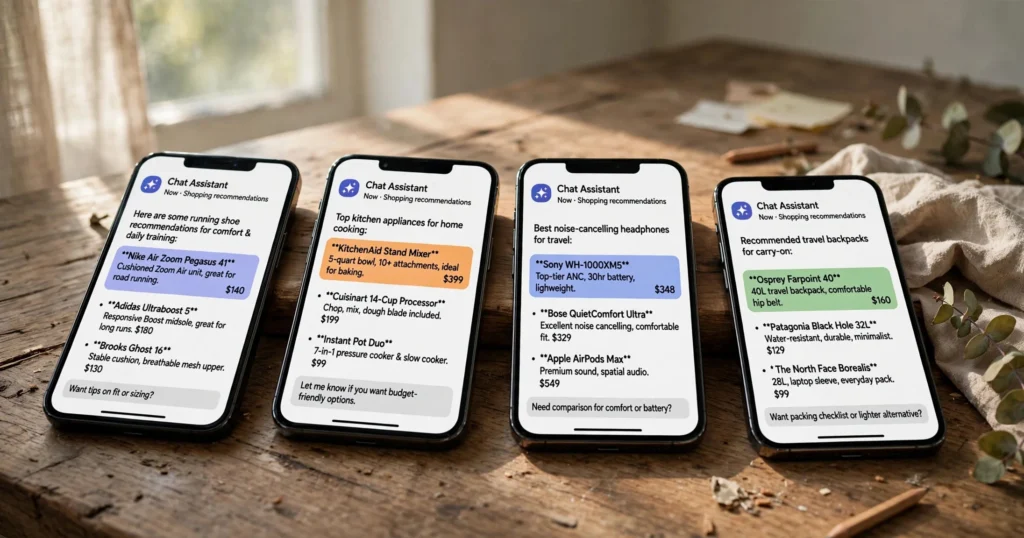
New research published October 7 puts a hard number on something practitioners have suspected for a while. London-based AI consultant Frank Vitetta ran 749 identical shopping and buying questions through ChatGPT, Claude, Gemini and Perplexity, and the four assistants disagreed on whether to name the tracked brand in 27.2 percent of cases. More than one question in four produced conflicting brand visibility depending on which assistant the buyer happened to ask. The questions were drawn from nearly 27,000 AI answers logged by LLM Scout over a nine-month period, and the full research note with method and limits is published on Vitetta’s website.
The breakdown inside that number is where the story gets sharper. On 53.7 percent of the questions, none of the four assistants named the tracked brand at all. All four named it on just 19.1 percent, roughly one question in five. And where at least one assistant named the brand, all four did so in only about four cases in ten, which means the majority of brand visibility wins were partial. ChatGPT came out as the assistant most likely to name a brand when the others did not, a finding worth filing away for anyone weighting their AI visibility tracking by platform.
The methodology note deserves the same respect I give every third-party study. This is one dataset from one researcher’s logged answers, not a census of how every brand performs across every assistant, and brand mention behaviour will vary by category, prompt style and how the question is framed. The direction of travel is what carries weight here, and it is consistent with everything else the industry is reporting about fragmented AI surfaces. Unlike traditional search, where indexing and ranking run on standardised algorithms, these models synthesise answers through different architectures and weighting, so visibility was never going to be uniform across them.
What the numbers demand from practitioners
- Single-platform tracking is a partial picture by definition, because a brand can appear in one assistant’s answer and be absent from another’s response to exactly the same question.
- The 53.7 percent of questions where nobody named the brand is the real opportunity, since being the first brand mentioned in those answers is a white-space play with almost no competition.
- Any GEO report that aggregates all assistants into one score is hiding the most useful signal, which is where the brand is present and where it is invisible.
Failon’s POV: consistency across assistants is the new rank one
I read this research as the formal confirmation of what generative engine optimization has been about from the start. Ranking number one on Google meant winning one surface. In AI answers, the equivalent prize is being named consistently across all four assistants for the same buying question, and right now most brands are nowhere near that, with all four naming the tracked brand in only about one question in five. The practical response is not to pick a favourite assistant and optimise for it. It is to build the kind of entity presence that every model can find, meaning clear brand positioning, consistent facts across the web, and content structured so that different architectures converge on the same answer. The brands that disappear in 27 percent of answers are not losing to a competitor, they are losing to fragmentation, and fragmentation is fixable.