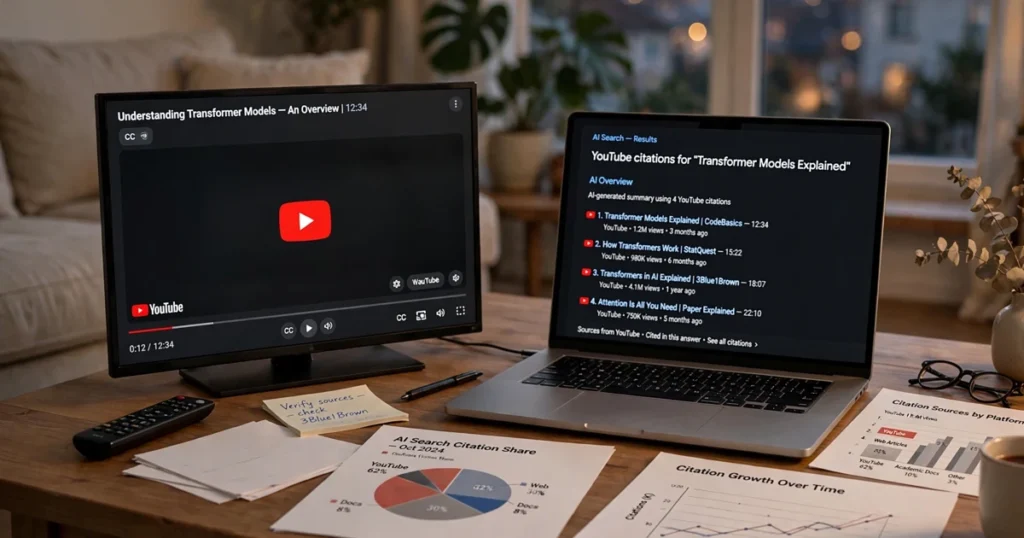
Video has quietly become the format that AI search trusts most when an answer needs a demonstration, and a report published today puts a scale on that trust that should change how brands plan content. Precisify released a report on creator influence across generations and platforms, and the figures it cites from Search Engine Land state that YouTube is cited 200 times more than any other video platform across AI search experiences, which leaves rival video platforms so far behind that the contest for video citations is effectively a contest for second place.
The trust findings in the same report explain why models lean on creator material when they assemble an answer. Among affluent adults in the United States, 38.4% said they trust content creators most for an in-depth product review, ahead of friends and family, and that ordering matters because an AI answer built from review content inherits the credibility that audiences already assign to the people who made it. Precisify also found that creator viewing concentrates heavily on YouTube across age groups and markets, with 66% of teens in the United States and 65% of millennials saying they like watching favourite creators on the platform, so the supply of citable video and the audience for it sit in the same place.
The pattern is not new, although the new report gives it a current frame and a purchase angle that earlier citation studies lacked. BrightEdge data reported by Search Engine Land last year found the same 200 times advantage over the nearest rival, with YouTube holding roughly a fifth of citations across AI platforms on average and close to three in ten citations inside Google AI Overviews, while competing platforms registered at a tenth of a percent or less. Tutorials, product demonstrations, pricing walkthroughs, and reviews were the formats that surfaced most often in that earlier work, and those are precisely the formats a buyer consults before spending money, which is why the citation pattern carries commercial weight rather than simple bragging rights.
A brand deciding how to respond to numbers like these should weigh a few points carefully:
- A citation is not a click, and a video that supplies the answer may satisfy the viewer without sending a visit, so video strategy has to be judged on influence over the final purchase rather than on referral traffic alone.
- Creator content earns citations that brand channels often struggle to win, because an independent review carries a point of view and first-hand detail that a product page rarely publishes about itself.
- Transcripts, titles, descriptions, and chapter structure decide whether a model can use a video at all, since the answer engine reads the text wrapped around the footage long before any human presses play.
- Categories where a product must be seen working are the most exposed, because a competitor with a clear demonstration video can become the cited authority while a stronger product with no video stays invisible.
What I would do with this research begins with an audit rather than a production spree:
- Search the questions buyers ask ChatGPT, Perplexity, Gemini, Copilot, and Google AI Mode in the category, and record which videos those answers cite, because that list shows the exact formats and creators the models already trust.
- Fix the text layer on every existing video that deserves to be cited, with accurate titles, complete descriptions, and transcripts that name the product, the problem, and the outcome in plain language.
- Brief creators on citation as well as reach, asking for demonstrations and honest comparisons that an answer engine can quote, instead of treating a partnership as a simple audience rental.
- Publish demonstrations for the products where a written description cannot settle the buying question, and keep those videos current when pricing or specifications change.
This builds on the pattern I described when I covered AI assistant brand mentions and why being named inside an answer has become a visibility channel in its own right. A video citation is a mention with evidence attached, because the model is not only naming a product but pointing the buyer toward a demonstration of it, and that combination is much harder for a competitor to displace once it settles into the answers for a category.
Failon’s POV: I think most brands are misreading this as a call to start a channel and post more often, when the data is really saying that credible demonstration is the currency and creators currently hold most of the supply. A brand with three excellent product demonstrations, properly titled and transcribed and placed where buyers research, will gain more from this shift than a brand publishing weekly videos that say nothing a model can use. The uncomfortable part is that the strongest citation in a category may belong to a creator the brand does not control, and working with that reality beats pretending it away.
Sources: Precisify, Precisify Insights: Influencer report as reported by Advanced Television (October 14, 2026), and Search Engine Land reporting on BrightEdge AI citation data.