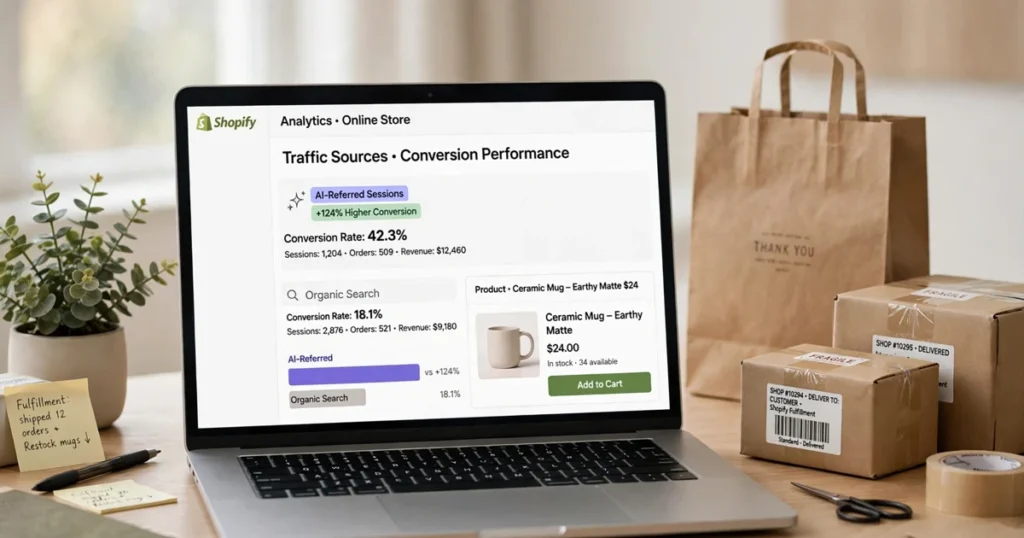
A buyer who arrives from an AI answer has usually finished most of the comparison work before the click ever happens, and Shopify has now put a conversion number on that behaviour. Data released with the launch of The Entrepreneur Effect hub shows that AI-referred sessions on Shopify converted 80% better than organic search sessions between April and June 2026, which means the channel many merchants still treat as an experiment is already outperforming the channel most of their budgets were built around.
The surrounding figures explain why that gap makes sense once the journey is considered in full. AI channels drove nearly twice as many orders from new buyers as other channels over the same period, and orders that began with an AI referral carried average order values 14% higher than orders from other channels, so the visitors arriving from ChatGPT, Perplexity, Gemini, Copilot, and Google AI Overviews were not only more likely to buy but also more likely to spend more when they did. Shopify also reported that shoppers who started with a language model landed directly on a product page far more often than shoppers who started with a conventional search, and that compression of the journey is the mechanism behind the conversion lift because the research stage happens inside the answer and the store visit becomes the confirmation stage.
The distribution of those sales matters just as much as the headline rate, because 75% of AI-referred sales in the period came from merchants selling outside the 100 most common product categories on the platform. A shopper describing a specific problem in plain language gives a specialised merchant a chance that a head keyword never offered, since the model matches the description against product detail rather than against the handful of domains that dominate a results page. Niche ranges with clear specifications, honest compatibility notes, and complete product data are therefore winning orders that would previously have required outranking much larger competitors.
Several practical conclusions follow from the way Shopify describes the channel:
- Conversion quality now depends on product data quality, because a model can only recommend a product with confidence when the specifications, pricing, and availability on the product page are complete and current.
- New buyer acquisition is shifting toward AI answers, so a store that never appears in those answers is missing the segment that is growing fastest rather than a segment that might matter someday.
- Average order value rises when the buyer arrives informed, which means the content that prepares a buyer before the click carries commercial value even when analytics credit the sale to the final session.
- Specialised merchants hold a genuine advantage in this channel, provided the catalogue explains each product in the language a buyer would use when describing the problem out loud.
What I would do with this data starts with treating the product page as the landing page that AI traffic expects it to be:
- Rewrite priority product pages so the opening lines answer the exact question a buyer asked the model, with specifications, use cases, and limitations stated plainly before any brand storytelling begins.
- Keep pricing, stock status, shipping terms, and returns information consistent everywhere the product appears, because a model that finds conflicting facts will either skip the product or repeat the wrong fact with confidence.
- Add comparison and compatibility detail for the products buyers research most carefully, since spec-led categories are where Shopify recorded the strongest AI referral advantage in its quarterly data.
- Measure AI-referred sessions as a separate segment in analytics rather than folding them into organic traffic, because a channel converting at this rate deserves separate reporting and separate decisions.
This connects directly with work I covered when I wrote about how ecommerce discovery is shifting upstream into AI answers, and it reinforces why I keep returning to how to track AI visibility as a reporting discipline rather than a vanity exercise. A merchant who cannot see which answers mention the store cannot tell whether the conversion advantage Shopify describes is available to them at all, and that measurement gap is now the easiest problem in the whole picture to fix.
Failon’s POV: I take the 80% figure seriously and I also read it with the caution that platform data deserves, because Shopify benefits when merchants believe AI commerce runs through Shopify and the base of AI-referred traffic is still small beside organic search. Even with that caution applied, the direction is hard to argue with, since every part of the pattern points the same way and the buyers arriving from AI answers are demonstrably further along in their decision. The stores I worry about are the ones still waiting for certainty, because their competitors are rewriting product pages for this channel right now and the head start compounds every month.
Sources: Shopify, The Entrepreneur Effect hub and accompanying article (October 2026), and Ecommerce News Australia coverage of the Shopify release (October 2026).