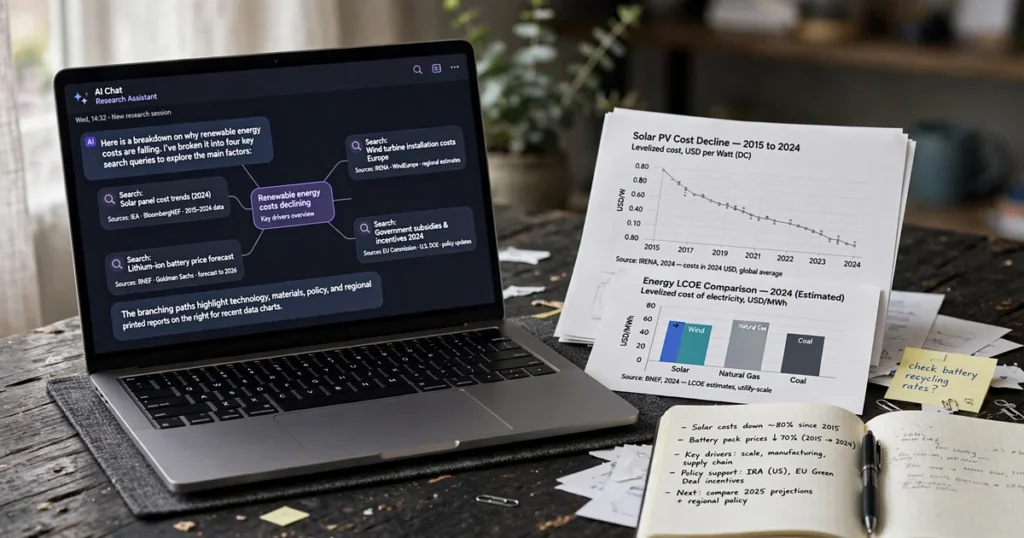
Most brands are optimising for a search that, in the majority of cases, never actually happens. Ahrefs analysed 66.6 million free ChatGPT responses from August and September and found that only 14.4% of those responses involved a web search, which means the model answered roughly six out of every seven prompts from what it already knew rather than from anything it went out and retrieved in the moment. Search Engine Journal covered the same release and reached the same central finding, so the pattern rests on more than a single summary of the data.
When ChatGPT did decide to search, the behaviour was measured rather than exhaustive. Responses that involved searching ran an average of about 1.6 fan-out queries, which are the background searches the model performs before it composes an answer, and those searches totalled around 15 million across the sample. A small share of that activity matters disproportionately for brands, because 6.8% of the fan-out queries used a site operator to search one single website, and those single-site searches were spread across roughly 116,000 different domains.
The destination of those single-site searches should reset a few assumptions about where AI visibility is won and lost. Among the most commonly searched domains, 75.9% of the single-site searches pointed at a brand site, such as a company website, rather than at a retailer, a forum, or a review site. Consumer brands accounted for eight of the ten most searched domains in that group, and the word official appeared in 13.1% of English fan-out queries in September, up from 10.1% in August, which suggests the model increasingly goes looking for the primary source when it does bother to look at all.
Ahrefs also tracked movement that points in the same direction, away from summary content and toward original material. Fan-out queries containing price and review language rose by as much as 47% in a single month, while citation data in the same report showed ChatGPT citations of Reddit falling sharply over six months. Health and finance explainer sites lost citation ground in the sample, while primary sources such as PubMed and the FDA gained ground, and testing publications that produce original measurements also improved their position.
The practical meaning of all of this becomes clearer when the findings are laid out together:
- Visibility inside ChatGPT depends first on what the model already believes about a brand, because most responses never trigger a retrieval step that could introduce a new source.
- When retrieval does happen, the model prefers the brand site itself for single-site searches, so product pages, pricing pages, and documentation carry more weight than most teams assign to them.
- Original material travels further than summarised material, because a page that publishes measurements, data, or first-hand product detail gives the model something it cannot reconstruct from general knowledge.
- Commercial intent is growing inside fan-out behaviour, since the sharp rise in price and review queries shows buyers asking the model to verify a decision rather than to explain a topic.
What I would do with this data starts with a change in how the work gets prioritised across a site:
- Audit what ChatGPT already says about the brand on the questions buyers actually ask, and treat every inaccurate or missing answer as a content gap that training data and repeated mentions across the web will have to close over time.
- Strengthen the brand site pages that a single-site search would land on, with clear product facts, current pricing, and specific detail that a model can lift into an answer without guessing.
- Publish original material on a regular cadence, including testing notes, survey results, and worked comparisons, because those are the pages that give retrieval a reason to choose the brand over a summariser.
- Keep tracking citation movement by topic rather than in aggregate, since a category can lose ground to primary sources even while total brand mentions look stable on the surface.
This finding also reframes work I covered when I wrote about AI assistant brand mentions and why being named inside an answer matters as a visibility channel in its own right. If most answers are composed from memory, then the mentions a brand earns across the web over months are what stock that memory, and a single strong page published last week has far less influence than the accumulated record suggests it should.
Failon’s POV: I read this study as a warning against treating AI search like a faster version of Google, because the retrieval step that SEO has always optimised for is optional in this environment and the model skips it most of the time. The brands that will win here are the ones that become the obvious primary source in their category, with product truth published clearly on the brand site and original evidence that no aggregator can copy, while everyone else keeps polishing listicles and wondering why the model never comes to visit.
Sources: Ahrefs, “How ChatGPT Does Query Fan-Out (15 Million Queries Studied)” (October 2026), and Search Engine Journal coverage of the same Ahrefs data (October 2026).