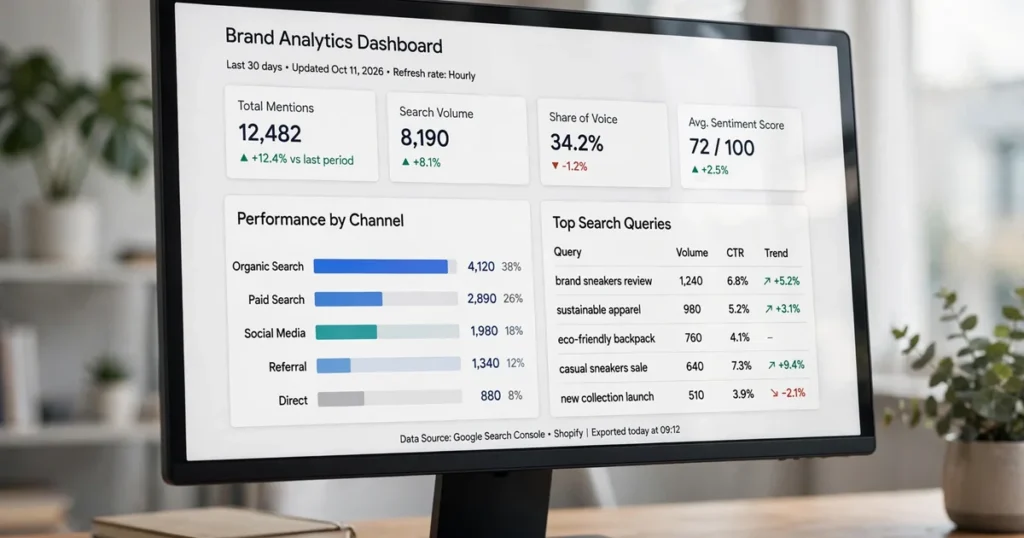
Microsoft Clarity keeps quietly building the most useful free GEO measurement tool nobody is talking about. The latest addition to its AI Visibility dashboard lets you customize the Brand Terms used to classify branded queries, and while that sounds like a small administrative feature, it fixes one of the biggest accuracy problems in AI visibility reporting.
Here is what shipped, and it builds on the August segmentation. Back in August, Clarity introduced branded versus non-branded query segmentation in its AI Citations dashboard, labelling each grounding query so you could separate direct brand visibility from category discovery. The new update goes one level deeper by putting you in control of the underlying terms. You can now add, edit and remove Brand Terms from Settings, covering abbreviations, alternate spellings, localized names, translations and common typos, and group related terms under a single Brand Name. Your initial list comes pre-populated by Clarity, which gives you a starting point, and you can then filter the whole dashboard by Brand Name or drill into an individual term. The feature is live now in the AI Visibility dashboard.
Why does this matter more than it looks? Because branded and non-branded AI visibility are completely different numbers that tell completely different stories, and most brands are measuring them wrong. Your share of authority on branded queries reflects demand you already created through marketing, press and reputation. People searching your name were always likely to see you cited, so a high branded number is mostly a confirmation rather than an achievement. Your share of authority on non-branded queries is the competitive number. That is where the engine had a real choice among domains and picked yours, and that is where your GEO content strategy actually shows up.
When the classification is wrong, both numbers lie. Every misspelled brand mention that Clarity files as non-branded inflates your discovery story with demand you did not earn. Every generic category query that accidentally matches a brand term hides the competitive wins you should be reporting. I have seen this same problem poison traditional SEO reporting for years, where branded traffic quietly inflated organic growth stories that had nothing to do with ranking performance. The AI visibility version of that mistake is happening right now, in dashboards people are showing to clients.
Share of voice has always been one of the metrics I push hardest, because it is the closest thing SEO has to market share. The branded versus non-branded split is share of voice for the AI answer layer, and it only works if the underlying classification is clean. A pre-populated list from Clarity is a decent starting guess, but it cannot know that your customers spell your name three different ways in support tickets, or that your product has a legacy name people still use, or that your brand means something different in another market. Only you know that, which is why handing you the controls was the right call.
With that in mind, I would start this week by auditing what Clarity pre-populated:
- Audit the pre-populated list before you trust a single number. Clarity’s starting guesses are reasonable, but they are guesses. Anything missing or wrong is silently corrupting your branded and non-branded splits right now.
- Add every variant you have ever seen in the wild. Misspellings from support tickets, abbreviations from social mentions, legacy product names, localized spellings. The unglamorous typos are exactly the queries a generic classifier misses.
- Group ruthlessly under one Brand Name per brand. If you run multiple brands or products, keep the groupings clean, because the whole point is filtering by brand and comparing performance at the right level.
- Re-check your share of authority split after two to three weeks of clean data. Expect your branded number to drop and your non-branded number to become the one worth discussing. That is not bad news, that is the truth arriving.
- Report the two numbers separately from now on. Branded visibility goes in the brand health section of your report. Non-branded visibility goes next to your content and GEO work, because that is what earned it. Never blend them again once you have seen what the clean split looks like.
This slots into a measurement stack that is finally getting serious. Between Search Console’s new AI performance reports and the multimodal search filters I covered during the September spam update rollout, and tracking developments like the Gemini UTM parameters for AI referral attribution, we are getting real instrumentation for the AI search era. Clarity’s contribution is the free one, and for smaller teams it may be the most immediately useful.
Failon’s POV: Measurement quality is a strategy decision, not a settings chore. Every GEO conversation I have eventually comes down to someone showing me a number and me asking what exactly went into it, and the answer is usually embarrassing. Clean classification in means a credible GEO story out. Dirty classification in, and you are presenting fiction with decimal places. I would rather have an honest small number on non-branded AI visibility than a flattering big one that falls apart the moment a client asks a follow-up question. Set aside the hour, fix your brand terms, and let the real numbers tell you where your AI search presence actually stands.