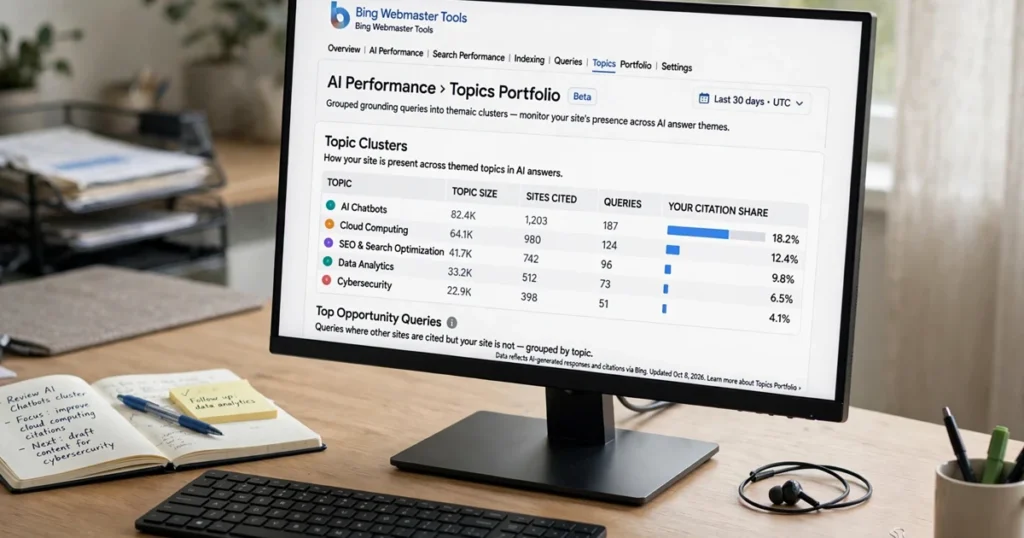
Microsoft keeps building the AI visibility reporting that site owners keep asking Google for, and the newest addition answers a question that raw citation lists never could. Bing announced Topics Portfolio as a beta feature inside the AI Performance report in Bing Webmaster Tools, and the feature groups the grounding queries where a site appears into broader thematic clusters, so a team can see the shape of its presence across themes instead of scrolling through one query at a time and guessing what the pattern means.
Grounding queries are the search terms that Bing AI uses to locate and cite content when it composes an answer across Copilot, Bing AI summaries, and select partner integrations, and that definition is the reason the grouping matters in practice. A single grounding query tells a team almost nothing, because the wording belongs to the retrieval system rather than to a human searcher, while a cluster of related queries reveals the topics a brand is actually trusted on and the topics where that trust has not been earned yet. Microsoft says the view appears only when a site has sufficient data, and smaller sites may see a shorter list or no list at all, which is an honest limitation that teams should factor into how much weight they place on an empty report.
Each topic in the portfolio carries three measures that turn the cluster into a planning tool rather than a curiosity. Topic Size estimates the total citations across all sites for the theme during the selected period, Sites Cited estimates how many sites appear for queries inside the theme, and Queries counts the distinct grounding queries grouped under it, so a team can judge demand and crowding before deciding where to invest. Below the portfolio, a Top Opportunity Queries list gathers the strongest queries across those themes where other sites are cited and the connected site is absent, with citation volumes shown as ranges rather than exact counts.
Used well, the report supports a disciplined sequence of decisions:
- Start with the themes where presence is already meaningful, because strengthening a topic the model associates with the brand is usually faster than forcing entry into a theme with no existing citations.
- Compare Topic Size against Sites Cited before chasing a gap, since a large theme with few cited sites is an opening, while a large theme with hundreds of cited sites is a long campaign.
- Treat every Top Opportunity Query as a research prompt rather than a publishing order, because the right response may be improving an existing page that the model overlooked instead of creating another page that competes with it.
- Recheck the portfolio after each content cycle, because movement at theme level is a steadier signal than the daily noise inside individual query rows.
What I would do with this report in a client account follows a short order of operations:
- Export the current topics and opportunity queries, then map each theme against the pages the business actually wants cited, so gaps are judged against commercial priorities rather than against the full list Microsoft returns.
- Pick one crowded theme where the brand has a legitimate claim and one open theme where a single strong page could establish presence, then assign different expectations and timelines to each.
- Review the pages behind the strongest existing citations for the qualities worth repeating elsewhere, including clear structure, direct answers early on the page, and specific facts that a model can lift without interpretation.
- Pair the Bing view with measurement on other surfaces before drawing conclusions, because the report covers Copilot and Bing-grounded experiences and says nothing direct about ChatGPT, Perplexity, or Google AI Overviews.
That last point connects with a limitation I noted when I covered Microsoft Clarity and AI visibility reporting, where each platform reveals a partial picture and the discipline lies in combining the partial pictures without mistaking any one of them for the whole. A periodic SEO audit is the natural place to fold a Topics Portfolio review into existing reporting, because the themes a model trusts a site on should influence content priorities in the same meeting that decides technical fixes and internal linking work.
Failon’s POV: I welcome this feature and I also think its greatest risk is teams treating the opportunity list as a content shopping list, because a query where a rival is cited is evidence of a gap and not proof that filling it will earn a citation. The value of Topics Portfolio is the strategic view it finally provides, showing whether a brand is building topical authority in AI answers or scattering single citations across unrelated themes with no pattern a model can learn. Brands that read the report at theme level and act with patience will get far more from it than brands that chase every row it returns.
Sources: Microsoft Bing Webmaster Blog announcement of Topics Portfolio (October 2026), as reported by Search Engine Roundtable and Search Engine Journal (October 2026).