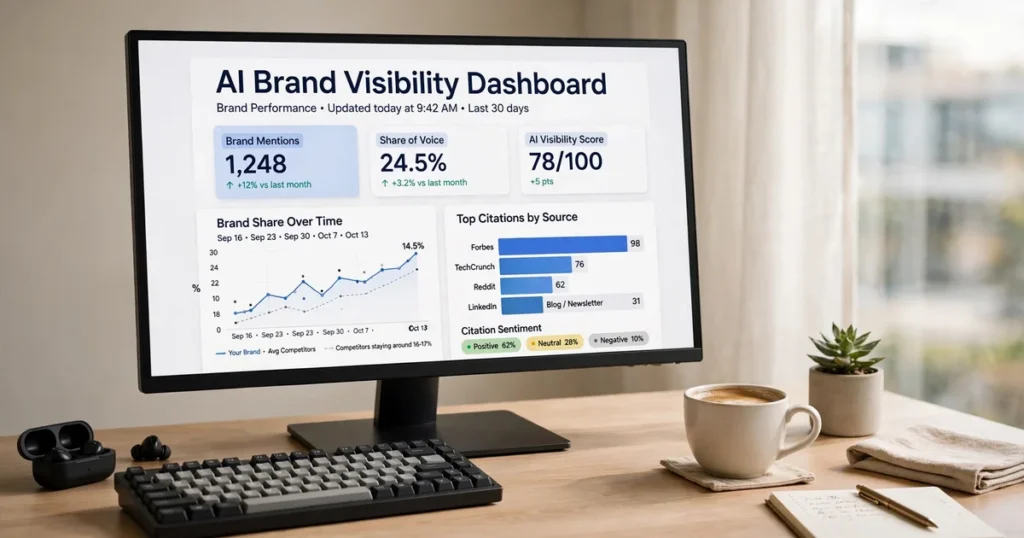
A new entrant joined the crowded AI visibility market today, and the launch says as much about where budgets are moving as it does about the product itself. Citations.io, a bootstrapped software company founded in Newcastle upon Tyne, launched publicly on October 13 with a platform that tracks how ChatGPT, Perplexity, Gemini and Claude mention, rank, recommend and cite brands when people ask those engines about products, services and businesses. Founder Josh Tulip, who spent around 15 years working across technical SEO, search intelligence and online reputation before building the platform, framed the gap plainly in the launch announcement, arguing that traditional search gave businesses sophisticated ways to understand visibility while AI search created a different discovery layer that most brands still cannot measure.
The platform focuses on what happens inside the generated answer rather than on a results page that a user scrolls through. Marketing teams can see whether a brand appears in an answer at all, which competitors get recommended in its place, how prominently the brand features when it does appear, and which source material appears to influence the response. That combination matters because a brand can hold a strong position in organic search and still be absent from the answer a buyer reads, and until recently most teams had no organised way to see that absence, let alone explain it to a client or a board.
The feature that will draw the most debate is the step the company takes after measurement. Citations.io packages what it finds into Implementation Packs, which are structured briefs that hand the visibility gaps to SEO, content, digital PR and brand teams as work to complete. Measurement tools in this category have mostly stopped at reporting, leaving each team to translate a citation chart into a content plan on its own, so a product that tries to close the loop between diagnosis and brief is aiming at the part of the workflow where tools usually go quiet.
Early demand also tells a story about geography that Canadian and British practitioners should notice. Around 70% of the customers the company described at launch are based in the United States, even though the business was founded in Newcastle and is preparing for wider international growth. Enterprise brands in the United States are funding AI search visibility work earlier and at greater scale than most other markets, and a British software company can build a viable business by selling into that demand long before domestic buyers catch up.
For practitioners deciding whether another tracking platform earns a place in the stack, the useful questions are concrete ones:
- Coverage needs to span the engines buyers actually use, and a platform that watches ChatGPT, Perplexity, Gemini and Claude covers the answers most commercial research now passes through.
- Recommendation tracking matters more than mention counting, because being named in passing and being the product an engine recommends lead to very different commercial outcomes.
- Source tracking is where strategy gets built, since knowing which pages influence an answer tells a team exactly where digital PR and content effort should go next.
- A brief that a content or PR team can act on without translation saves more time than another dashboard, and that saving is what most small teams are really buying.
What I would do before paying for any tool in this category is build a manual baseline that any platform then has to beat:
- Fix a set of buyer questions that reflect how customers actually research the category, and run those same questions across ChatGPT, Perplexity, Gemini and Claude on a regular schedule.
- Record which brands appear in each answer, which brand gets recommended most prominently, and which source pages appear to shape the response.
- Repeat the exercise over several weeks and note how the answers shift, because a single snapshot hides the volatility that makes this channel hard to manage.
- Compare any paid platform against that record on accuracy and time saved, and keep the subscription only where the tool clearly finds gaps the manual work missed.
That exercise costs nothing beyond attention, and it exposes whether a category has a visibility problem worth paying to monitor in the first place. Readers who want the wider method can follow the approach I set out in my guide on how to track AI visibility and then judge new platforms against that standard.
Failon’s POV: I welcome every serious entrant in this category because measurement is what turns AI visibility from a conference topic into a line item a client will fund, and a founder with a search intelligence background building briefs instead of vanity charts is aiming at the right problem. I will judge Citations.io the way I judge every platform in this space, on whether the recommendations it surfaces lead to work that changes an answer, because a beautiful record of being ignored by ChatGPT is still a record of being ignored, and the value sits entirely in closing the gap the chart reveals.
Sources: EINPresswire launch release, “Former agency boss launches Citations.io to show brands how AI engines mention, rank and cite them” (October 13, 2026), with syndicated coverage of the same release.