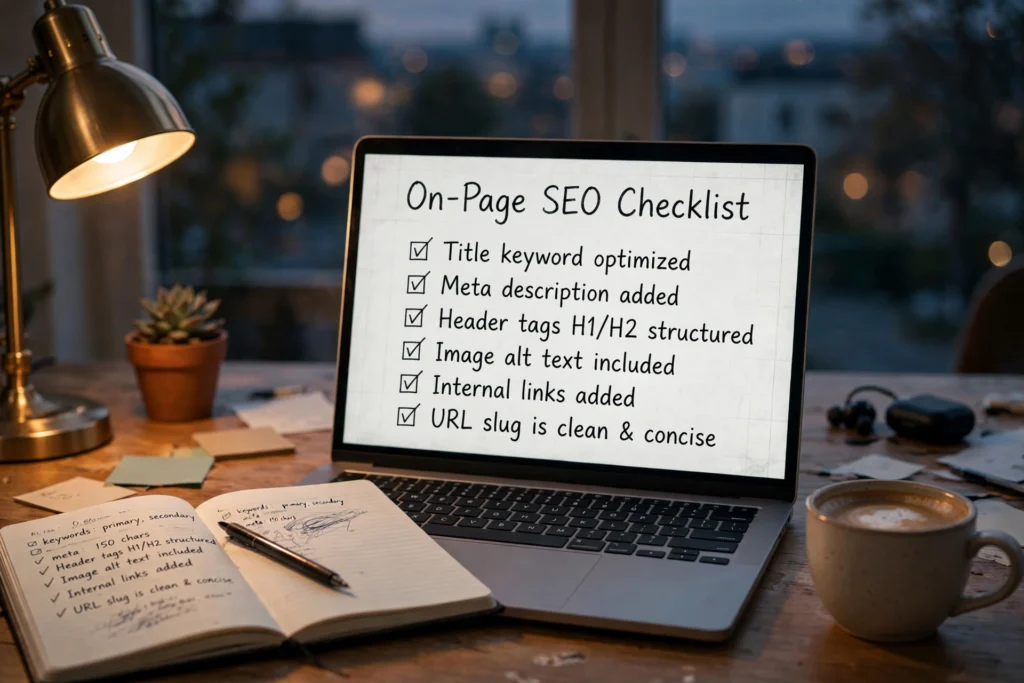
On-page SEO did not die when AI search arrived. It became the foundation everything else stands on.
Here’s the pattern: the pages getting cited by ChatGPT, Perplexity, and Google AI Overviews are almost always pages with clean on-page fundamentals. Clear title tags. One H1. Logical headings. Descriptive internal links. Answer engines extract from well-structured pages because well-structured pages are easier to trust.
SEO got you onto the page. On-page SEO gets you into the answer.
This checklist covers the 11 on-page factors I still check on every audit in 2026. Not the 200-item bloated versions. The ones that move rankings and citations.
Does your primary keyword sit in your title tag, H1, and URL?
This is factor one, two, and three on the checklist, and it still matters more than most people admit.
Title tag: front-load the primary keyword, keep it under 60 characters, and make it read like a headline a human would click. Google rewrites titles it does not like. Give it one it can keep.
H1: one per page, matching the title tag’s intent (not necessarily word for word). Your H1 tells both readers and crawlers what the page is about in a single glance.
URL: short, lowercase, hyphenated, containing the primary keyword. No dates, no parameters, no keyword stuffing.
Image alt text: describe the image for someone who cannot see it, and work the keyword in only when it genuinely fits. Alt text is an accessibility feature first and a ranking signal second.
The mistake: stuffing the exact keyword into all four spots verbatim. Match intent across them, not identical strings.
Compress images and serve via CDN
Oversized images are the most common silent killer of on-page performance I see. Compress every image before upload, serve modern formats, and put a CDN in front of them. This is pure image optimization for SEO, and it affects both rankings and whether impatient AI-era users stick around long enough to convert.
Is your heading hierarchy actually logical?
One H1. Then H2s for the main sections. Then H3s for subsections. In that order, no skipping levels.
This sounds basic because it is basic, and yet broken heading hierarchies show up in most audits I run. An H3 floating under nothing. Two H1s because the theme puts the logo in one. H2s used as styling instead of structure.
What this means for you: headings are how both Google and answer engines understand what your page covers. A clean H1 to H2 to H3 outline is a table of contents for machines. When I ran a citation audit for a supplement e-commerce brand, the pages with proper heading structure were cited noticeably more often than the ones with flat or skipped hierarchies.
Question-based H2s are the 2026 upgrade. Phrase your H2s the way people actually ask: “How long should a meta description be?” instead of “Meta Description Length.” This mirrors natural language queries and gives answer engines clean extraction points.
Keep paragraphs to 2-4 sentences for AI extraction
Short paragraphs are not just a readability choice anymore. They are an extraction choice. Answer engines lift 40 to 75 word blocks, and a tight paragraph is already shaped like an answer.
Make every section self-contained
Each H2 section should make sense on its own, with its own direct answer up front. Assume the reader (or the model) lands mid-page and never reads the intro. If a section only makes sense after reading three previous sections, restructure it.
Are your meta descriptions written to earn the click?
Meta descriptions are not a direct ranking factor. They are a click factor, and clicks are a visibility factor.
The formula I use: keep it around 105 characters, include the primary keyword naturally, and end with a clear call to action. “Learn how,” “See the checklist,” “Start here.” Give the searcher a reason to choose your result over the nine others.
The mistake: auto-generated descriptions or, worse, none at all, letting Google grab random body text. You would not let a stranger write your ad copy. Do not let an algorithm write your snippet.
Write unique descriptions for every indexable page. Yes, every one. Duplicate meta descriptions across dozens of pages is one of the fastest audit wins I know.
Have you added JSON-LD schema where it counts?
Schema markup is machine-readable labeling for your content, and in 2026 it serves two masters: Google’s rich results and AI engines deciding what to cite.
Prioritize three types:
Article schema on every blog post and guide. It tells engines who wrote it, when, and what it is.
FAQ schema on pages with real question-and-answer content. Keep answers visible on the page, matching the markup exactly.
HowTo schema on instructional content. Step-by-step formats are among the most cited structures in AI answers.
Validate everything with Google’s Rich Results Test before it ships. Mismatched schema, where the markup says something the visible page does not, is worse than no schema at all. For the full breakdown of which types drive citations, see my schema markup strategy guide.
Do your internal links use descriptive anchor text?
Internal links are the most underused ranking lever on most sites I audit. You control them completely, they cost nothing, and they tell Google exactly how your content connects.
The rules:
Descriptive anchors, five words or fewer. “On-page SEO checklist” beats “click here” every time. For the deeper logic on how anchors work in the AI era, read my anchor text strategy breakdown.
Link from authority to opportunity. Your strongest pages should link down to the pages you want to rank. Link equity flows downhill only if you build the pipes.
Every new post connects to its cornerstone. No orphans. When you publish, link the new page from at least one relevant existing page, and link out from the new page to its siblings.
Vary your anchors. Using the identical anchor for every internal link to a page looks manipulative. Rotate through natural variations.
The mistake: linking every mention of a keyword site-wide until the page has 40 internal links pointing at it with identical anchors. That is over-optimization, and it dilutes the signal instead of strengthening it.
Frequently asked questions
What is the most important on-page SEO factor?
Matching search intent with a clear title tag, one H1, and content that answers the query directly. No single tag or trick outweighs a page that gives the searcher exactly what they asked for in a structure engines can parse.
Where should the primary keyword appear?
In the title tag, the H1, the URL slug, and naturally in the first 100 words of body content. It should also appear in at least one H2 and in image alt text where it fits honestly. Placement across these spots beats repetition in any single one.
How long should a meta description be?
Aim for around 105 characters including a call to action. That length displays fully on most devices without truncation. Include the primary keyword early, since Google bolds matching terms, and end with a reason to click.
Should I keyword-stuff H2s?
No. Write H2s for humans first, phrased as the questions your readers actually ask. A single natural keyword inclusion per H2 is plenty. Stuffed headings read badly, convert badly, and answer engines prefer clean, quotable headings anyway.
What to do this week
Run this checklist against your five most important pages. Not the whole site. Five pages.
Fix the title tags first, then the heading hierarchy, then the meta descriptions. Add schema where it is missing. Rewire the internal links with descriptive anchors. That is a single focused week of work, and it is the foundation every AI visibility tactic builds on. If you want a second pair of eyes on the audit, that is exactly what I do. Reach out and we will talk through what your pages need.
For the full technical companion to this checklist, including crawlability and JavaScript rendering, see the technical SEO checklist.