
Why Your Anchor Text Strategy Is Killing Your Rankings, And How to Fix It for AI and Humans
Anchor text optimization is the art of choosing the right clickable words for your links to satisfy three masters: traditional search engines, AI answer engines, and actual humans. In 2026, it isn’t just about “ranking”; it’s about providing the semantic breadcrumbs that tell a generative AI model (like ChatGPT or Perplexity) that your page is the authoritative source for a specific fact.
I’ve been doing SEO for over a decade, and I’ve seen anchor text go from a “set it and forget it” task to a high-stakes game of risk management. If you’re still using “click here” or “read more” for everything, you’re basically whispering in a room where everyone else is shouting with a megaphone. Let’s fix that.
What is anchor text optimization in plain English?
Anchor text optimization means using descriptive, natural language in your links so both people and robots know exactly what’s on the other side of the click. Think of anchor text as a road sign. If you’re driving to Toronto and the sign just says “Click Here for City,” you’re going to be confused. You want a sign that says “Downtown Toronto: 10km.”
In my experience, the biggest mistake people make is trying to “trick” the system. But Google’s SpamBrain and AI models like Gemini 3 are now smarter than we are (that’s just what they think) at spotting forced patterns.
The Core Types of Anchor Text:
- Branded: Using your company name (e.g., “Failon OB”).
- Exact Match: The precise keyword you want to rank for (e.g., “anchor text optimization”).
- Partial Match: A natural phrase that includes the keyword (e.g., “how to optimize anchor text”).
- Naked URL: Just the web address (e.g., “failonoben.com“).
- Image Alt Text: When you link an image, the “alt text” acts as your anchor.
How do the US and Canadian markets differ for link building?
The US market is a high-volume, high-competition “arms race,” while the Canadian market rewards geographic authority and bilingual relevance. In the US, you are fighting over head terms with massive search volume; in Canada, a link from a local .ca domain often carries more weight than a generic .com link from a bigger site.
| Metric | United States Market | Canadian Market |
| Market Style | Mature, volume-driven, hyper-competitive. | Authority-driven, niche-focused, rapidly growing. |
| Growth (CAGR) | Stable industry average. | 11.4% projected growth (2026-2034). |
| Primary Goal | High-volume leads and SaaS dominance. | Local trust and bilingual publishing authority. |
| Search Intent | Heavy focus on technical tools and audit services. | High value on regional relevance and expert sources. |
What does the latest keyword data tell us about the US market?
The US market is currently obsessed with “over-optimization,” with a high volume of searches focused on avoiding Google penalties. Data from recent Semrush reports shows that while “anchor text optimization” remains the top head term (320 volume), queries like “anchor text over optimization tool” (110 volume) have a Keyword Difficulty (KD) of only 9, suggesting a wide-open opportunity for creators to help worried SEOs.
Top US Keyword Performance (2026)
| Keyword | Volume | KD % | Intent |
| anchor text optimization | 320 | 26 | Informational |
| anchor text over optimization tool | 110 | 9 | Informational |
| over optimized anchor text | 110 | 25 | Informational |
| anchor text optimization in seo | 40 | 43 | Informational |
| anchor text optimization cincinnati | 20 | n/a | Local |
Wait, check out that KD for “anchor text optimization in seo”, it’s 43!
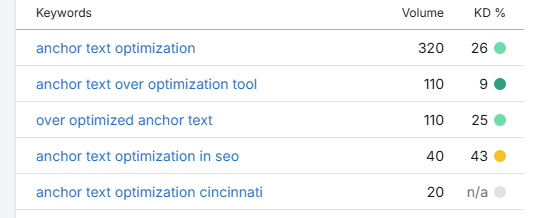
That tells me the professionals are fighting over that term, while the “over-optimization” tools are being sought by people who are currently panicking about their rankings.
Can anchor text actually get you cited by AI engines like Perplexity?
Yes, descriptive internal anchor text is a massive signal for AI retrieval; bi-directional linking can increase your AI citation probability by 2.7 times. AI engines like Perplexity and Gemini don’t just look for keywords; they look for “answer-worthy passages” and the links that validate those facts.
Here’s a real-world example: Hostinger recently updated 100 articles to use more descriptive internal anchors instead of “click here.” Their AI citation share jumped 52% in just three months. They moved from being just a website to being a “trusted source” for AI models.
How should I distribute my anchor text to stay safe?
You should follow the “80/20 Rule”: keep 80% of your links natural (branded or generic) and limit your exact-match keywords to 20% or less. In fact, most experts suggest keeping exact-match anchors under 10% for external links to avoid triggering Google’s spam filters.
My Recommended 2026 Distribution Strategy:
- Branded (40-50%): Use your name. It’s the safest way to build authority.
- Generic/Natural (20-30%): Phrases like “this article” or “learn more.” These make your link profile look human.
- Partial Match (15-25%): Natural phrases like “best link building strategies.”
- Exact Match (5-10%): Use these only for your absolute most important pages.
What is the “Query Fan-Out” and how does it change my links?
Query Fan-Out is when an AI engine breaks a single user question into 10-20 smaller sub-searches; you need descriptive links to rank for those “fanned out” sub-topics. If your anchor text covers these specific sub-questions, you are 161% more likely to be cited in an AI Overview.
Think of it like a librarian. If you ask for “the history of Canada,” the librarian (the AI) actually looks for “Indigenous history,” “Confederation,” and “Modern politics.” If your links help the librarian find those specific sections on your site, you win.
Frequently Asked Questions on Anchor Text Optimization
Q: Does anchor text still matter for SEO in 2026?
A: Absolutely. It remains a confirmed ranking signal and is now the primary way AI engines determine which sources are trustworthy enough to cite.
Q: Is it bad to use “click here” as anchor text?
A: It’s not “bad,” but it’s a wasted opportunity. Vague anchors like “click here” provide zero context to search engines or AI, making it harder for them to understand your page.
Q: How do I know if my anchor text is “over-optimized”?
A: Use a tool like Ahrefs or Semrush to check your “Anchors” report. If your exact-match keywords make up more than 10-15% of your total links, you’re in the danger zone.
Q: Should I use different anchor text for internal vs. external links?
A: Yes. You can be more aggressive with internal links (using more keywords) to help robots map your site. For external links, stay conservative and focus on branded or natural language.
Q: How often should I audit my anchor text profile?
A: I recommend a quarterly audit. Link profiles change naturally over time, and a regular check-up ensures you aren’t drifting into a pattern that looks manipulative to search engines.
Q: Does Canada have different anchor text rules?
A: The technical rules are the same, but the strategy is different. Focus on geographic relevance (e.g., “SEO services in Toronto”) and bilingual variations to capture the unique Canadian search landscape.
If you’re feeling like your current link strategy is stuck in 2019, it’s time to pivot. Start by auditing your top 10 pages and making your internal links descriptive. It’s the fastest “quick win” in the AEO era. If you want to see how I handle this for my e-commerce clients, come find me on LinkedIn.
Written by Failon OB, SEO Specialist with more than a decade of experience in SEO, AEO, GEO, or whatever we’re calling it these days. I help brands get found by humans and by the AI systems that answer on their behalf. Working with clients in e-commerce, real estate, and commercial services from Toronto, ON. failonoben.com | Connect on LinkedIn