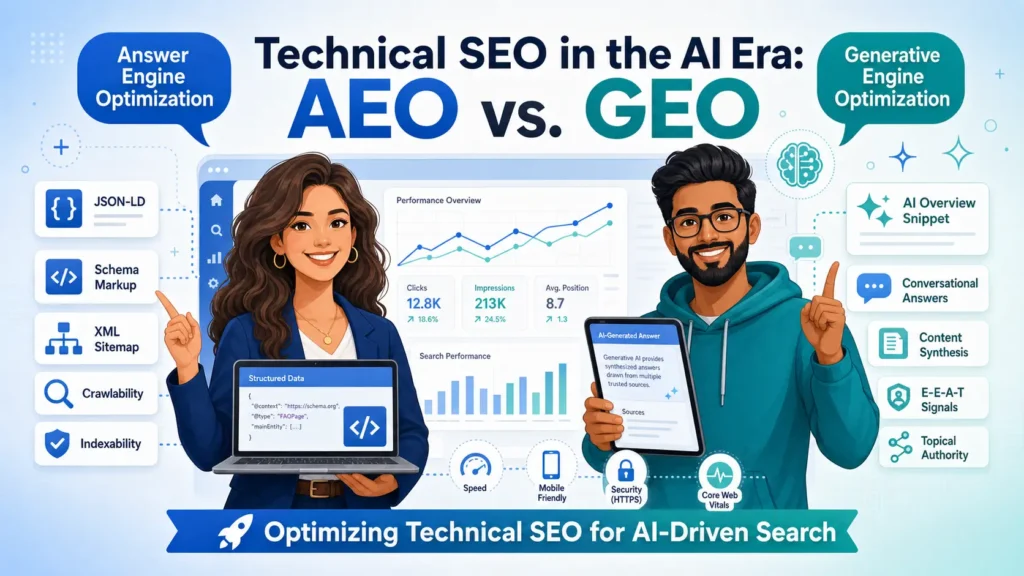

Most definitions of website optimization read like they were written for a glossary, not for someone responsible for a site’s revenue. They describe the term without conveying the work. After years of doing this for a living, I define it differently: website optimization is the ongoing discipline of making a website faster, easier to find, and more persuasive, measured against outcomes that matter to the business. It is not a project with a finish line. It is a practice, closer to fitness than to construction.
What Is Website Optimization?
At its core, website optimization means systematically improving how a website performs across three dimensions:
- Performance in the literal sense: how quickly pages load, how smoothly they render on a phone, how reliably they work.
- Discoverability: whether search engines can crawl, understand, and rank the site’s pages, and increasingly whether AI answer engines can read and cite them.
- Persuasion: whether the people who arrive actually do the thing the page was built for, whether that is buying, booking, subscribing, or picking up the phone.
These three dimensions overlap constantly. A page that loads in under two seconds but answers the wrong question is a fast failure. A beautifully persuasive page that Google cannot crawl might as well not exist. And a page that ranks first for a valuable query but confuses the visitor burns the very traffic it worked to earn. Optimization is the work of holding all three in balance, and that balance shifts as search behaviour changes, which is why the work never truly ends.
What Does Website Optimization Mean?
In practice, the phrase gets stretched to cover almost anything done to a website, which drains it of meaning. A redesign is not optimization. New branding is not optimization. Optimization means making targeted changes, each tied to a specific measurable outcome, and then verifying the change actually moved the number. If you cannot say what a change was supposed to improve and whether it did, you were not optimizing. You were redecorating.
This distinction matters because it determines how the work is planned. Genuine optimization starts from evidence: analytics, crawl data, search performance, user behaviour. A proper SEO audit tells you what is broken and what is merely unpolished, and the difference decides where the hours go. Without that evidence-first habit, “optimization” becomes a label slapped on busywork, and site owners pay for motion instead of progress.
How Does Website Optimization Work?
The process runs as a loop, not a straight line.
- It begins with a baseline: how the site performs today across speed, rankings, traffic, and conversions.
- From there, findings get prioritized by expected impact against effort, because no site has unlimited hours and the highest-value fixes are rarely the most glamorous.
- Implementation follows in focused sprints, and every change gets measured against the baseline it was meant to move.
Keyword research sits near the start of that loop for most sites, since it defines the language the pages need to speak. The on-page work then follows: titles, headings, internal links, and content shaped around real queries rather than internal jargon. Technical fixes run in parallel, because content cannot compensate for a site that crawlers cannot reach. Then the loop repeats. Search results shift, competitors publish, Google updates its systems, and AI engines change how they select sources, so last quarter’s finished work becomes this quarter’s maintenance.
What Is Website Optimization in Digital Marketing?
Within digital marketing, website optimization is the foundation everything else stands on. Paid campaigns, social, and email all eventually send people somewhere, and that somewhere is usually the website. If the site is slow, confusing, or untrustworthy, every dollar of acquisition spend works harder for less. Optimization is what makes the rest of the marketing mix efficient, which is why I treat it as infrastructure rather than as one channel among many.
It also connects directly to content marketing. Content only compounds when the pages it lives on are technically sound and internally linked so both readers and crawlers can follow the thread. A brilliant article on a site with broken navigation and no internal linking strategy is a brilliant article nobody finds twice. Optimization is the unglamorous work that lets the glamorous work pay off.
What Elements of a Website Are Important for Website Optimization?
The elements that matter most are the ones that touch performance, discoverability, or persuasion, which in practice means nearly everything, prioritized ruthlessly:
- Site speed and mobile experience come first because they gate everything else; a visitor who leaves before the page renders never sees the copy.
- Information architecture comes next: clear navigation, logical URL structure, and internal linking that distributes authority to the pages that earn revenue.
Content quality is the third pillar, and I mean quality as usefulness, not word count. Pages need to answer the query behind the keyword completely enough that the visitor stops searching.
- Metadata still matters: titles and descriptions are the advertising copy of organic search.
- Structured data increasingly matters too, since it feeds rich results and helps AI systems parse what a page is about.
- Security basics like HTTPS are table stakes at this point.
None of these elements wins in isolation, which is why checklist thinking fails and systems thinking works.
What Is Website Optimization and Why Is It Done?
It is done for one reason that contains multitudes: a website exists to produce outcomes, and optimization is how you get more of them from the same asset:
- More qualified traffic
- More conversions
- More revenue per visitor
- Lower acquisition costs
Every technical fix and content rewrite is ultimately a bet that a specific change will move one of those numbers, and the discipline lies in checking whether the bet paid off.
The “why” has also gained a new dimension in the last two years. Search is no longer only ten blue links. ChatGPT, Perplexity, Gemini, Claude, Copilot, and Google’s AI Overviews and AI Mode now answer questions directly, citing a handful of sources. A site that is not structured to be understood and cited by these systems is invisible in a growing share of discovery, no matter how well it ranks traditionally. That is why AI visibility has joined speed and rankings as a core optimization target: the definition of “findable” has expanded, and the work has expanded with it.
So when someone asks me what website optimization is, I skip the glossary answer. It is the ongoing work of making a website earn its keep: fast enough to keep visitors, clear enough for search engines and AI systems to understand, and persuasive enough to turn attention into outcomes. Everything else is commentary.