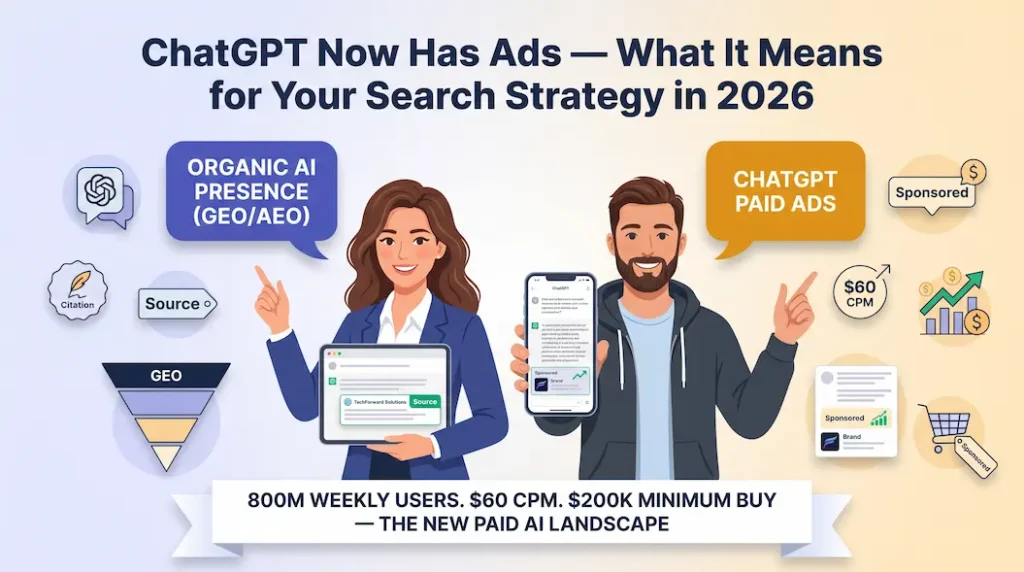
ChatGPT Now Has Ads (What It Means for Your Search Strategy in 2026)
OpenAI launched ads inside ChatGPT on February 9, 2026, officially ending months of “we would only do this as a last resort” energy from Sam Altman. The ads are live for logged-in adult users on ChatGPT’s Free and Go tiers in the U.S., and as of May 7, 2026, the pilot has expanded to the UK, Mexico, Brazil, Japan, and South Korea (OpenAI official announcement, May 2026). Plus, Pro, Business, Enterprise, and Education subscribers remain ad-free. The channel reaches 800 million weekly users and has a CPM of approximately $60, nearly three times Meta’s CPM (TechCrunch, February 2026).
Here is what most people are misreading: this is not Google Ads inside a chatbot. The targeting model is completely different, the intent signals are deeper, and organic GEO presence is now a direct input into whether your paid placement performs. If your brand has no organic AI visibility, your paid ad in ChatGPT is a sponsored interruption. If it does, the paid placement is a reinforcement.
What exactly did OpenAI launch and how are the ads structured?
ChatGPT ads appear as a single clearly labelled sponsored placement below the AI-generated answer, one ad per conversational turn, separated from the organic response.
How the ad format actually works, confirmed by OpenAI (February 2026):
- Placement: Ad appears below the AI answer, not inside it. The organic response is unaffected
- Labelling: Explicitly marked “Sponsored” always visually separated from ChatGPT’s answer
- Targeting: Matched to the subject of the ongoing conversation, past chats, and prior ad interactions contextual intent, not keyword bidding
- User controls: Users can dismiss ads, review their ad history, clear ad interest data, and toggle personalization off at any time
- Privacy: OpenAI confirmed advertisers cannot see user conversations, only aggregate data (views, clicks)
- Exclusions: Ads are blocked from users under 18; not shown near sensitive topics including health, mental health, and politics; and not placed in temporary chats, after image generation, or inside ChatGPT’s Atlas browser
Pricing and access:
| Metric | ChatGPT Ads | Google Display | Meta Ads |
|---|---|---|---|
| CPM | ~$60 | $3–$30 | ~$14–$20 |
| CPC | ~$12 | $1–$2 | $0.50–$3 |
| Minimum buy | $200K (pilot); self-serve now open | No minimum | No minimum |
| Targeting model | Conversational context + past chats | Keywords + audience | Demographic + interest + behaviour |
| Intent signal | Active problem-solving dialogue | Keyword match | Passive feed scroll |
In May 2026, OpenAI dropped the $200,000 minimum and opened ChatGPT Ads Manager to all U.S. businesses via self-serve (OpenAI, May 2026). International self-serve availability is unconfirmed at the time of publishing.
Early pilot participants include Target, Adobe, Williams-Sonoma, Audible, HelloFresh, and agency groups WPP Media, Dentsu, and Omnicom have all confirmed active campaigns (TechCrunch, February 2026; DTC Dispatch, February 2026).
Who does this affect and how seriously should you take it right now?
Enterprise brands with six-figure paid media budgets are the primary audience right now, but every SEO and content marketer working on organic AI visibility is indirectly affected from day one.
ChatGPT processes approximately 1.6 billion daily queries, roughly 12% of Google’s volume (eMarketer/Digital Applied, 2026). eMarketer projects AI-driven search ad spending will reach $2.08 billion in 2026 and scale to approximately $26 billion by 2029, with ChatGPT as the dominant platform in that growth (eMarketer Forecasts, April 2026). Analysts at OpenAI project that the ad business alone could generate $25 billion annually by 2030, making it one of the largest digital ad platforms in the world.
For SEOs managing client budgets below the $200K threshold, the self-serve drop now makes this channel accessible. But here’s the honest reality: the $60 CPM reflects a high-intent environment that not every category justifies. A CPM three times Meta’s rate only makes economic sense when the conversion probability is proportionally higher, and in a mid-decision, problem-solving conversation, it often is.
Here’s something I noticed across my supplement clients: the ChatGPT queries where competitors were appearing in organic GEO citations were almost exactly the same categories as the product-decision queries driving the highest-converting paid traffic. Post-purchase “how did you find us?” responses from customers who came through paid channels increasingly referenced AI chatbots as an earlier touchpoint. The paid click was the last step. ChatGPT was the research phase. If you are optimizing for the last click and ignoring the conversation upstream, you are bidding on the symptom and missing the cause.
Why did OpenAI actually launch ads and why now?
OpenAI launched ads to fund infrastructure costs at scale, and the timing reflects competitive pressure from Anthropic and Perplexity more than strategic patience.
According to OpenAI COO Brad Lightcap, speaking at the India AI Summit in February 2026, the rollout is “an iterative process” with user trust and experience as the design constraint (ALM Corp, February 2026). The stated rationale from OpenAI CEO Sam Altman on X: “It is clear to us that a lot of people want to use a lot of AI and don’t want to pay, so we are hopeful a business model like this can work.”
Here is my honest take on what is happening as well. In 2024, Altman publicly called advertising a “last resort.” By September 2025, OpenAI was actively recruiting a Head of Advertising. By February 2026, ads were live. That is not a considered pivot; that is a company facing serious cost pressure finding a path to revenue that doesn’t require every user to pay $20+ a month. The competitive pressure from Anthropic’s Super Bowl “ads are coming to AI but not to Claude” ad accelerated the positioning war. OpenAI’s response was pragmatic: most users accept ads if the product remains free. A Forrester survey found that 83% of users would accept ads to maintain free-tier access (Forrester, cited in multiple February 2026 coverage).
The structural risk is trust. Jeremy Goldman of eMarketer named it directly: “If ChatGPT turns on ads, OpenAI is admitting something simple and consequential: the race isn’t just about model quality anymore; it’s about monetizing attention without poisoning trust.” An OpenAI researcher, Zoe Hitzig, resigned specifically in protest of the ad decision, warning that OpenAI had accumulated an “archive of human candor” from deeply personal user conversations and that inserting commercial interests into that context was a category error.
What are most marketers getting wrong about ChatGPT ads?
Most marketers are treating ChatGPT ads as a new keyword channel, the same search intent model, different interface. They are not.
The critical difference is context depth. In Google Search, a user types “best protein powder for women” as a 5-word snapshot of intent. In ChatGPT, that same user might be three turns deep into a conversation about their training schedule, dietary restrictions, past products that didn’t work, and a budget. The ad that appears in that conversation has access to an intent signal that no traditional ad auction can match.
Search Engine Land described this clearly in February 2026: ChatGPT ads represent “a shift from keyword intent to behavioural understanding, changing how relevance, creative and measurement work.” The implication is structural: ad creative that works on Google short, punchy, keyword-anchored does not work in a mid-conversation AI context. Longer-form, contextual, problem-acknowledging creative performs better. The ad is entering a dialogue, not interrupting a scroll.
AdsMurai’s June 2026 analysis of OpenAI’s “Hints” targeting system the mechanism ChatGPT uses to match ads to conversations confirmed this: “We are moving from a keyword-based logic to one based on conversational intent.” Hint-matched ads are being served to users already demonstrating the exact problem the advertiser solves, multiple turns into a reasoning session.
The metric most teams are not tracking: Sensor Tower reported that more than 100 individual brand promotions ran in ChatGPT in the first four weeks of the pilot, with retail and grocery brands dominating (Sensor Tower, reported March 2026). If your category is represented and you are not in the auction, a competitor is absorbing both the paid-placement and organic-citation advantages.
So what should I actually do about this?
- Audit your organic GEO presence in ChatGPT before spending a dollar on paid. The conversational targeting model means that ChatGPT ads perform better when the brand already has an organic presence in AI answers, because the AI’s contextual matching draws on its training data and retrieved citations. Run your top 10 category queries in ChatGPT, record which brands are cited organically, and identify your citation gaps. If your brand has zero organic presence on ChatGPT, paid placement is a cold entry into a cold environment. Fix the organic layer first. The mistake: launching ChatGPT ad campaigns without first understanding where the brand sits organically in conversational AI results.
- If your budget qualifies for self-serve, set up a test campaign in ChatGPT Ads Manager with a $500-$2,000 budget focused on one high-intent category. OpenAI dropped the $200K minimum in May 2026 (OpenAI, May 2026), making entry-level testing accessible to mid-market brands. Use your highest-converting Google search query group as the starting point for contextual targeting. Track clicks, sessions, and on-site conversion rate separately from your Google Ads baseline; this is a new channel with different user behaviour, and blending the data will mask the signal. The mistake: applying Google Ads creative directly to ChatGPT without adapting for conversational context.
- Rewrite ad creative for conversational context, not keyword matching. ChatGPT’s “Hints” targeting system matches ads to the substance of an ongoing problem-solving conversation (AdsMurai, June 2026). Ad copy that opens by acknowledging the problem being discussed, not just announcing a product, will outperform standard search ad copy. Think of the format as a short, helpful recommendation from a knowledgeable friend, not a billboard headline. “If you’re comparing X and Y for your budget, we offer Z, here’s why” outperforms “Buy Z Now Best Price Guaranteed.”
The mistake: treating ChatGPT ad creative as an extension of your Google Ads copy library.
- Track ChatGPT referral traffic as a standalone channel in GA4. Create a custom channel group that captures sessions from chat.openai.com and chatgpt.com. Even if paid spend is zero, organic GEO traffic from ChatGPT is already flowing for many brands, and without proper attribution, it is landing in “Direct” or “Other.” Establishing clean ChatGPT attribution now means you have a baseline before your first paid campaign launches.
The mistake: waiting until you start spending before setting up attribution, leaving three to six months of organic AI referral data unclassified.
- Align SEO/GEO and paid teams on a shared ChatGPT strategy brief. Search Engine Land described ChatGPT ads as the development that “collapses the wall between SEO and paid media” (Search Engine Land, February 2026). In a channel where the paid placement appears below the organic citation, the two teams are competing for the same screen real estate, each with separate budgets and KPIs. Brief both teams together on ChatGPT strategy: organic GEO citation target queries, paid targeting approach, and creative direction should come from the same document.
The mistake: running ChatGPT paid through the paid media team and ChatGPT organic through the SEO team with no shared brief, resulting in misaligned messaging inside the same AI conversation.
- Monitor the trust question and have a brand safety policy for ChatGPT ads. OpenAI excludes ads from health, mental health, and political topics by default, but the exclusion list is narrow. If your brand operates in supplements, financial services, insurance, or legal services, define your own adjacency policy before campaigns launch. The last-thing-you-want scenario is a supplement ad appearing in a conversation about a health condition OpenAI’s exclusions didn’t flag. Establish a category exclusion list, a brand safety checklist, and a human review process for creative before any ChatGPT campaign goes live.
The mistake: relying entirely on OpenAI’s exclusion defaults without defining your own brand safety standards.
ChatGPT ads are the first genuinely new paid search channel in a decade, and I’m tracking how organic GEO presence and paid performance interact across my client base. If you’re navigating the organic-to-paid strategy question for AI channels, connect with me on LinkedIn.