
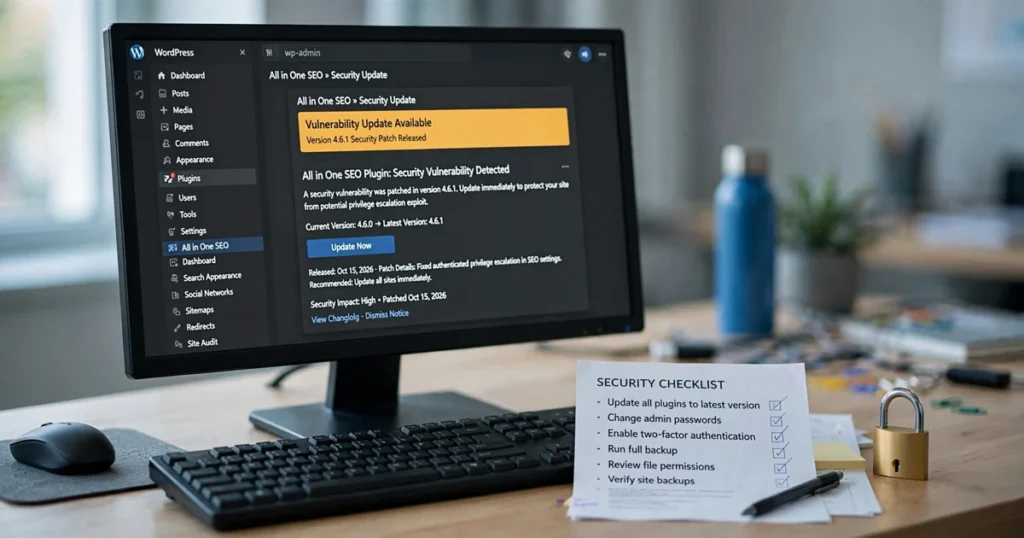
A plugin installed to protect search visibility can become the opening through which a site gets damaged, and the latest advisory for one of the most widely used WordPress SEO plugins is a reminder of how quickly that reversal can happen. Search Engine Journal reported a security advisory covering two vulnerabilities in All In One SEO, a plugin active on over two million installations, and the advisory describes flaws that let unauthenticated attackers execute arbitrary shortcodes or inject malicious scripts when specific conditions on the site line up in the wrong way.
The first flaw, tracked as CVE-2026-100152 and rated 6.5, affects versions up to and including 5.0.2, and it allows an unauthenticated attacker to run arbitrary WordPress shortcodes because a value is not properly validated before the plugin processes shortcodes. That exposure carries an important condition, since exploitation requires the AIOSEO breadcrumb to be rendered on a search results page through a block, a widget, a shortcode, or a template tag, so sites that never display those breadcrumbs on search pages sit outside this particular path even while running an affected version.
The second flaw, tracked as CVE-2026-85492 and rated 6.1, is a DOM based cross site scripting issue affecting versions up to and including 5.0.1.1, and it stems from insufficient input sanitisation and output escaping in how a URL pathname is handled. Exploiting it takes more than sending a crafted link into the world, because the targeted person must hold the aioseo_manage_seo capability and must open the SEO Preview panel in the WordPress admin toolbar while visiting a page carrying the malicious payload in the address, which makes the attack dependent on the actions of a privileged user rather than on a casual visit by anyone at all.
Both flaws are now patched, and the version path is simple enough that nobody needs to guess which release covers which problem:
- Version 5.0.2 addressed the cross site scripting flaw, with the changelog citing improved security and access protections across SEO Revisions, SEO Analysis, and the SEO Preview.
- Version 5.0.2.1 addressed the shortcode execution flaw, with the changelog citing improved security protections for shortcodes on search pages.
- Updating straight to 5.0.2.1 or a newer release covers both issues in a single move, which is the route I recommend rather than stepping through intermediate versions.
- Sites that display AIOSEO breadcrumbs on search results pages should treat the update as urgent, because that configuration is the stated condition for the shortcode flaw.
An update routine that takes a few minutes protects far more than a version number on a plugins screen:
- Check the installed AIOSEO version on every WordPress site you manage, including staging copies and client sites you touch only occasionally, because forgotten installs are where outdated plugins tend to survive.
- Update to 5.0.2.1 or newer, then confirm that titles, meta descriptions, sitemaps, and redirects still behave as expected, since a fast post update check costs little and catches surprises early.
- Review which accounts hold SEO management permissions and trim that list, because the scripting flaw depends on a privileged user being drawn into a specific action, and fewer privileged accounts means fewer possible targets.
- Turn on automatic updates for security releases where the site setup allows it, so the next patch of this kind lands without waiting for someone to notice an advisory.
The search consequences of a compromise are the part site owners often underestimate until they are living through a cleanup. A hacked site can serve injected pages, lose trust signals, and pick up warnings that suppress clicks for weeks after the technical problem is fixed, which is the same slow recovery pattern I described when covering the September 2026 spam update and how long search systems take to trust a cleaned up site again. Prevention through a routine plugin update is dramatically cheaper than regaining that trust.
Failon’s POV: I do not read a medium severity rating as permission to relax, because the rating reflects the conditions an attacker needs rather than the damage a successful attack can do to a business that depends on search traffic. Over two million installs make this plugin a target worth probing at scale, and automated scanning does not care how small a site feels to its owner. Update today, check the version on every site you are responsible for, and treat plugin hygiene as part of SEO work rather than as a separate chore that belongs to somebody else.
Sources: Search Engine Journal, All In One SEO WordPress Plugin Vulnerable To Two Exploits (published October 12, 2026, updated October 13, 2026), reporting Wordfence advisory details for CVE-2026-100152 and CVE-2026-85492.