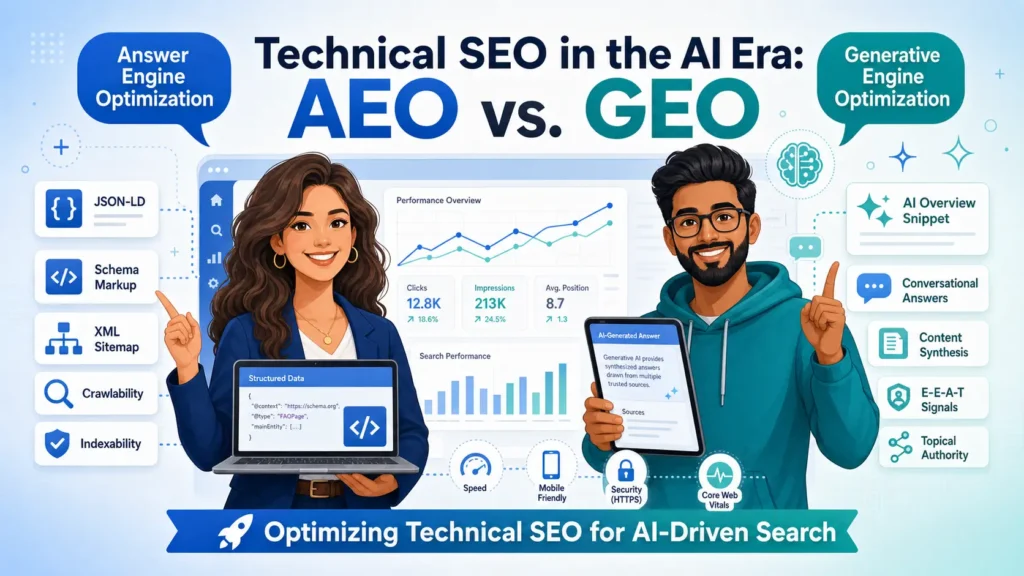

The Strategic Imperative of Structured Data: A Technical Analysis of Schema Markup and Search Discovery in 2026
The search landscape in 2026 is defined by a fundamental transition from a “strings-based” indexing model to an “entities-based” understanding model. As traditional search engines like Google incorporate sophisticated generative layers through AI Overviews and AI Mode, the importance of schema markup has evolved from a technical elective to a primary architectural requirement. Structured data serves as the critical semantic bridge between human-authored content and the large language models (LLMs) that now mediate the majority of digital discovery. This report evaluates the multifaceted role of schema markup in traditional Search Engine Optimization (SEO), Answer Engine Optimization (AEO), and Generative Engine Optimization (GEO), providing a data-driven assessment of its impact on click-through rates, citation probability, and brand authority.
The Semantic Evolution: From Information Retrieval to Knowledge Synthesis
The historical function of search was the retrieval of relevant documents based on lexical matching. In 2026, however, the paradigm has shifted toward knowledge synthesis, where search systems attempt to construct direct answers by parsing and aggregating data from across the web. Schema markup, primarily implemented via JSON-LD (JavaScript Object Notation for Linked Data), provides the standardized vocabulary required for this aggregation. Without structured data, AI crawlers must rely on probabilistic natural language processing (NLP) to interpret content meaning, which introduces a margin of error that can lead to misrepresentation or exclusion from high-visibility search features.
The magnitude of this shift is underscored by recent click-through rate (CTR) data. Traditional organic results are experiencing significant downward pressure as zero-click searches rise to 64% for queries containing AI Overviews. Research indicates that pages failing to provide machine-readable structure are increasingly relegated to the 96.55% of web content that receives zero search traffic from Google. Conversely, content that utilizes robust schema to explicitly define entities, attributes, and relationships is 3.4 times more likely to be cited by generative systems.
| Search Metric (2026) | Without Schema | With Valid Schema | Change (%) |
| AI Overview Citation Probability | Baseline | 2.1x Increase | +110% |
| Organic CTR (Position 1) | 31.7% | 39.8% | +25.5% |
| AI Answer Inclusion Rate | Baseline | 30-50% Higher | +40% (avg) |
| Voice Search Selection Rate | Baseline | 40x Higher | +3,900% |
The Mechanism of Retrieval and LLM Interaction
The role of schema in 2026 extends beyond visual enhancements. LLMs used by platforms such as ChatGPT, Perplexity, and Google Gemini use structured data as a “trust signal” during synthesis. When a generative agent crawls a page, it prioritizes structured blocks such as FAQPage, HowTo, and Product because they offer a high degree of “extractability.” This allows the model to summarize or quote the information with greater confidence, reducing the likelihood of hallucination.
A key technical insight from 2026 is that while AI platforms are increasingly capable of reading unstructured text, the computational cost of doing so at scale remains higher than parsing structured JSON-LD. Gemini, in particular, has been identified as the most effective platform at retrieving and accurately reflecting JSON-LD schema fields, such as author, publisher, and datePublished, which directly influences its evaluation of content freshness and expertise.
Quantifying the Impact: CTR, Rankings, and the Recognition Economy
The objective of SEO in 2026 has shifted from simple rankings to “recognition,” being identified as a primary source by both humans and machines. Structured data facilitates this recognition by triggering rich results that capture visual attention and convey credibility before a user even clicks.
The Behavioural Influence of Rich Snippets
Rich results enhanced listings featuring star ratings, pricing, availability, and images consistently outperform standard listings at every position in the SERP. Data from early 2026 shows that pages earning rich snippets achieve a 30-50% lift in CTR. This lift is particularly pronounced in commercial and transactional query spaces, where users seek quick verification of product details.
The indirect ranking benefit of these CTR gains is a critical second-order effect. While schema markup itself is not a direct ranking factor, the sustained increase in clicks signals to Google’s behavioural algorithms that a page effectively satisfies search intent. This leads to a positive feedback loop where structured data drives clicks, and clicks drive long-term ranking stability.
| Industry Sector | AI Overview Coverage (%) | CTR Decline (Without Citation) | CTR Boost (With Citation) |
| Healthcare | 34% | -31% | +5% |
| B2B / SaaS | 48% | -14% | +35% |
| Technology | 31% | -26% | +5% |
| E-commerce | 8% | -8% | +5% |
| Finance | 23% | -23% | +5% |
The severity of organic CTR decline in 2026, measured as high as 61% on queries with AI Overviews, makes the capture of these citations a “survival-level” requirement for B2B and informational brands. Brands cited in AI Overviews see a 35% boost in organic CTR compared to uncited competitors, effectively offsetting the general downward trend.
Answer Engine Optimization (AEO) and the FAQ Paradox
Answer Engine Optimization (AEO) is the specialized practice of structuring content to be selected as the “direct answer” for voice assistants and featured snippets. The core of AEO in 2026 is the use of FAQPage and HowTo schema to create discrete, extractable answer blocks.
The May 7, 2026, FAQ Deprecation: Analysis and Implications
On May 7, 2026, Google implemented a significant update that deprecated FAQ rich results for most standard websites, restricting the visual dropdown feature to authoritative government and health-related domains. This move was initially misinterpreted by some as a devaluation of FAQ structured data. However, analysis of search behaviour post-update reveals that the visual removal was a cleanup of the traditional SERP to accommodate a more aggressive AI-generated answer layer.
The underlying FAQPage data remains one of the most powerful signals for AEO and GEO. In fact, pages with FAQPage markup are 3.2 times more likely to appear in Google’s AI Overviews than those without. The structured Q&A format aligns perfectly with how LLMs retrieve and synthesize information, making it the “highest citation potential” schema type in 2026.
| Feature Status (Post-May 2026) | Government/Health Sites | Standard Commercial Sites |
| Visual Dropdown Eligibility | Eligible | Not Eligible |
| Featured Snippet Probability | High | High |
| AI Overview Inclusion | High | High |
| Voice Search Selection | Primary Source | Primary Source |
Optimizing FAQ Content for Machine Extraction
To maximize the impact of the FAQ schema in the current search environment, content must adhere to a “machine-first” structure. This involves front-loading direct answers in the first 40-60 words to fit within the constraints of AI responses and voice search snippets. The inclusion of specific entity names and quantifiable data in the acceptedAnswer text further enhances the content’s “citable nature”.
Generative Engine Optimization (GEO): The 2026 Performance Playbook
Generative Engine Optimization (GEO) focuses on the synthesis logic of LLMs like ChatGPT, Perplexity, and Gemini. A central finding in 2026 is that AI systems do not evaluate domain authority using traditional metrics like backlink volume alone; instead, they prioritize “reputation through data quality” and “structural clarity”.
Information Gain and Citation Probability
The “Princeton GEO study” established that “Information Gain,” the provision of unique data or perspectives not found in existing training sets, is a primary driver of citation. Schema markup supports this by explicitly identifying original research, datasets, and expert credentials. For example, the Dataset schema type has been shown to increase citation rates by up to 50% for sites publishing original research.
Case study data from Hostinger validates this approach. By re-engineering 100 blog posts using a “Semantic SEO” framework focusing on answer-first introductions, direct subheadings, and robust JSON-LD, the brand achieved a 52% increase in AI citation share within 90 days. The leap from 3.1% to 4.7% in citation share demonstrates that even small shifts in structural clarity can move the needle in high-volume, competitive niches.
| Case Study: Hostinger (2026) | Pre-Optimization | Post-Optimization (90 Days) | Change (%) |
| AI Citation Share | 3.1% | 4.7% | +52% |
| Content Sample Size | 100 articles | 100 articles | N/A |
| Primary Tactic | Answer-First Intro | Semantic SEO + Schema | N/A |
| Search Platform | AI Answers / GEO | AI Answers / GEO | N/A |
Multi-Surface Citation Patterns
The 2026 citation landscape is fragmented, with different platforms exhibiting specific sourcing biases. Understanding these patterns is essential for prioritizing schema implementation:
- Google AI Overviews: Mirror the traditional SERP most closely, favouring sites that rank in the top 10 and use structured data.
- Perplexity AI: Heavily weights “academic and news” sourcing, over-indexing on primary research and official statistics.
- ChatGPT Search: Blends training data with live retrieval, favouring reference-heavy sites like Wikipedia and high-authority community threads like Reddit.
- Google Gemini: Exhibits a distinct bias toward Google-owned properties, including YouTube, Google Maps, and Google Shopping.
Technical Foundations: JSON-LD and the Unified Semantic Graph
The standard for schema implementation in 2026 is exclusively JSON-LD. Unlike legacy microdata or RDFa, JSON-LD is injected as a separate block of code, allowing for easier maintenance and more complex relationship mapping without cluttering the HTML.
The Move to Unified Semantic Graphs
A significant trend in 2026 is the shift from fragmented, page-level markup to site-wide “Unified Semantic Graphs.” Rather than treating each schema type as an isolated block, sophisticated SEO architectures now use the @id property to link entities across the domain. This allows a search engine to understand that the “Organization” defined on the homepage is the same entity that acts as the “Publisher” of the blog and the “Merchant” of the store.
| Implementation Tactic | Purpose | AI Discovery Impact |
| Schema Stacking | Layering multiple types (e.g., Article + FAQ) | High |
| Entity Linking | Connecting the Organization to the Person via the author | High |
| SameAs Expansion | Linking to verified 3rd-party profiles | Critical |
| Dynamic Generation | Syncing schema with real-time site data | High |
Tools like Yoast SEO have championed this unified graph approach, automatically generating a single, cohesive JSON-LD structure that links authors, content, and organizations. This reduces “semantic friction” and increases the confidence with which AI agents can parse and represent a brand’s footprint.
Local SEO and the Hyperlocal Shift in 2026
For businesses with physical locations, schema markup is no longer an “extra”; it is the backbone of local search discovery. In 2026, the local map pack is driven by three primary signals: Distance, Relevance, and Prominence.
The Canadian Context and Physical Presence
In Canada, specific local trends for 2026 emphasize the return of “Physicality”. Google has implemented stricter verification rules for businesses, rewarding those with a verifiable street address and penalizing virtual offices. The LocalBusiness schema is the primary mechanism for conveying this physical legitimacy.
| Local Optimization Pillar | Role of Schema | Data Point |
| NAP Consistency | Explicitly defines Name, Address, Phone | Fundamental ranking factor |
| Precision Location | Provides exact geo coordinates | Essential for GPS/Map Pack |
| Operational Clarity | Defines openingHours and areaServed | Triggers “Open Now” filters |
| Commercial Trust | Includes AggregateRating and Review | Drives 20-30% CTR lift |
Advanced local strategies now incorporate “Hyperlocal Content Marketing,” in which schema is used to tie business services to specific neighbourhoods and landmarks in Canadian cities. This granularity allows businesses to win “Near Me” searches even against larger national competitors with higher domain authority.
Voice Search and the 29-Word Constraint
Voice search adoption has reached a tipping point in 2026, with over 8.4 billion active voice assistants globally. Unlike traditional text searches, which are brief and keyword-focused, voice queries are conversational and longer, averaging 29 words.
The Role of Position Zero in Voice Visibility
Google’s voice responses draw disproportionately from “Position Zero,” the featured snippet area. Statistics show that 40.7% of all voice search answers are sourced directly from featured snippets, and pages earning these snippets are 40 times more likely to be selected as a voice response. Structured data, particularly FAQPage and HowTo, is the most effective way to optimize for this position.
| Feature Metric (2026) | Value / Characteristic | Source |
| Avg. Voice Answer Length | 29 Words | DigitalApplied |
| Voice Answer Source (Snippets) | 40.7% | DigitalApplied |
| Voice Query Length (Avg) | 4-7 Words | ALMCORP |
| Page Speed for Voice Answer | 2.68 seconds (Avg) | DigitalApplied |
| Reading Level for Voice Answer | 9th Grade (Avg) | DigitalApplied |
Successful voice search optimization requires content that passes a “6th-8th grade readability test” and provides clear, immediate answers that can be spoken aloud by an AI assistant. Schema markup identifies these conversational blocks, ensuring the assistant selects the correct sentence to read to the user.
Tool Analysis: Yoast SEO vs. Rank Math in the AI Era
For WordPress-based environments, the selection of an SEO plugin is largely a choice of schema philosophy. As of 2026, Yoast SEO and Rank Math have evolved into comprehensive “Search Experience Platforms.”
- Yoast SEO: Focuses on stability and the “Unified Graph” framework. It is the preferred choice for beginners and businesses that prioritize technical hygiene and entity-relationship mapping.
- Rank Math: Offers a more modular, feature-rich experience. It is popular among power users and agencies for its multi-keyword tracking, advanced schema generator, and built-in “Content AI” features.
| 2026 Feature Set | Yoast SEO Premium | Rank Math Business |
| Schema Generator | Automatic unified graph | Modular, multi-type generator |
| AI Content Support | Integrated AI title/meta | Credit-based Content AI assistant |
| Advanced Tools | AI Brand Insights | Redirects, 404 monitor, Rank tracker |
| Scalability | Per-site pricing | Bulk site licenses |
| Speed Impact | ~87,200 lines of code | ~51,300 lines of code |
While the practical speed difference between the two is negligible on high-performance servers, Rank Math’s leaner code base and expansive free features have made it the dominant choice for cost-conscious agencies in 2026.
Conclusions and Future Outlook: The 2027 Projections
As search continues to evolve into 2027, reliance on structured data will only intensify. Projections suggest that 20-25% of all query volume will flow through AI-native platforms by the end of 2027, and zero-click searches will continue to rise as AI Overviews cover more transactional intents.
The strategic imperatives for search professionals remain rooted in structural clarity and entity authority. Those who successfully implement “Schema Stacking,” the layering of Organization, Person, Article, and FAQ schemas into a single semantic graph, will capture the majority of visibility in a fragmented discovery ecosystem. In an environment where 96.55% of content is invisible to search engines, schema markup is not merely a tool for optimization; it is the definitive method for ensuring that a brand’s knowledge is recognized, trusted, and cited by the machines that now define search reality.
Written by Failon OB, SEO Specialist with more than a decade of experience in SEO. I help brands get found by humans and by the AI systems that answer on their behalf. Working with clients in e-commerce, real estate, and commercial services from Toronto, ON.
failonoben.com | Connect on LinkedIn