Optimizing Your Website for Generative AI: The No-Fluff Guide to GEO and AEO in 2026
To optimize your website for generative AI, you must build a flawless technical SEO foundation, deploy structured data, and publish unique, non-commodity content. Doing this ensures AI engines like Google’s AI Overviews, Perplexity, and ChatGPT can crawl, understand, and cite your pages. It is simply traditional SEO, but updated for robots that write summaries for humans.
In my ten-plus years of doing SEO, this is the most exciting and chaotic shift since Google killed keyword stuffing. Watching fellow marketers panic over “AI optimization” while ignoring basic crawlability is my new favorite spectator sport. Let’s put some numbers on the board: BrightEdge data shows that Google AI Overviews now trigger on nearly 48% of tracked queries, up 58% year-over-year. Meanwhile, conversational engines like Perplexity have surged to 45 million monthly active users, processing over 780 million queries monthly. AI search is no longer a futuristic hobby; it is half the game.
Is AEO replacing traditional SEO or is that a false alarm?
AEO is not replacing traditional SEO, it is a specialized layer of visibility built directly on top of it.
Think of traditional SEO as building a physical road. AEO and GEO are the signs that self-driving cars use to navigate. You cannot have the signs without the road. If your page cannot index or rank in traditional search, Google will never pull it into an AI Overview. Both approaches are vital, working together to capture different types of user intent.
In fact, during Google Search Central Live Toronto, Google displayed a slide titled “So what to do?” that mapped out exactly how traditional search practices transition into the AI search era. I’ve translated Google’s exact slide comparison table below:
| Traditional Search Element | AI Search Action | Google’s Key Recommendation |
| Content | Prioritize non-commodity content | Focus on unique, experienced-led information. |
| Page experience | Remains foundational for success | Keep site speed fast and layout clean. |
| SEO fundamentals | Remains foundational for success | Stick to core technical guidelines. |
| Structured data | Audit for any gaps | Deploy schema JSON-LD to bridge gaps. |
| Shopping, Local, Video, & Image SEO | Review for new opportunities | Align multiple formats for visual blocks. |
| Agentic | Stay tuned & review for new opportunities | Prepare your site structure for autonomous browsers. |
Note: As Google explicitly noted on the slide, while these actions are built for AI experiences on Google Search, they’re also generally applicable to Gemini.
Here is what I do differently now in my daily campaigns. I no longer build content targeting hundred-word variations of the same keyword. Instead, I focus on “information gain” which means adding unique data, expert quotes, or hands-on testing that no one else has published. According to BrightEdge, only 17% of sources cited in AI Overviews rank in the organic top 10. This tells us that if your content is rich in unique information, you can leapfrog the ranking giants and earn direct AI citations.
What is generative AI optimization? (Plain-English Version)
Generative AI optimization is the practice of formatting your web content so artificial intelligence models can easily crawl, understand, and cite your pages.
If a smart 12-year-old asked me what this means, I would tell them: “Think of AI search as a student writing a book report. The student is not going to read a book that has missing pages or messy writing. They are going to read a clean, easy-to-follow book that has a clear index.” AI engines need technical clarity to parse your site without wasting computational power.
To win in AI-driven search, you must prioritize these three fundamental pillars:
- Crawlability is your ticket to the game: If Google cannot find, parse, or index your page, your site is invisible to both humans and AI bots.
- Structured data is your translator: Schema markup tells search engines exactly what your products, reviews, and business details mean with 0% guesswork.
- Non-commodity content is your currency: AI will gladly summarize basic, generic facts, but it must cite unique, first-hand expertise to maintain user trust.
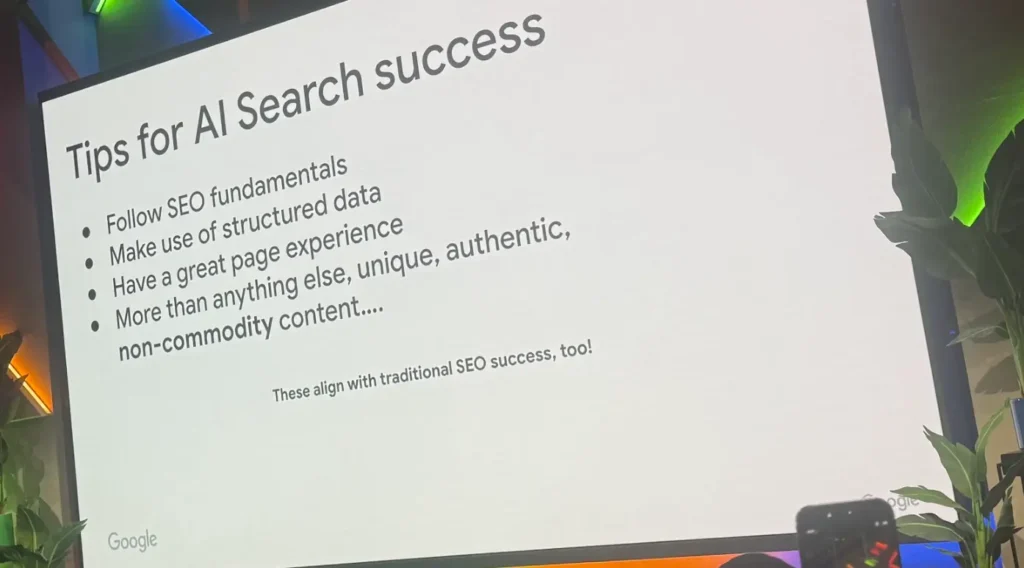
These concepts are visually reinforced in Google’s official presentation slides on “Tips for AI Search success”. Google’s slide explicitly lists “Follow SEO fundamentals”, “Make use of structured data”, and “Have a great page experience” alongside the most crucial tip: “More than anything else, unique, authentic, non-commodity content…” Google’s team made sure to add a punchy sub-note on screen: These align with traditional SEO success, too!
How does Google’s AI search actually decide what to quote?
Google’s AI search decides what to quote by using retrieval-augmented generation to pull real-time results directly from its traditional web search index.
On April 21, 2026, I attended the first-ever Google Search Central Live in Canada, held in Toronto. I sat in a room with Google’s Danny Sullivan, Martin Splitt, and Ryan Levering as they explained how AI-driven search actually operates under the hood. They explained that Google does not rely solely on the pre-trained knowledge of its LLMs. Instead, it uses Retrieval-Augmented Generation (RAG) which means Google performs a traditional search behind the scenes to fetch live, up-to-date web pages from its index, using those pages to synthesize its final AI response.
They also detailed a process called “query fan-out”. In everyday user setups, users are increasingly typing highly conversational, multi-part queries (such as: “How can I optimize my blog content for generative AI tools?” or “What are the best practices for structuring data for AI knowledge bases?”). When a user enters a complex, conversational query like “e-bikes in red for a 5-mile commute with hills,” Google’s AI “fans out” that single prompt into several parallel, simpler searches. It queries terms like “best e-bikes for hills” and “red commuting e-bikes” simultaneously, compiling a singular, cited answer from the best sources across all of them. If your site has structured product feeds, optimized images, and expert reviews, you can capture multiple citations within a single fan-out query.
How do I prepare my website for AI search?
You prepare your website for AI search by executing a clean technical audit, refining your content quality, and implementing robust schema markup.
To execute this strategy successfully, here is what you’ll need:
- Google Search Console access to monitor indexing health and quality signals.
- A text editor to strip out generic, regurgitated advice.
- Google Merchant Center account (crucial for e-commerce brands to power AI product feeds).
- About 2 to 3 hours per page to weave in real-world expert perspectives.
Follow these steps to optimize your site:
Step 1: How do I create non-commodity content that AI must cite?
Create non-commodity content by sharing original datasets, hands-on tests, or unique expert takes that AI models cannot easily replicate.
AI systems love to summarize general knowledge on their own. If you write generic, boring articles, the AI will steal your information, answer the user on Google’s results page, and leave you with zero clicks. This is why educational query coverage has jumped to 83% and B2B tech has hit 82%. To get clicks, you must produce “non-commodity content”.
Let me give you a real example that Google shared on stage in Toronto to contrast the two styles :
- Real Estate Agent: A commodity piece is “7 Tips for First-Time Homebuyers”. A non-commodity piece is “Why We Waived the Inspection (And Saved $15k): A Look Inside the Sewer Line”.
- Running Store: A commodity piece is “Top 10 Things to Consider When Buying Running Shoes”. A non-commodity piece is “Why This Customer’s Shoes Collapsed After 400 Miles: A Wear Pattern Analysis”.
- Interior Designer: A commodity piece is “2026 Kitchen Trends You Need to See”. A non-commodity piece is “Marble vs. Grape Juice: Why I Refused to Install Stone for a Family of Five”.
The mistake I see most often is publishing mass-produced AI fluff and expecting it to earn citations. If a cheap bot can write it, Google will summarize it without giving you a single link.
Step 2: How do I structure my H2 tags and paragraphs for AI?
Structure your H2 tags and paragraphs to provide a clear, logical reading experience for human users first.
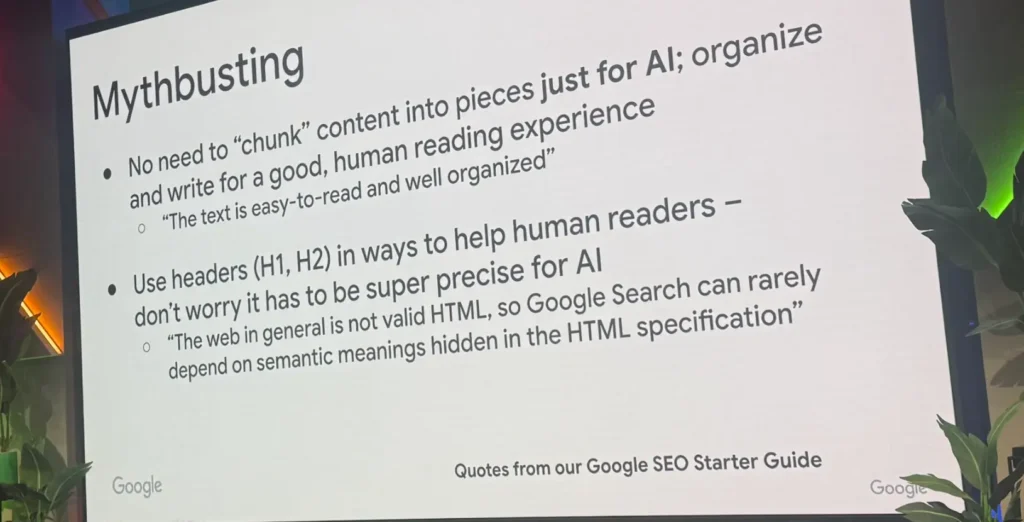
According to Google’s official SEO Starter Guide, you do not need to hyper-optimize your header tags to be super precise for AI systems. Google’s official “Mythbusting” presentation slide from Toronto explicitly dispels this by quoting their own guide: “No need to ‘chunk’ content into pieces just for AI; organize and write for a good, human reading experience.” It further states: “Use headers (H1, H2) in ways to help human readers – don’t worry it has to be super precise for AI. The web in general is not valid HTML, so Google Search can rarely depend on semantic meanings hidden in the HTML specification.”
The mistake I see constantly is “chunking” content into tiny, rigid, unnatural fragments in a desperate bid to help AI understand it. This ruins the human reading experience, which actually signals to Google that your site is low quality.
Quick Win: Go to your top three blog posts, read them on a phone, and break up any paragraph longer than four sentences into two smaller, snappier blocks to instantly improve readability.
Step 3: How do I use structured data as an AI cheat sheet?
Use structured data to explicitly feed accurate information about your products, reviews, and local business directly to search crawlers.
During Search Central Live, one of Google’s engineers debunked the myth that AI makes structured data obsolete. Running massive AI models to predict the price of an item or the rating of a business is incredibly expensive and highly error-prone. Structured data remains a faster, highly precise, and cost-efficient way to tell Google exactly what is on your page.
Let me give you a real-world example from my client work. When I audited a commercial services business, their local pages had zero local business schema and zero citations in AI local packs. Within three weeks of deploying the correct JSON-LD schema and optimizing their Google Business Profile, their AI citation share for “emergency commercial plumbing” jumped by over 40%.
The mistake I see most often is failing to keep schema updated, leading to schema mismatches that destroy trust.
Quick Win: Use a free JSON-LD generator to create and paste LocalBusiness schema into your homepage code in under 5 minutes.
What are the biggest myths about AI search optimization?
The biggest myths about AI search optimization are that you need special markdown files, LLM-specific coding, or to avoid blocking Google’s web crawlers.
The SEO community loves shiny new objects, which means we have seen plenty of useless “hacks” pushed as groundbreaking AI SEO strategies. Let’s call out the worst offenders and look at the actual reality.
Should I rewrite my entire website in Markdown format?
Converting your website to Markdown format does not offer any ranking boost in traditional search or AI search.
- The Myth: Some agencies are charging thousands of dollars to convert standard HTML pages into clean Markdown, claiming that LLMs cannot parse HTML efficiently.
- The Reality: Google is built on crawling raw HTML and does not depend on Markdown or perfect semantic code.
- The Practical Implication: Keep using your standard CMS. Focus on editing your content for quality rather than reformatting code.
Does blocking the Google-Extended bot hurt my AI search presence?
Blocking the Google-Extended bot does not negatively affect your website’s ability to appear in AI Overviews or AI Mode.
- The Myth: Marketers fear that if they block Google-Extended in their robots.txt, Google will ban their site from AI search results.
- The Reality: Blocking Google-Extended only stops Google from using your content to train future versions of Gemini. AI Overviews pull from the live, crawled web index not the pre-trained model meaning your site remains fully eligible for AI citations.
- The Practical Implication: Feel free to block Google-Extended if you want to protect your intellectual property; your search visibility is perfectly safe.
The honest truth: The generative search landscape is still highly volatile, and even the search engines themselves are constantly recalibrating their algorithms. For example, Google’s team admitted they are still actively exploring how to build reliable, standardized AI search reports in Search Console. Third-party GEO tools do not have access to Google’s internal metrics, meaning their “AI optimization scores” are merely guesses. Trust raw data, test your own sites, and never let flashy acronyms distract you from building a great experience for real humans.
Ready to stop chasing shiny AI objects and build a search strategy that actually drives revenue? In my experience, the brands that win this transition are those that focus on real-world expert takes.Connect with me on LinkedIn and let’s whip your site into shape.