Most websites I review do not have a traffic problem. They have a conversion problem. Thousands of visits arrive every month and almost nothing happens, because nobody ever sat down and decided what each page is supposed to make the visitor do. That single question is the starting point of conversion optimization, and it is also the question most site owners skip entirely. This article is my plain-language explanation of the discipline: what conversion optimization actually means, how the rate part works, which tools are worth your attention, and where AI genuinely helps rather than just adding noise.
What Is Website Conversion Optimization?
Website conversion optimization is the practice of increasing the share of your visitors who take a meaningful action. The action itself depends entirely on the business:
- For an online store it is usually a purchase.
- For a service business it might be a quote request, a phone call, or a booked consultation.
- For a publisher it could be a newsletter signup.
The discipline starts by defining those actions clearly, then systematically removing whatever stands between the visitor and the action. That is the whole game, and it is less glamorous than it sounds:
- Clearer headlines
- Faster pages
- Simpler forms
- Stronger proof
- Fewer distractions
What it is not matters just as much. It is not a redesign, and it is not a matter of taste. I have watched businesses spend five figures on a beautiful new website that converted worse than the plain one it replaced, because nobody tested anything and the redesign was driven by opinions in a meeting room. Real conversion optimization is a research discipline:
- You study how visitors actually behave
- You form a hypothesis about what is stopping them
- You test the change against the original
- You let the numbers decide
Opinions are cheap. Tested results are the only currency that counts.
The reason this discipline punches above its weight is simple arithmetic. If your site converts at one percent and you lift it to two percent, you have doubled your revenue without buying a single extra visitor. Paid traffic gets more expensive every year, and organic growth takes months of compounding effort. Conversion work multiplies the value of traffic you already have, which makes it the highest-leverage activity most businesses are ignoring. An SEO audit will tell you where your traffic comes from, but conversion optimization decides what that traffic is actually worth.
What Is Website Conversion Rate Optimization?
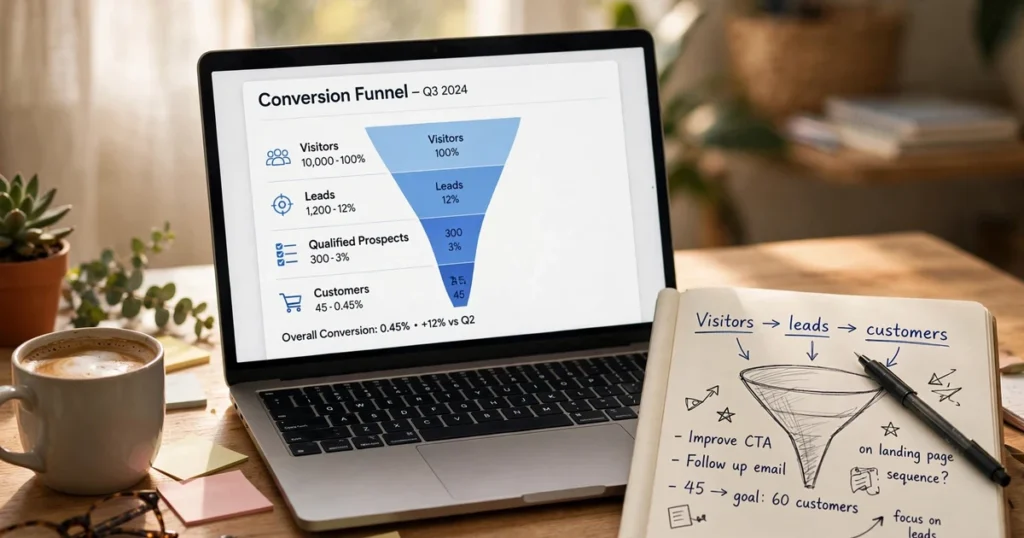
Website conversion rate optimization, usually shortened to CRO, is the formal name for the same discipline, with the emphasis on the rate itself. The conversion rate is simply the number of conversions divided by the number of visitors, expressed as a percentage. One hundred purchases from ten thousand visitors is a one percent conversion rate. The reason practitioners obsess over the rate rather than the raw number of conversions is that the rate isolates the performance of the website from the volume of traffic. If your conversions doubled because you doubled your ad spend, your website did not improve. If your rate moved from one percent to one and a half percent on the same traffic, something real happened on the page, and that improvement compounds every month from here on.
The method behind CRO is controlled testing, most often A/B testing. You show half your visitors the original page and half the variation, then measure which group converts at a higher rate. The part most people get wrong is statistical validity. A test that runs for two days on a site with fifty visitors a day proves nothing, yet businesses declare winners off noise constantly. You need enough traffic for the result to mean something, and you need the discipline to let tests run their course. This is also why the highest-leverage tests come first:
- The offer
- The headline
- The page structure
Testing button colours on a page nobody reads is rearranging furniture in a house with no foundation.
Speed deserves a special mention because it is the silent conversion killer. Slower pages convert worse, and the effect is brutal on mobile, where most browsing now happens. Before you test a single headline, make sure your pages load quickly and render cleanly on a phone. That groundwork is technical SEO as much as it is CRO, and the two disciplines overlap more than most people admit. A fast, crawlable, well-structured page serves both the search engine and the human, and both of them are keeping score.
Best Tools for Website Conversion Optimization?
You need fewer tools than the software vendors want you to believe. The honest starter stack is an analytics platform and a behaviour analytics tool, and both have capable free options:
- Google Analytics 4 tells you what is happening: where visitors land, where they drop off, which pages convert.
- A behaviour tool like Microsoft Clarity, which is free, shows you why it is happening through heatmaps and session recordings.
Watching ten real visitors struggle with your checkout teaches you more in an hour than a month of staring at dashboards. I consider that combination the minimum viable CRO setup for any small business, and the price is right.
When you outgrow the free tier, the next layer is dedicated A/B testing software. The well-known names in this space let you run experiments without deploying code for every variation, which matters because the biggest cost in CRO is usually developer time, not software licences. Ecommerce platforms have their own testing apps too, and they are often the pragmatic choice for store owners who do not have a development team on call. My rule of thumb is simple: do not pay for testing software until you have a backlog of at least a dozen test ideas and enough traffic to get results within a few weeks. Tools do not generate hypotheses. Research does.
One more category worth knowing is the survey and feedback tool. On-site polls that ask a single question at the right moment, such as asking visitors on the pricing page what is holding them back, produce qualitative insight that no amount of click data can replace. Keep the questions short, keep them optional, and actually read the answers. The pattern in the responses usually points straight at your next test.
How to Use AI in Website Conversion Optimization
AI is genuinely useful in CRO, just not in the way the marketing suggests. The strongest use case I have seen is analysis at scale. Session recordings are gold, but nobody has time to watch five hundred of them. AI summaries can surface the recurring friction points across hundreds of sessions in minutes:
- The form field everyone hesitates on
- The section visitors consistently scroll past
- The error message that keeps appearing
Similarly, feeding open-ended survey responses into a language model like ChatGPT or Claude produces a categorized breakdown of objections in a fraction of the time manual tagging takes. This is analysis assistance, and it is excellent, because it compresses the most time-consuming part of the research phase.
The second legitimate use is generating test variations. Once you have a hypothesis, AI can:
- Draft ten headline alternatives
- Rewrite page copy in different tones
- Suggest structural changes based on the friction you found
Treat every suggestion as a starting point, not a finished product. The model does not know your customers, your margins, or your brand voice. Your job is to supply the insight and let the machine multiply your output. Used this way, AI turns one researcher into the equivalent of a small team, which is exactly the kind of leverage small businesses need.
What AI cannot do is tell you what matters to your buyers. No model can interview your customers, feel the hesitation before a purchase, or know which objection is the real one. Personalization engines that adapt pages per visitor are powerful in theory, but they need serious traffic volume to work, which puts them out of reach for most small sites. Keep your expectations grounded: AI is a brilliant assistant and a terrible strategist. The strategy still has to come from you.
Conversion optimization is not complicated, but it is disciplined:
- Define what a conversion means for your business
- Measure the rate honestly
- Research where visitors struggle
- Test one meaningful change at a time
- Let the data decide
Do that consistently for a year and the compounding effect will surprise you. Traffic gets the glory in this industry, but conversions pay the bills, and the businesses that understand that difference are the ones that keep growing when ad costs rise.