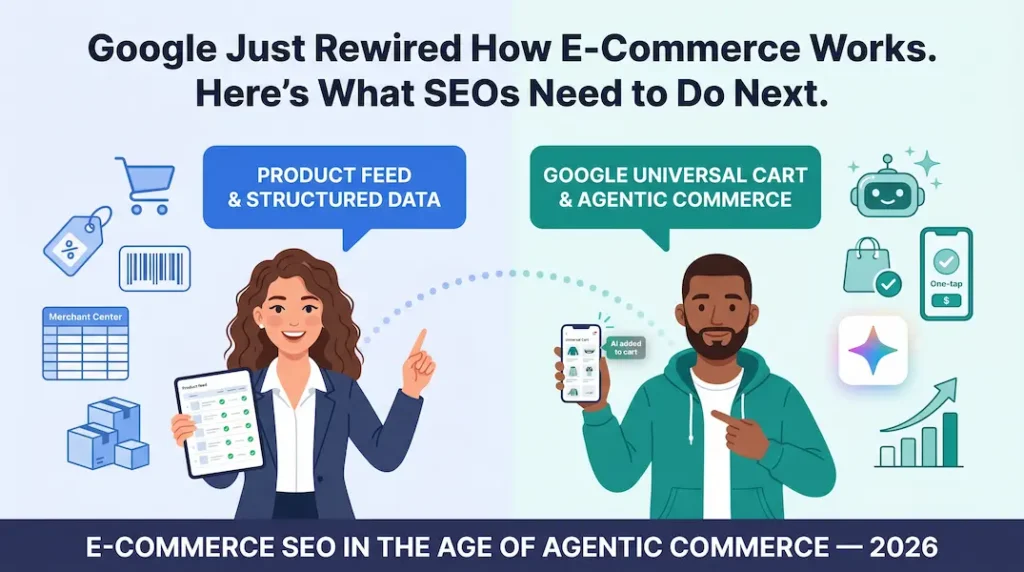
Google Just Rewired How E-Commerce Works, Here’s What SEOs Need to Do Next
Google’s Universal Cart, announced at Google I/O 2026, is a persistent, AI-powered shopping cart that follows users across Search, Gemini, YouTube, and Gmail. It tracks products, monitors prices, alerts on stock changes, and can complete purchases autonomously via the Agent Payments Protocol (AP2). For e-commerce SEO, this changes almost everything about how products get discovered, evaluated, and bought.
I’ve been watching agentic commerce inch forward for two years. But Universal Cart isn’t inching. It’s a full sprint. And the brands that don’t adapt their product data, structured markup, and content strategy now will watch AI agents recommend their competitors instead.
What is Google Universal Cart, and why does it matter for your store?
Google Universal Cart is a single, persistent shopping cart that lives across every Google surface and is powered by AI that actively helps users decide what to buy.
Think of it like a shopping assistant that never clocks out. A user spots a product in a YouTube review, adds it to their Universal Cart, and Gemini starts monitoring the price, checking for deals, comparing alternatives, and flagging when stock drops low. When the user is ready to buy, AP2 Google’s Agent Payments Protocol can complete the transaction without the user ever visiting the merchant’s website.
That last sentence is the one that should get your attention.
According to Google’s I/O 2026 announcement, the Shopping Graph, which powers Universal Cart, already tracks over 60 billion product listings updated in real time. Salsify’s 2026 Consumer Research found that 22% of shoppers already use AI search tools to research new products and brands, and 31% say detailed product descriptions and specifications make them trust AI-generated recommendations enough to buy.
The implication is stark: if your product data isn’t clean, complete, and machine-readable, Universal Cart’s AI won’t recommend your product. It will recommend the one it can actually read.
What Universal Cart tracks and acts on:
- Price changes: monitors drops and notifies the user proactively
- Stock availability: alerts when an item is back in stock
- Deal matching: surfaces coupons, bundles, and promotional pricing
- Compatibility checks: cross-references related products that a user is considering
- Autonomous checkout: completes purchases via AP2 when the user has pre-authorized payment
How does Universal Cart decide which products to surface and which to ignore?
Universal Cart pulls directly from Google Merchant Center feeds and your on-page structured data, so the quality of your product data feed is now a direct ranking factor for AI-assisted purchases.
This is the part most e-commerce teams haven’t fully processed yet. Universal Cart isn’t crawling your beautifully designed product page and inferring information. It’s reading your Merchant Center feed and your Product schema. If those two sources are incomplete, inconsistent, or stale, the AI has nothing to work with.
SEO expert Aleyda Solís put it plainly after the I/O 2026 announcement: AI shopping will increasingly be decided by whether your product data is understandable, reliable, and actionable enough to work across AI-assisted shopping journeys.
Here’s something I see constantly when auditing e-commerce clients. A brand has a polished storefront, great photography, and strong copy, but their Merchant Center feed hasn’t been updated in three weeks, their Product schema is missing half the attributes, and their JS-heavy product pages make it genuinely difficult for Google’s AI to extract pricing or availability. They wonder why their organic visibility is flat. The answer is in the data layer, not the design.
Let me put it in plain terms: if Google’s AI can’t read your product data clearly, it won’t put your product in the cart.
What does traditional e-commerce SEO look like versus AI-optimized product data?
Traditional e-commerce SEO optimized for crawlability and keyword placement. AI-optimized e-commerce SEO optimizes for data completeness, feed freshness, and structured attribute coverage.
Both are still necessary. But the weight has shifted.
| Signal | Traditional E-Commerce SEO | AI-Optimized E-Commerce SEO |
|---|---|---|
| Primary goal | Rank product pages for keywords | Make product data readable by AI agents |
| Key asset | On-page copy and meta tags | Merchant Center feed + Product schema |
| Update frequency | Weekly or monthly | Real-time or daily for price/stock |
| Content focus | Keywords in title and description | Attribute completeness (specs, materials, compatibility) |
| Link building | Domain authority through backlinks | Brand mentions and review signals for E-E-A-T |
| JS handling | Render correctly for Googlebot | Strip JS barriers from all product data extraction paths |
| Best for | Organic ranking on desktop SERPs | AI Overview citations, Universal Cart eligibility, agentic purchases |
Google AI Overviews now appear in over 25% of all U.S. searches and in 14% of shopping queries. For “best [product]” searches, that figure jumps to 83% (EvolveAMZ, 2026). Brands that earn a citation in an AI Overview see 35% more organic clicks and conversion rates 5x higher than traditional organic results.
The table above isn’t “old way vs. new way.” It’s “foundation vs. the layer you’re missing.”
How do I actually optimize my e-commerce store for Universal Cart and AI search in 2026?
Start with Google Merchant Center feed hygiene, then layer in Product schema, then fix any JavaScript barriers in that order.
What you’ll need:
- Google Merchant Center access (feed management)
- A schema implementation method (Yoast, RankMath, or JSON-LD in theme)
- A technical SEO crawl tool (Screaming Frog, Sitebulb, or Ahrefs Site Audit)
- Estimated time: 3-5 hours for initial audit, ongoing for feed maintenance
Step 1: How do I make my Merchant Center feed AI-ready?
Audit your feed for the six attributes that Universal Cart relies on most, and ensure all six are accurate, complete, and updated at least daily.
The six non-negotiable feed attributes in 2026:
- Price: must match the live page price exactly. Mismatches trigger feed disapprovals and kill AI eligibility.
- Availability: in_stock, out_of_stock, or preorder must be real-time accurate
- Shipping: estimated delivery windows, not just carrier names
- Returns: return window and policy in structured format
- Product identifiers: GTIN, MPN, and brand must be present and correct
- Condition: new, refurbished, or used must be explicitly declared
The mistake I see most is that teams treat Merchant Center as a one-time setup. Universal Cart’s AI is reading this feed in real time. If a product goes out of stock and your feed takes 48 hours to reflect that, the AI will recommend a competitor whose feed updates hourly.
POV: In Merchant Center, go to Products → Diagnostics. Sort by “Affected items” descending. Fix the top three reasons for disapproval first; in most accounts I audit, these three account for over 70% of all feed issues.
Step 2: How do I add the right structured data for AI-powered product discovery?
Implement the Product schema with full attribute markup on every product page, including price, availability, reviews, and product identifiers, and add the BreadcrumbList schema to category pages.
Here is the schema stack I implement for every e-commerce client targeting AI shopping surfaces:
- Product schema: name, description, image, sku, gtin, brand, offers (with price, priceCurrency, availability, url), aggregateRating
- Review schema: individual Review entities within the Product schema for E-E-A-T reinforcement
- BreadcrumbList schema: on every PDP and category page to help AI map site structure
- FAQPage schema: on buying guide and category pages. Note: Google discontinued FAQ rich results in May 2026, but the FAQ schema still aids AI extractability for Universal Cart context
POV: Run your top 10 product URLs through Google’s Rich Results Test. Any missing offers properties are your first fix; that’s the data Universal Cart needs most to function.
Step 3: How do I fix JavaScript barriers that block AI from reading my product data?
Audit every PDP for JS-rendered price, stock, and spec content and move those elements to server-side rendering so AI agents can extract them without executing JavaScript.
Universal Cart’s AI, like Googlebot, struggles to extract product data that only appears after JavaScript executes. Price loaded via a client-side API call. Stock status updated by a React component. Specs revealed by a tab interaction. All of these are invisible to AI agents that need the data immediately.
The fix is not a full site rewrite. Target the specific data points Universal Cart needs:
- Price and availability: must be in the initial HTML response, not loaded by JS
- Product specifications: move key specs out of JS tabs into static HTML sections
- Shipping and returns: render these server-side on every PDP
- Schema markup: always implement as static JSON-LD in the <head>, never dynamically injected
What are most e-commerce SEOs getting wrong about Universal Cart and AI shopping?
Most e-commerce SEOs are optimizing for AI Overview citations when they should also be optimizing for AI agent eligibility, two different things with two different requirements.
Getting cited in an AI Overview is a content and authority problem. Getting your products into Universal Cart is a data and feed problem. Both matter. Most teams are focused entirely on the first and ignoring the second.
Here’s the data that should shift priorities. Brands cited in AI Overviews earn 35% more organic clicks. But Universal Cart enables AI agents to complete purchases autonomously, meaning your product doesn’t need a click at all. The agent adds it to the cart, the user approves, and AP2 processes the payment. Zero clicks. Full conversion.
According to EvolveAMZ’s 2026 e-commerce AI analysis, the share of e-commerce queries triggering an AI Overview grew 5.6x in four months alone. That growth curve doesn’t slow down. Brands building AI-readable product data are now building a compounding advantage. The brands waiting are watching their click-through rates fall and calling it “an algorithm update.”
The other mistake: treating buying guides and comparison content as a nice-to-have. Aleyda Solís specifically flagged comparison, compatibility, and buying-guide content as a Universal Cart optimization priority. When Google’s AI is deciding between two products for a user’s cart, it draws on content that helps it compare, not just the product pages themselves. If your category pages are a grid of images and prices, the AI has nothing to work with.
If you want a product data audit or a structured data review for your e-commerce store, connect with me on LinkedIn. This is exactly the kind of work I do.