AEO & GEO in 2026: The Deep Dive Framework for Getting Cited by AI
Answer Engine Optimization and Generative Engine Optimization have moved from buzzwords to measurable disciplines with documented frameworks, peer-reviewed research, and real performance benchmarks. Gartner forecasts that traditional search volume will drop by 25% by the end of 2026 as users shift to AI chatbots and virtual agents (Gartner, 2022 prediction, directionally confirmed by 2026 data). Google AI Mode has already reached 75 million daily active users (Digital Applied, March 2026). Nearly 60% of Google searches end without a website visit (SparkToro/Similarweb, 2026). If you are still optimizing only for blue-link rankings, you are optimizing for the shrinking half of the market.
Here is the full 2026 AEO and GEO playbook: what each discipline covers, which frameworks work, and a 7-step action plan grounded in sourced data.
What are AEO and GEO, and are they actually different things?
AEO and GEO are related but distinct: AEO focuses on structuring individual pages for AI extraction, while GEO focuses on managing your entire digital presence for citations across all AI platforms.
The clearest way to understand the difference is by output. AEO asks: can an AI pull a clean, accurate answer from this specific page? GEO asks: When someone asks ChatGPT, Perplexity, Google AI Mode, Claude, or Gemini a question in your category, does your brand appear in the answer, and does it appear positively?
| Dimension | AEO | GEO |
|---|---|---|
| Goal | Get a specific page extracted and cited as an answer | Get your brand mentioned across all AI answer surfaces |
| Primary focus | Content structure, extractability, schema | Entity authority, platform presence, community signals |
| Key metric | Citation frequency per page | Share of Model brand mentions across AI platforms |
| Core tactic | Inverted pyramid, question-format headings, FAQPage schema | Entity consistency, community presence, original research |
| Scope | Page-level optimization | Whole-brand, multi-platform optimization |
| AI surfaces | Primarily Google AI Overviews and AI Mode | ChatGPT, Perplexity, Claude, Gemini, Copilot, AI Overviews |
The relationship matters: AEO is a subset of GEO. Strong AEO is the page-level foundation. GEO is the broader architecture that gets your brand into AI answers even on platforms that never crawled your site, because those platforms encountered your brand in training data on Reddit, YouTube, Wikipedia, and trusted editorial sources.
Google confirmed this in its May 15, 2026 official guide: “Optimizing for generative AI search is optimizing for the search experience, and thus still SEO.” That means the foundation is the same. The scope has expanded.
What does the data actually say about how AI picks its citations?
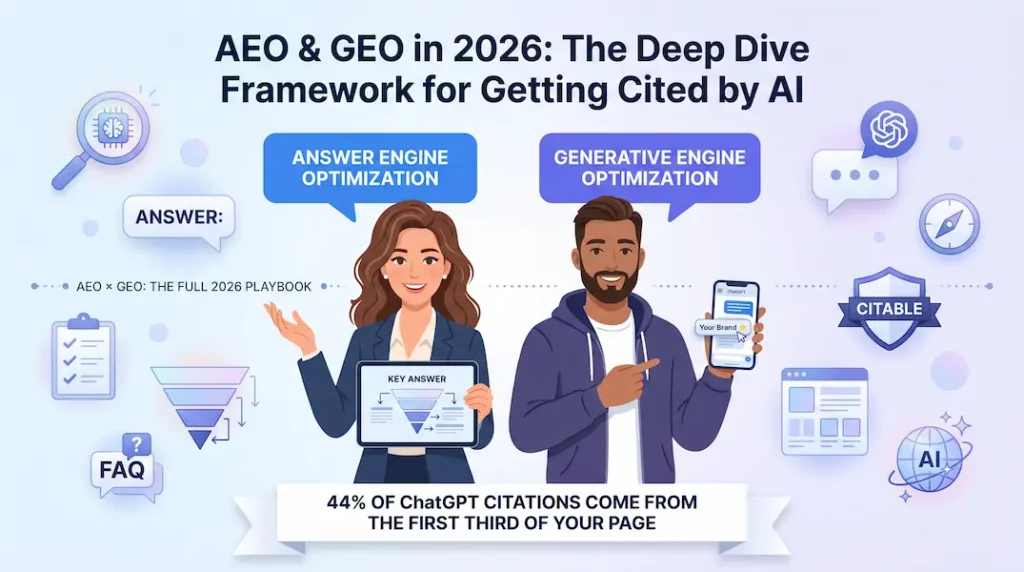
AI systems cite the beginning of your content 44% of ChatGPT’s citations come from the first third of a page, and top organic rankings no longer reliably predict AI visibility.
The two most important AEO data points in 2026:
An analysis of 1.2 million ChatGPT citations across 18,012 verified pages, published by Search Engine Land in February 2026, found that 44% of citations appeared in the first third of the page. The researchers described a consistent “ski ramp” pattern: claim density and citation probability drop sharply after the first 30% of a document. If your key answer is buried in paragraph four, it is 2.5 times less likely to be cited than if it appears in the opening block (Search Engine Land, February 2026).
The organic rankings-to-AI-citations link has also broken down significantly. Top-10 organic rankers accounted for roughly 76% of AI Overview citations in mid-2025. That figure dropped to approximately 38% by early 2026, according to Evergreen Media analysis (Evergreen Media, February 2026). The overlap between AI citations and Google’s top 10 results is only about 12% overall; for ChatGPT specifically, it’s closer to 8%. Strong traditional rankings remain helpful; they are one of several inputs, but they are no longer a proxy for AI visibility.
Three additional data points that change how you should structure content:
- AirOps analyzed 548,534 pages ChatGPT retrieved. Only 15% made it into a final answer, meaning retrieval and citation are two separate events. ChatGPT read your page. Then cited someone else. The differentiator is almost always content structure (Authority Tech, March 2026)
- AI Mode reached 75 million daily active users by March 2026: a 4x increase from its May 2025 launch. It operates across 53 languages and 40+ markets. AI Mode AI Overview ads now appear in 25.5% of AI results, up 394% year-over-year (Digital Applied, March 2026)
- ChatGPT processes approximately 1.6 billion daily queries: roughly 12% of Google’s volume but sends significantly less referral traffic. Its click-through rates sit below 1% versus approximately 29.2% for traditional Google search, making citation frequency a brand signal even when it drives no direct traffic (Digital Applied, April 2026)
Here’s something I noticed in practice: when I ran a citation audit for a supplement e-commerce client against a competitor with nearly identical domain authority, the competitor earned 8x more AI Overview citations. When I pulled the pages being cited, every single one opened with a direct, standalone answer sentence under 40 words before any brand context or product framing. My client’s pages opened with brand narrative. Same authority. Completely different extractability.
What is the AEO implementation framework and in what order does it work?
AEO implementation follows a five-step sequence: audit, restructure, create, build authority, then measure and iterate.
Five-step AEO implementation framework for 2026:
Step 1: Audit your current AI visibility baseline. Before optimizing anything, establish where you stand. Use tools like Peec AI, Profound, or Otterly to query your top 20 category prompts across ChatGPT, Perplexity, and Google AI Overviews. Record which brands are cited and how often yours appears. This is your Share of Model baseline. The mistake most teams make: starting with content rewrites before knowing which pages are already being cited and which queries are citation gaps.
Step 2: Restructure existing pages for extractability. Apply the inverted pyramid to every major section on your high-traffic pages. The first sentence answers the heading’s question completely, in under 40 words. Supporting detail follows. For ChatGPT specifically, this restructuring directly addresses the 44% first-third citation bias. If your answer is front-loaded, you are already in the zone where most citations happen.
Step 3: Create answer-ready content formats. The content formats AI systems most consistently surface in 2026 are:
- FAQ sections with FAQPage schema, minimum 5 Q&A pairs per page, 10+ per key topic area
- Comparison posts: “X vs. Y” format, structured with a summary table and a direct recommendation sentence
- “What to look for” guides: decision-support content that matches how AI systems answer “what should I consider when choosing…?” queries
- How-to content with HowTo schema numbered steps, each with a one-sentence explanation
Step 4: Build external authority signals. AI platforms cite brands they encounter consistently across trusted surfaces. Identify the three platforms your target AI engine most often cites in your category, and build a genuine presence on them. For most categories: Reddit (authentic community participation), YouTube (topically relevant video with transcripts), and at least one category-specific review or listing platform (G2, Trustpilot, Capterra, Yelp depending on vertical). Earned editorial coverage on industry publications is the highest-value signal; it appears in training data, not just crawl data.
Step 5: Track and iterate on a 90-day cycle. Citation rates, brand mentions, and AI-driven referral traffic (via a GA4 custom LLM channel group) are your core AEO KPIs. Refresh underperforming pages by adding a newer statistic, tightening the opening 40 words, or adding a missing FAQ block. Google Search Console’s Generative AI Performance Report (launched June 3, 2026) gives you first-party impression data for Google’s own AI surfaces.
What is the GEO content architecture and what does it look like on the page?
GEO content architecture is the structural system that makes every page extractable, every entity verifiable, and every section quotable by AI systems working through RAG (Retrieval-Augmented Generation).
RAG is how most AI platforms work: they retrieve relevant content from the web and then generate an answer using what they find. For your content to survive the retrieval-to-citation step, it must be structured in readable, self-contained blocks that each answer a specific question without requiring context from the surrounding paragraphs.
GEO content architecture standards for 2026:
| Element | Best Practice | Why It Matters |
|---|---|---|
| Answer blocks | 200-400 word extractable units per section | RAG systems pull individual blocks, not full pages |
| Opening | 2-3 sentence BLUF (Bottom Line Up Front) per page and per major section | ChatGPT cites first-third content at a 44% rate |
| Headings | Question-format H2/H3 aligned with natural language prompts | AI systems are trained on Q&A; question headings improve extraction |
| FAQs | Minimum 5 Q&A per page with FAQPage schema; 10+ per key topic area | FAQ format is structurally aligned with AI answer generation |
| Schema | FAQPage + HowTo + Article + Author on all key pages | Structured data reduces ambiguity and confirms entity relationships |
| Statistics | Cited with source name, date, and URL; refreshed every 90 days | Named-source data boosts citation probability (Princeton GEO paper, KDD 2024) |
| Server rendering | Prefer SSR or SSG; avoid client-side JS for key content | AI crawlers largely do not execute JavaScript |
| Freshness | Implement dateModified in JSON-LD; update core pages quarterly | Content freshness is confirmed citation signal across AI platforms |
The CITABLE framework (Discovered Labs, 2026) provides a useful checklist for reviewing any page against GEO standards:
- C: Clear entity and structure (BLUF opening on every page and every major section)
- I: Intent architecture (main conversion question + adjacent buyer research questions as headings)
- T: Third-party validation (reviews, community mentions, expert citations on trusted platforms)
- A: Answer grounding (verifiable facts with sourced, dated statistics)
- B: Block-structured for RAG (200–400 word self-contained sections per topic)
- L: Linked internally (maps entity relationships and topic clusters for AI systems)
- E: Engagement signals (UGC, forum presence, positive sentiment on third-party platforms)
In my view, the two highest-leverage elements in the CITABLE framework are A (answer grounding with statistics) and B (block-structured RAG-ready sections). The Princeton GEO research (Aggarwal et al., KDD 2024) confirmed that adding statistics is the single tactic that consistently improves AI citation rates across all platforms, validated independently on 3,205 real pages in 2026, post-Princeton analysis. Block structuring is what allows those statistics to be extracted cleanly. Everything else builds on those two foundations.
So what should I actually do about this?
- Front-load every key page with a 2-3 sentence direct answer in the first 40 words. The Search Engine Land/AirOps analysis of 1.2 million ChatGPT citations is unambiguous: 44% of citations come from content in the first third of a page. If your opening paragraph is brand introduction, context-setting, or keyword padding before the actual answer, you are conceding the majority of citation probability to competitors who answer first. Rewrite the opening of your 10 highest-traffic pages this week.
The mistake: treating the first paragraph as brand-storytelling real estate rather than AI-extraction real estate.
- Set up a Share-of-Model tracking routine across five AI platforms. Pick your top 10 category queries and test them monthly in ChatGPT, Perplexity, Google AI Overviews, Gemini, and Bing Copilot. Record who is cited, how often, and what they say. Track your brand’s citation frequency as a percentage of total citation opportunities. This is your AEO/GEO KPI, and it is currently invisible to most teams because they are still measuring only rankings and sessions.
The mistake: measuring traditional rankings as a proxy for AI visibility when the citation overlap is below 15%.
- Structure each page section as a 200-400-word self-contained block. RAG systems extract blocks, not pages. Each section should open with its answer, deliver the supporting evidence, and conclude without requiring the reader to have read the previous section. If a section requires prior context to make sense, it is not RAG-ready. Audit your money pages using the CITABLE checklist (Discovered Labs, 2026), focusing first on the B (block-structured) and A (answer grounding) elements.
The mistake: writing for a human narrative reading experience rather than for modular AI extraction.
- Add an FAQPage schema with at least 10 questions per key topic area. AI tools are built as question-answer systems. FAQPage schema directly maps your content to the Q&A format AI retrieval uses. Write the questions in natural language, exactly as your audience would phrase them in ChatGPT or a voice search query, not keyword-dense phrasing. Validate every implementation in Google’s Rich Results Test before publishing.
The mistake: adding FAQ sections as thin filler content with two generic questions rather than as a structured 10+ Q&A corpus per topic.
- Add dated, named-source statistics to every major section. Princeton’s GEO paper (KDD 2024), validated on 3,205 real pages in 2026, found that adding statistics is the single most reliable tactic for improving AI citation rates. Every major claim on your key pages should have a number, a named source, and a date. “Studies suggest…” is not a stat. “ChatGPT citations come from the first third of content in 44% of cases (Search Engine Land, February 2026)” is a citable stat. Go through your top 10 pages and identify every claim currently stated without a number; that is your AEO gap list.
The mistake: updating statistics only when refreshing full articles rather than maintaining a living stat layer on every high-value page.
- Build or deepen active presence on the two platforms your target AI engine most cites for your category. Check your manual AI citation audits (from Step 2) and note which platforms appear most in citations for your category. For most brands in 2026, this means Reddit and YouTube. For supplements and health brands, it also means bodybuilding forums and Examine.com discussions. For real estate, local community platforms and Google Business Profile Q&A. Genuine community participation earns citations. Promotional posts earn bans.
The mistake: treating platform presence as a secondary brand awareness activity rather than a primary citation-infrastructure investment.
- Connect GA4 LLM referral tracking to your monthly reporting before traffic volume justifies it. Create a custom channel group in GA4 that captures sessions from chatgpt.com, perplexity.ai, claude.ai, gemini.google.com, bing.com/chat, and copilot.microsoft.com. Even at 1–2% of total traffic today, this channel is growing. The data you capture in Q3 2026 becomes the trend line that proves AEO ROI in Q1 2027, as shown in client reviews.
The mistake: waiting until AI referral traffic becomes “significant enough to report”; by that point, you have 12 months of missing baseline data and no story to tell.
I track AEO and GEO performance across clients in supplements, real estate, and commercial services, and I post what the data is actually showing on LinkedIn. If you are building these frameworks into your client programmes or internal strategy, connect with me there.