
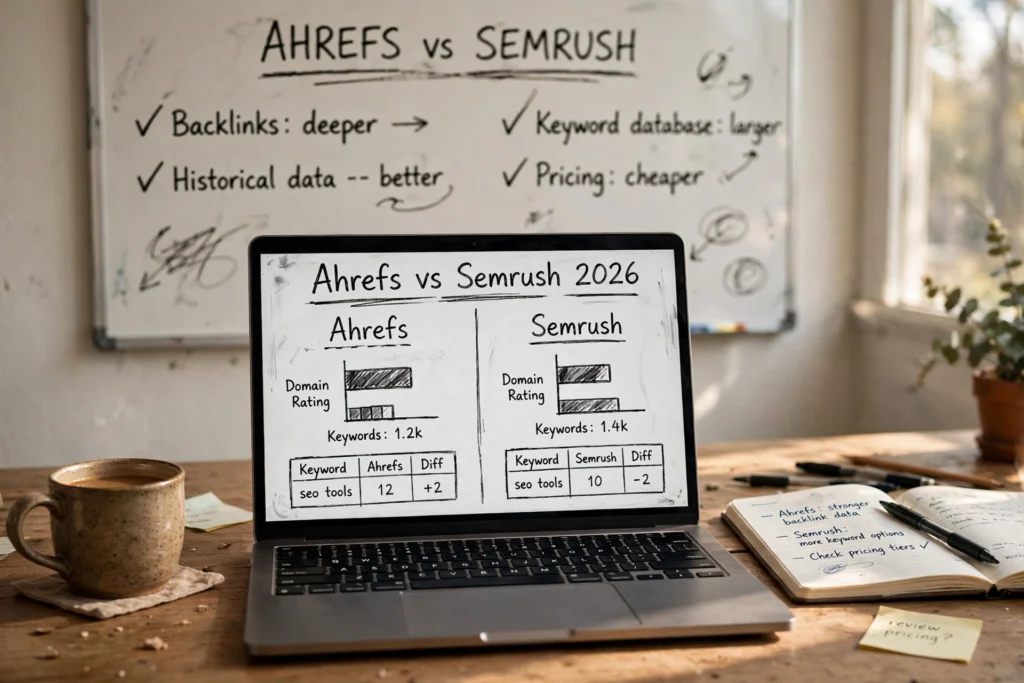
Ahrefs vs Semrush is the oldest argument in SEO, and it got strange this year. One of them now belongs to Adobe. The other rebuilt its pricing around a $29 entry plan and bolted on an AI visibility product that costs more than the base subscription. And underneath both of them, Google quietly made rank tracking harder and more expensive twice in two years. So the comparison that mattered in 2023 does not quite hold in 2026, because the two products are no longer really the same kind of thing.
I spent the research for this piece across the pricing pages, the review aggregators, practitioner threads, and the 2026 reviews that actually dug into the details. Everything here is public information, framed as my read on it. I am not claiming I ran controlled head-to-head tests inside both dashboards, and I will be straight about where each tool is genuinely better rather than declaring a universal winner. There is not one. There is a right tool for your situation, and the two diverge faster the further you look past the core feature lists.
One thing to know up front. Semrush’s pricing lineup is in flux as I write this. Multiple 2026 sources describe both the classic Pro, Guru, and Business tiers and a newer bundled lineup under the Semrush One name, with different prices quoted per source. The figures below are the best current snapshots I could verify in early October 2026. Check the live pricing page before you buy, because this one moves.
Pricing and plans compared
This is where the two companies have taken opposite bets, and the difference is bigger than it looks.
Ahrefs runs five paid tiers. Starter at $29 a month is the headline: the cheapest legitimate entry into either suite, aimed at freelancers and very small operations. Then Lite at $129 a month, Standard at $249, Advanced at $449, and Enterprise at $1,499 on annual commitment. Every plan includes one user seat, and the whole system is credit-based. Lite includes 1,000 credits per user and 200K API units a month, and Standard and Advanced scale up from there. Extra users run $40 to $60 a month depending on tier. There is no free trial, and Ahrefs states plainly that it never runs discounts. There is a free plan for verified sites carrying the Webmaster Tools lineage, with limited Site Explorer, a 5,000 crawl-credit monthly site audit, and a handful of free tools, which is a decent foot in the door for a small site.
Semrush’s classic ladder starts much higher. Pro at $139.95 a month, Guru at $249.95, Business at $499.95, with annual discounts roughly equivalent to two months off. There is a limited free account and a 7-day trial on the paid tiers. The newer Semrush One lineup reported in recent months bundles SEO with AI visibility: SEO at $139, Starter at $199 with 50 AI prompts, Pro+ at $299 with 100 prompts, Advanced at $549 with 200 prompts. Extra users are pricier than Ahrefs, running $45 to $100 a month per seat depending on tier.
The honest read on pricing: if you are solo and cost-conscious, Ahrefs’ $29 Starter is the only way into either ecosystem without spending over $100 a month. If you need a second seat, Semrush gets expensive fast, because the per-user add-on pricing is steeper. And if AI visibility tracking matters to you, do not compare the base plans at all. Compare the bundled cost of base plan plus AI add-on, because that is what you will actually pay.
Failon’s POV: Ahrefs wins the pricing conversation for solos and small teams, mostly because of that $29 entry and gentler per-seat pricing. Semrush’s lineup is more confusing right now than it should be, and the moving prices mean you should negotiate from the live page, not from any review you read. Neither tool is cheap at the professional tiers, so price your choice against the work you will actually do every week, not the features you might touch twice a year.
Head-to-head: keyword data, backlink index, site audit
Strip away the marketing and both tools sell three things: keyword data, link data, and site auditing. Here is where they genuinely diverge.
On keyword databases, the headline numbers are effectively a tie and should be treated as vendor claims, not audited fact. Ahrefs reports 28.7 billion filtered keywords across 217 locations. Semrush reports 28.8 billion keywords across 142 geo databases. Practitioners who dig deeper tend to note that Semrush’s US desktop database is larger than Ahrefs’ US total, which matters if your market is American. The practical takeaway from the reviews: both databases are deep enough that keyword coverage is rarely the reason to pick one over the other. What differs is the interface around it. Reddit practitioners consistently call Ahrefs’ UI cleaner and faster to work in, while Semrush’s Keyword Magic Tool and broader marketing workflow integration win fans on the agency side.
On backlink data, this is the least controversial call in the comparison. Ahrefs’ index runs to 35 trillion live backlinks refreshed every 15 to 30 minutes, with its crawler chewing through 5 million pages a minute. Semrush claims 43 trillion backlinks across 390 million referring domains. The vendor numbers point in different directions, but practitioner consensus is steady: Ahrefs wins backlink data and it is not close. If link prospecting, competitor link gap analysis, and broken-link building are your daily work, Ahrefs is the tool built for that job. Semrush’s link data is fine for general use, but it is not the reason anyone buys Semrush.
On site auditing, the comparison comes down to crawl limits and workflow. Semrush allows 100K pages a month on Pro, 300K on Guru, and 1M on Business, with the audit folded into a broader marketing suite that includes the on-page SEO checker and content tooling. Ahrefs runs on crawl credits: 10K on Lite, 500K on Standard, 1.5M on Advanced. The audits themselves are both competent, and both catch the standard technical issues. The differentiator is what surrounds the audit. Semrush wraps it in content and reporting workflows aimed at teams. Ahrefs keeps it tighter and more SEO-pure.
Failon’s POV: Pick the tool that matches your heaviest workload. Link research as a daily driver means Ahrefs, no real debate. Keyword research and agency reporting at scale mean Semrush earns its keep. Anyone telling you one tool is universally better on data is selling something. Match the database to the work.
The num=100 fallout: what Google broke, and how each tool coped
This is the section most comparisons skip, and in 2026 it matters more than any feature list. Google killed the &num=100 parameter around September 2025, unannounced. That parameter let tools pull 100 results in a single SERP request. Without it, every rank tracker had to work harder and spend more to report the same depth.
Here is how each vendor responded, based on the public record. Semrush confirmed roughly a tenfold operational cost increase within a day, and kept top-10 and top-20 tracking intact through the disruption. Ahrefs initially fell back to first-page-only tracking, positions 1 through 10, and restored top-100 tracking at the end of October 2025 without disclosing the method. So if rank-tracking depth is your comparison criterion, the record is clear: Ahrefs visibly stumbled here while Semrush held.
Then came a second wave. In August and September 2026, Google rolled out google.com/goto redirect rewriting of all result links, confirmed as an anti-abuse measure. Trackers can no longer read destination URLs from the markup, and per Nozzle CEO Derek Perkins, resolving all links for a single five-page ranking now takes 500 to 1,000 requests per query. That is fresh cost pressure on every rank tracker, layered on top of the 2025 fallout.
Now the practitioner’s counter-take, and this one matters for how you read the whole comparison. A 319-site study found 87.7% of sites lost GSC impressions and 77.6% lost unique keywords after the num=100 change, concentrated in short and mid-tail terms, while average position actually improved because deep-page bot and tool impressions dropped out. And October 2026 is the first month with a clean apples-to-apples year-over-year comparison in Search Console. Anyone who compared 2025 keyword counts or GSC impressions year over year without knowing about the num=100 cut was misreading a measurement change as a ranking change. This ties directly to my share-of-voice work: visibility and keyword counts dropped for measurement reasons, not ranking reasons. Only the top 20 positions generate traffic anyway, so the honest adjustment is to target the top 20 from the start, and both tools’ top-20 coverage is the part worth comparing. Treat anything past position 20 in any tracker as directional, not data.
Failon’s POV: Semrush handled the num=100 shock better, and that tells you something real about operational resilience. But the bigger lesson is methodological. If your reporting still leans on total keyword counts and third-party visibility scores, you are measuring tool coverage, not performance. Keep rank tracking for positions 1 to 10, treat the rest as directional, and compare both tools on top-20 depth rather than top-100 theatre.
The 2026 twist: AI visibility features compared
Both companies now sell AI visibility tracking, and both charge for it as an add-on rather than including it. This is the newest and most expensive part of the comparison.
Ahrefs Brand Radar gives a 360-degree view of brand presence across AI search engines, built on a database of roughly 450 million search-backed monthly prompts. It reports mentions, citations, impressions weighted by search volume, and AI share of voice, with an AI Visibility Index for market-wide research, custom prompts for your own queries, competitor benchmarking, and citation discovery. Engines covered: Google AI Overviews, Google AI Mode, ChatGPT, Perplexity, Gemini, Microsoft Copilot, and Grok. Note the gap: Claude is not natively indexed. It is a paid add-on on every plan: the AI Visibility Index runs $199 a month per AI platform or $699 a month for all six, and custom prompt packages start at $50 a month. Paid plans include only a small daily quota, 5 to 20 prompts a day depending on tier.
The Semrush AI Visibility Toolkit scores AI visibility 0 to 100 by LLM and country, updated daily, with prompt research covering volume, difficulty, and intent, daily prompt tracking inside Position Tracking, brand performance with sentiment narratives updated weekly, competitor tracking up to 50 competitors, and an AI-readiness site audit checking schema, llms.txt, and AI-crawler blockers. Engines covered: ChatGPT, Google AI Mode, Google AI Overviews, Perplexity, and Gemini, with Claude added more recently. Standalone pricing is $99 a month per domain for 25 tracked prompts daily, or bundled into the Semrush One tiers at $199, $299, and $549.
The honest comparison: Semrush’s bundle is cheaper for getting started with AI visibility, and its per-domain add-on pricing is simpler to reason about. Ahrefs’ Brand Radar has the deeper prompt database and the more SEO-native metrics, but the realistic full setup cost runs roughly $830 to $1,150 a month per independent reviewers, which puts it firmly in agency and enterprise territory. And the recurring practitioner take: for AI visibility specifically, neither suite product wins outright. A dedicated tool does more. I covered those in my first article in this series.
Failon’s POV: If you want AI visibility inside your existing suite subscription, Semrush’s bundle gets you in cheaper. If you are already deep in Ahrefs and want the richest prompt-level data, Brand Radar is the more serious product but at a serious price. For most teams, the right move is neither: run your SEO suite for SEO, and buy a dedicated AI visibility tool for AI visibility. Bundling is convenient. It is not always better.
What Adobe’s $1.9 billion Semrush acquisition means for buyers
Verified and worth stating plainly: Adobe acquired Semrush for $1.9 billion, announced November 2025 at $12 a share, and the deal closed in April 2026. Semrush is delisted and now operates inside Adobe’s Experience Cloud. Adobe’s stated play is fusing Semrush’s SEO and AI-visibility data into Experience Manager, Analytics, its LLM Optimizer, Commerce, and Brand Concierge, positioning Semrush as the brand-visibility layer for AI and agentic search.
What does that mean for you as a buyer? The optimistic read: deeper integration with enterprise marketing stacks and real investment in AI visibility tooling, backed by Adobe’s resources. The watch-out, voiced by practitioners: once the deal closes, the roadmap answers to an enterprise profit and loss, not an agency one. If you are a solo or small agency, watch whether pricing, packaging, and the features you rely on drift toward enterprise buyers over the next two years. Ahrefs, still independent, has no such overhang, which is a genuine structural difference worth weighing.
Where both tools nickel-and-dime you
Both companies have moved toward credit-based and add-on pricing, and you should go in with eyes open.
Ahrefs is explicit about it: every plan runs on credits, the $29 Starter is the most constrained, extra users cost $40 to $60 a month, and Brand Radar is entirely separate. Heavy or automated use of certain tools draws from the monthly credit pool, and the API units scale hard with tier. Budget the add-ons you will actually use, not just the base plan.
Semrush’s nickel-and-diming is more scattered: pricier extra user seats at $45 to $100 a month, white-label report packs, the AI Visibility Toolkit at $99 per domain per month as a standalone, and add-ons for trends, local SEO, and extra prompts. The new bundled lineup simplifies some of this, but the flux in the lineup itself is a cost: you cannot confidently budget a tool whose packaging is being rewritten.
Who should still consider Moz or SE Ranking instead
Not everyone needs a $249-a-month suite. Two alternatives keep showing up in 2026 comparisons for good reason.
SE Ranking starts at $65 a month ($52 on annual) and practitioners consistently call it the best feature-to-price ratio in the category, roughly 70 to 80% cheaper than Semrush for a similar all-in-one stack. Its AI visibility tracker includes daily prompt sampling, and it carries a 4.8 on G2. If you want the Semrush shape of product at a fraction of the price, start here.
Moz Pro starts at $49 a month ($39 annual) and remains the gentlest learning curve of any major suite, with the best educational content. Domain Authority is still the most widely recognized third-party authority metric in the industry, and every plan now includes AI visibility tracking across ChatGPT, Gemini, Google AI Mode, and Perplexity. For teams that value simplicity and the DA metric in client reporting, Moz is a legitimate pick.
Failon’s POV: SE Ranking is the value play that makes the giants uncomfortable, and for a lot of small agencies it is simply the right-sized tool. Moz is the pick when ease of use and Domain Authority matter more than raw database depth. Neither replaces Ahrefs for link work, but not everyone does link work.
The two at a glance
| Ahrefs | Semrush | |
|---|---|---|
| Entry price | $29/mo Starter | $139.95/mo Pro (classic) / $139/mo SEO (new) |
| Professional tier | $249/mo Standard | $249.95/mo Guru / $299/mo Pro+ (new) |
| Keyword database | 28.7B claimed, 217 locations | 28.8B claimed, 142 geo databases |
| Backlink index | 35T live, refreshed every 15-30 min, practitioner consensus best in class | 43T claimed, fine for general use rather than the differentiator |
| Rank tracker depth | Top-100 restored Oct 2025 after first-page-only fallback | Top-10/20 held through the num=100 shock |
| AI visibility | Brand Radar add-on, ~$199/mo per platform or $699/mo all six | AI Visibility Toolkit, $99/mo per domain or bundled in Semrush One |
| Free trial | None, but free plan for verified sites | 7-day trial on paid tiers |
| Ownership | Independent | Owned by Adobe since April 2026 |
| Best for | Link research, solo operators, cleaner UI | All-in-one marketing workflows, agency reporting, broader keyword research |
Final verdict
There is no universal winner, so here is the decision the way I would actually make it.
If backlink research is your daily work, buy Ahrefs. The link index is the best in the business, the UI is the cleanest to live in, and the $29 Starter makes it the cheapest way into a professional suite. Solo operators and link-focused teams should default here.
If you run paid and organic together, or you report to clients at scale, buy Semrush. The all-in-one marketing workflows, the broader keyword tooling, and the reporting depth are what agencies actually use it for, and it weathered the num=100 shock better. Just go in knowing the pricing is in flux and the roadmap now answers to Adobe.
If AI visibility is the priority, buy neither as your primary. Run your SEO suite for SEO and get a dedicated AI visibility tool for AI visibility. If you must bundle, Semrush gets you in cheaper and Ahrefs gives you deeper data at a much higher price.
If the budget will not stretch to either, look at SE Ranking before you look at anything else. It covers the all-in-one shape at a fraction of the cost.
One last thing worth saying plainly, because it applies to this whole category. The num=100 saga proved that the ground under rank tracking moves. Your tool choice matters less than your methodology: track the top 20, distrust total keyword counts in executive reports, and never read a measurement change as a ranking change. Buy the tool that fits your work, then do the work.