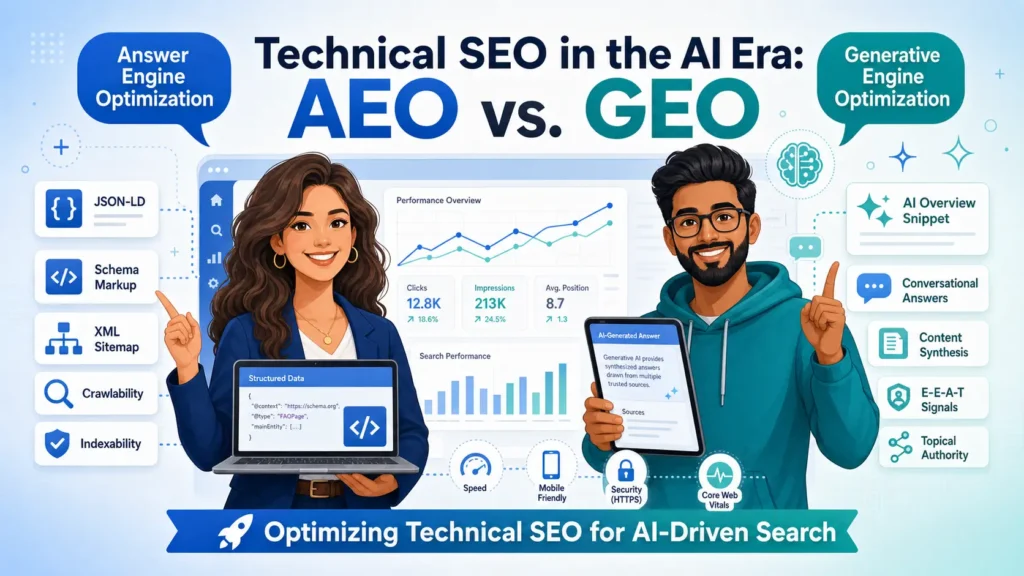

For years the deal was simple: rank well, earn the click, get the traffic. AI answer engines have rewritten that deal. When ChatGPT, Perplexity, Gemini, Claude, Copilot, or a Google AI Overview answers a question directly, the click that used to come to your site may never happen. That is why site owners keep asking me how GEO optimisation affects website traffic, and whether the traffic they built over years is about to evaporate. The honest answer is more nuanced than either panic or dismissal.
How Does GEO Optimization Affect Website Traffic?
The diversion effect is real, and it concentrates on informational queries. When someone asks an AI assistant a question your blog post used to answer, and the assistant answers it completely while citing three of your competitors, your page loses a visit it would once have earned. I see this hitting how-to content, definitions, and comparison queries hardest, because those are exactly the formats AI engines summarise well. Transactional and local-intent traffic is more insulated for now, since AI engines still push users toward actual businesses when money is about to change hands.
But a second effect runs the other way, and it is the one most site owners underestimate. Being cited in AI answers is a new traffic source, and in some niches it converts remarkably well. A citation in a Perplexity answer or a Google AI Overview puts your brand in front of someone at the exact moment of curiosity, with an implied endorsement from the engine itself. The visitors who do click through from AI citations tend to arrive pre-sold: they have already read a summary of what you offer and decided it is worth a closer look. Lower volume, higher intent. That trade is not obviously bad.
What determines which effect dominates for your site is citability. AI engines cite sources that are:
- Factual
- Clearly structured
- Quotable
Pages with original data, precise definitions, and clean heading structure get referenced. Vague, padded, or heavily templated content gets summarised without attribution or skipped entirely. This is why tracking your AI visibility score matters now: you cannot manage a traffic source you are not measuring, and traditional rank tracking does not show you where your brand appears inside generated answers.
The practical implication is that traffic strategy splits in two:
- You still need classic SEO for the clicks that remain click-driven
- You also need your content to be the kind of source AI engines quote
That means writing answers, not just articles:
- Direct statements early in the content
- Statistics with clear provenance
- Structure that survives being lifted out of context
Sites that adapt collect both streams. Sites that ignore GEO keep only the shrinking one.
Measurement has to evolve alongside the strategy. Traditional analytics will undercount AI-driven visits, because many AI referrals arrive as direct traffic or get stripped of referrer data entirely. I watch for the indirect signals instead:
- Branded search volume trending upward as AI citations put the name in front of new audiences
- Direct traffic growth on pages that are frequently cited
- Assisted conversions from visitors whose first touch was an AI answer they never clicked
None of these is a perfect metric on its own, but together they show whether GEO effort is translating into business value rather than just visibility.
What Is GEO in Website Optimization or Marketing?
GEO, or generative engine optimisation, is the practice of making your brand and content visible inside AI-generated answers. Where SEO optimises for ranked lists of links, GEO optimises for being cited, quoted, and recommended by systems like ChatGPT, Perplexity, Gemini, Claude, Copilot, and Google’s AI Overviews and AI Mode. It sits alongside SEO in the marketing mix rather than replacing it, because the two disciplines share a foundation: both reward content that is accurate, well-structured, and genuinely useful. The difference is the consumer:
- SEO serves an algorithm that ranks pages.
- GEO serves a model that synthesises answers.
In practice, GEO work looks like a blend of things marketers already know:
- Content marketing becomes more valuable because original research and distinct viewpoints are what models cite instead of paraphrasing.
- Digital PR matters more because brand mentions across the web shape how models describe you.
- Technical clarity matters because models favour content they can parse cleanly: descriptive headings, concise definitions, tables, and schema markup that labels what each page element means.
For most site owners, the starting point is an honest assessment of where they stand in AI answers today, which is exactly what dedicated AEO services are built to establish. From there the work is iterative:
- Strengthen the pages that should be cited
- Prune or consolidate the ones that dilute topical authority
- Build the off-site mentions that reinforce what the site claims about itself
GEO is not a separate channel to bolt on. It is the same website, optimised for a second audience that happens to be artificial.
GEO does not kill website traffic. It redistributes traffic toward the sources AI engines trust enough to cite. The site owners who treat that as a technical problem to solve, rather than a trend to wait out, are already collecting the clicks their competitors are losing.