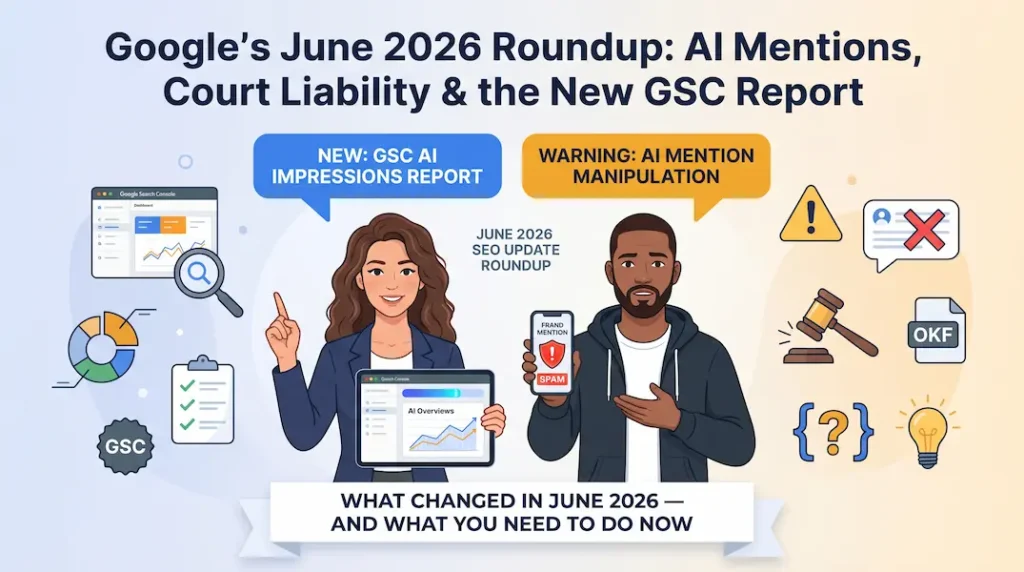
Google’s June 2026 Roundup: AI Mentions, Court Liability & the New GSC Report
June 2026 was one of the busiest months in search in years, and not because of a single headline. Google launched its long-awaited Search Console AI performance reports on June 3, Google engineer Gary Illyes officially classified fake brand mentions as spam at Search Central Live Shanghai (May 15, 2026), and a Munich court issued a first-of-its-kind ruling on May 28 holding Google directly liable for false claims in AI Overviews. In the same month, Google quietly introduced the Open Knowledge Format (OKF) on June 12, a new markdown-based standard for feeding structured site content to AI agents.
Five developments landed inside 30 days. Every one of them has a direct action item attached. Let’s go through each one.
What did Google actually launch and announce in June 2026?
Five confirmed developments, one new tool, one formal spam warning, one legal ruling, one new format standard, and one clarification that closes a long-running debate.
Here is the full breakdown:
| Development | Date | Source | Who It Affects |
|---|---|---|---|
| GSC Generative AI Performance Report launched | June 3, 2026 | Google Search Console (official) | All site owners, SEOs, digital marketers |
| Gary Illyes: buying AI mentions = spam | May 15, 2026 (Search Central Live Shanghai) | Google/Search Engine Roundtable | Any brand using paid mention outreach for AEO/GEO |
| Munich Regional Court: Google liable for false AI Overviews | May 28, 2026 (ruling)/June 9-12, press coverage | Regional Court of Munich (Case 26 O 869/26)/Reuters, Search Engine Land | Publishers, brands, legal teams globally |
| Google Open Knowledge Format (OKF) v0.1 launched | June 12, 2026 | Google Cloud Blog (McVeety & Hormati) | Enterprises, agencies, brands building AI agent infrastructure |
| llms.txt confirmed: Google ignores it | June 15, 2026 | John Mueller (Google)/Search Engine Journal | Anyone using llms.txt as a GEO/AEO ranking tactic |
None of these are algorithm updates with rollout windows. They are policy, legal, and tooling developments, all now in effect.
What does the new Google Search Console AI report actually show you?
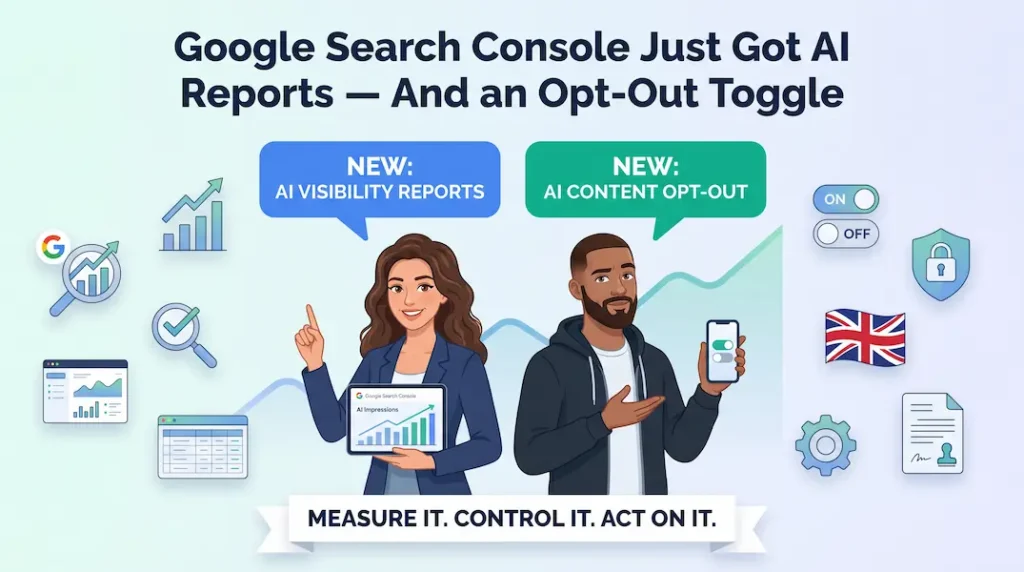
The GSC Generative AI Performance Report shows how many times your pages appeared in AI Overviews, AI Mode, and generative Discover features, broken down by page, country, device, and date (including hourly granularity).
Google launched this report on June 3, 2026, beginning with a subset of UK site owners, with global expansion ongoing at the time of publishing. To access it: open Search Console and look for the Generative AI tab under Performance, or navigate directly by appending /ai to your existing Performance report URL.
What data does it actually give you?
- Impressions by page: see exactly which URLs are appearing inside AI Overviews and AI Mode
- Country breakdown: understand whether your AI visibility is concentrated or geographically distributed
- Device breakdown (Search only, not Discover): phone, tablet, and desktop data segmented
- Date granularity: daily, weekly, monthly, and hourly views available
- Data start date: May 18, 2026: there is no historical backfill before this date
What it does NOT give you:
- No clicks: click-through data is absent from the current version
- No CTR: you cannot calculate click-through rate from the report alone
- No query data: you cannot see which search queries triggered AI impressions
- No coverage of non-Google AI engines: ChatGPT, Perplexity, Claude, and Gemini are not tracked here
Before this report existed, the closest SEOs could get to AI visibility data was manually querying AI platforms, monitoring GA4 for LLM referral sessions under “direct/other,” or paying for third-party AI citation tools. This is a genuine improvement: a first-party, free impression signal within the dashboard that every SEO already uses. Here’s my honest take: it is genuinely useful as a baseline, but it is one leg of a four-platform table. In February 2026, Bing Webmaster Tools launched its own AI visibility report covering citations from ChatGPT and Microsoft Copilot. Together, Google’s and Bing’s reports cover two of the five major AI platforms. ChatGPT (non-Bing), Perplexity, Claude, and Gemini still require manual or third-party tracking.
The opt-out toggle: The same release shipped a toggle in Search Console that lets site owners opt out of AI Overviews, AI Mode, and AI Overviews in Discover entirely. The toggle activated on June 17, 2026. Google confirmed the opt-out will not affect organic rankings in standard Google Search. Ahrefs (2026) reported a 34.5% drop in position-one CTR for queries that trigger an AI Overview, suggesting that less AI exposure can sometimes lead to more clicks from the same traditional rankings. Whether to flip the toggle is a business decision, not a technical default.
Who gets hit by Google’s new AI mention spam warning?
Any brand or agency using paid outreach to place brand mentions on websites to influence AI Overviews or AI Mode visibility is now on notice; Google has officially classified this as spam.
Google’s Gary Illyes issued the warning at Search Central Live Shanghai on May 15, 2026, and Search Engine Roundtable reported the full context. Illyes explicitly compared fabricated or purchased brand mentions to the prohibited link-buying schemes Google has penalized for years. He gave a specific example: a dog food brand being cited on a sports betting site, an inauthentic co-occurrence that signals manipulation rather than genuine authority.
This matters because the AEO community spent parts of 2024 and early 2025 testing whether brand mentions on high-traffic sites could improve AI Overview citation rates. Some early data suggested they could. Google’s May 2026 warning means those tactics now carry the same risk profile as buying links: short-term gain, documented spam policy violation, and potential manual action.
What changed vs. what stayed the same:
- Changed: Fabricated, purchased, or placed brand mentions targeting AI surfaces are now explicitly spam
- Changed: Google is actively monitoring for inauthentic brand-site co-occurrences (the dog food/betting site example confirms pattern-matching is in use)
- Unchanged: Earning genuine brand mentions through digital PR, community participation, expert commentary, and editorial coverage remains the correct approach and a confirmed GEO signal
- Unchanged: Organic Reddit mentions, authentic LinkedIn references, and editorial brand coverage continue to be cited positively
Here’s something I noticed first-hand when I audited a supplement client’s third-party mention profile earlier this year. The citations with the strongest AI co-occurrence were from bodybuilding forums, sports science blogs, and Reddit threads where the brand had been genuinely discussed by users, rather than from press release pickups or directory-style mention placements. The signal Google rewards is authentic community presence, not engineered footprints.
Does the German court ruling on AI Overviews affect my site?
Directly, no, but the ruling signals a structural shift in how AI platforms will manage content liability, which affects every brand whose business relies on accurate AI representation.
The Regional Court of Munich issued a temporary injunction on May 28, 2026 (case no. 26 O 869/26) barring Google from repeating false statements generated by its AI Overview about two Munich-based publishers. The AI had fabricated connections between those publishers and scams and subscription traps associations that appeared in none of the linked source documents. The court ruled that AI Overviews produce “independent, new, and substantive statements,” meaning they are Google-authored content rather than a neutral aggregation, and rejected Google’s defence that users could verify claims by checking source links (Search Engine Land, June 9, 2026). Google has confirmed it will appeal (Reuters, June 12, 2026).
The ruling is currently a regional injunction under European liability doctrine. It does not apply directly in Canada, the US, or most other jurisdictions. But the directional implication is significant: when a platform becomes legally cautious about what it says about a brand, it will preferentially cite businesses whose identity is unambiguous, consistent, and machine-verifiable. An entity it cannot verify confidently becomes a liability risk to name at all.
In my view, the most underappreciated second-order effect of this ruling is the incentive it creates for AI platforms to hedge on brands with ambiguous or contradictory identity signals. If your brand name resolves to multiple entities, your address appears inconsistently across platforms, or your category is described differently on your homepage vs. your GBP vs. your LinkedIn, you are a riskier entity to cite, not just a harder one to find.
What is Google’s Open Knowledge Format and do I need to implement it now?
OKF (Open Knowledge Format) is Google’s new open standard for organizing site knowledge as a structured directory of markdown files designed for AI agents and agentic workflows, not for traditional search ranking.
Google Cloud launched OKF v0.1 on June 12, 2026, in a post by Sam McVeety and Amir Hormati. The format is vendor-neutral and open-source. Each OKF file is a single concept or topic, written in Markdown with YAML front matter for metadata. Files link to each other to form a navigable knowledge graph. Think of it as a structured internal wiki that AI agents can read and navigate without building a custom RAG pipeline or vector database.
What OKF actually is vs. what it is not:
- Is: A markdown + YAML spec for packaging your organization’s knowledge for AI agent consumption
- Is: Vendor-neutral, open-source, hosted on GitHub, not locked to Google infrastructure
- Is: Relevant for agentic use cases, AI agents that need to understand your site’s structure, products, policies, and terminology
- Is not: A Google Search ranking factor; Google confirmed OKF is a Cloud and agent-layer standard, not a Search signal
- Is not: A replacement for schema.org markup; those two operate at different layers for different purposes
- Is not: An urgent tactical priority for most SEO practitioners in 2026; it matters most for enterprise brands deploying internal AI agents or building AI-powered customer-facing tools
The same June 2026 Yoast roundup also surfaced a schema.org usage data point worth noting: 95% of websites use only 12 of the 958 available schema types, while fewer than 1,000 sites globally use 485 or more. That gap represents a real optimization opportunity, particularly for e-commerce brands that could implement Product, Review, Offer, and BreadcrumbList but currently only have Organization and WebSite.
So what should I actually do about this?
- Check your Search Console for the Generative AI performance tab, and take a screenshot of your baseline impressions. This is your first-party AI visibility benchmark: free, official, and in the dashboard you already use daily. Note your top five pages by impression count and your top countries. The mistake: waiting for click data before starting to track; the baseline impression data is actionable on its own for identifying which pages are earning AI visibility.
- Make a deliberate decision about the AI Overviews opt-out toggle before it affects you. The toggle is live as of June 17, 2026. For most brands, the right call is to leave AI Overviews active; AI impression exposure builds brand recognition even without a click. For brands where click volume is the primary revenue driver and AI Overviews demonstrably suppress clicks (Ahrefs measured a 34.5% CTR drop on AI Overview queries), opting out is defensible. The mistake: treating the default setting as a non-decision and ignoring the toggle entirely.
- Audit your brand mention profile and stop any paid mention outreach targeting AI surfaces immediately. Google’s Gary Illyes made the policy explicit at Search Central Live Shanghai in May 2026. Any outreach programme placing brand mentions on websites specifically to influence AI Overviews or AI Mode now carries the same risk as paid links. Replace it with genuine digital PR, earning editorial coverage, contributing expert commentary to industry publications, and building authentic community presence. The mistake: assuming the tactic is fine because Google “can’t prove” the mentions were paid.
- Run your brand name through ChatGPT, Perplexity, Google AI Overviews, Gemini, and Bing Copilot and read what each AI says about you. The Munich court ruling has accelerated the incentive for AI platforms to hedge on brands with inconsistent identity signals. If any platform makes an inaccurate claim, document the false statement with a screenshot, note the search query, and submit a correction request through Google’s feedback tool. The mistake: assuming AI descriptions of your brand are accurate and never checking.
- Standardize your entity identity across every platform AI engines read. Your brand name, description, address, and service area should be identical on your website, Google Business Profile, LinkedIn company page, Wikipedia entry (if applicable), G2 or Trustpilot profile, and industry listing platforms. This is the direct defensive response to both the Munich court’s liability ruling and the general principle that AI systems preferentially cite brands they can unambiguously verify. The mistake: updating your website description and leaving your GBP or third-party profiles inconsistent.
- Audit your schema.org implementation against the 958 available types. If your site only uses Organization and WebSite, you are in the 95% and leaving structured signal on the table. For e-commerce clients, prioritize Product, Offer, Review, and BreadcrumbList. For real estate and local service clients, prioritize LocalBusiness, Service, and FAQPage. For content sites, prioritize Article, HowTo, and FAQPage. The mistake: treating current schema as “good enough” because it validates without errors, when validation and completeness are two different things.
- Hold off on OKF implementation for now unless you are actively building AI agents. OKF v0.1 is a promising standard for enterprise knowledge management and agentic workflows, but it has no confirmed effect on Google Search rankings. If your 2026 roadmap includes deploying internal AI agents or AI-powered customer tools, add OKF to your Q3–Q4 planning. If not, monitor developments and prioritize the six actions above first. The mistake: treating OKF as an urgent SEO task because Google announced it, when it is an agent-layer infrastructure standard, not a ranking signal.
June 2026 dropped five meaningful developments in 30 days. If you are working through any of these: the GSC report, the opt-out decision, entity auditing, or schema gaps, connect with me on LinkedIn. I post practical breakdowns of what the data is actually showing across client accounts.