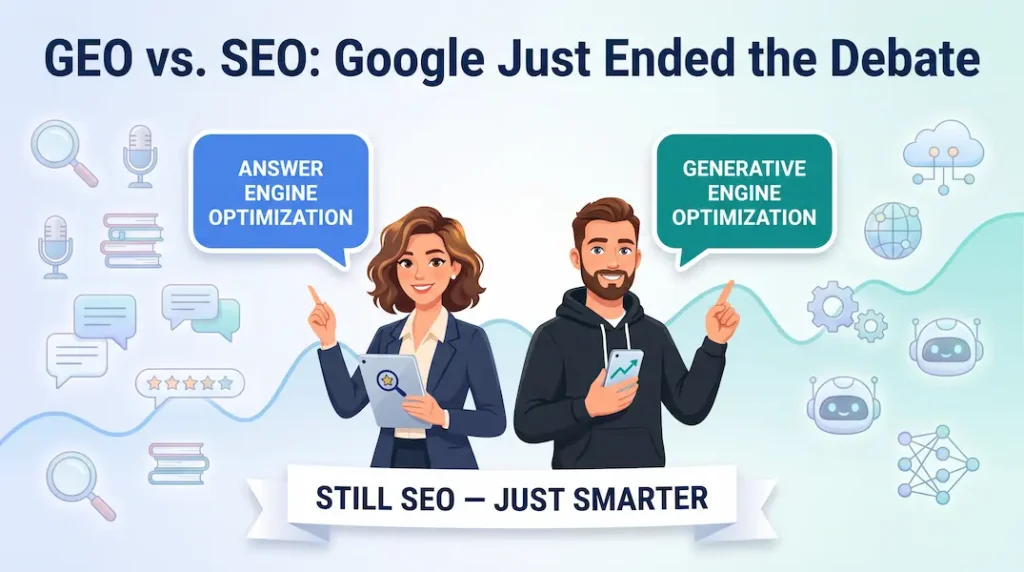
Google Just Settled the GEO vs. SEO Debate, Here’s What You Actually Need to Do
Google published its first official AI search optimization guide on May 15, 2026, and the headline is blunter than most people expected: “Optimizing for generative AI search is optimizing for the search experience, and thus still SEO.” The guide, announced by John Mueller via the Google Search Central Blog and housed under a new “Generative AI fundamentals” section in Search Central documentation, covers AI Overviews, AI Mode, and every related surface. It explicitly kills off the idea that GEO and AEO are separate disciplines requiring separate playbooks.
So the GEO vs. SEO budget debate? Google just ended it. Whether your agency calls it AEO, GEO, or AI Optimization, you’ve been doing SEO all along, just with a fancier acronym on the invoice.
What actually changed, and what stayed the same?
The guide did not introduce new ranking factors. What changed is that Google made official what most practitioners had been piecing together from scattered documentation.
What is now officially confirmed:
- AEO and GEO are not separate disciplines. Google’s documentation folds both terms into standard SEO, same systems, same signals, same quality criteria.
- AI Overviews and AI Mode run on Google’s main index. There is no separate AI crawl and no special AI-targeting schema required.
- llms.txt files are explicitly optional for Google Search. The guide states Google’s crawler may discover these files but treats them “like any other text file” with no preferred indexing pathway.
- Content chunking is unnecessary. Google’s systems can extract the relevant passage from a multi-topic page without the author pre-fragmenting the article.
- AI-specific rewrites are not needed. Google’s AI features understand synonyms and general meanings without keyword-stuffed variations.
What did not change:
- Crawlability and indexability remain the first gate. A page must be indexed and eligible to appear in Google Search with a snippet before it can be cited in any AI feature.
- E-E-A-T (Experience, Expertise, Authoritativeness, Trustworthiness) is still the quality framework.
- Core Web Vitals thresholds still apply; the guide explicitly names page experience as a factor.
| Old Thinking | What Google Actually Confirmed |
|---|---|
| GEO/AEO = new discipline | GEO/AEO = advanced SEO |
| llms.txt needed for AI crawling | Treated as a plain text file, no special treatment |
| Chunk content for AI extraction | Google extracts passages from full pages natively |
| Use a special schema for AI features | Standard schema still applies; no AI-only markup needed |
| Rank #1 or miss the AI answer | Query fan-out means subtopic authority earns citations |
Who does this affect, and how badly?
Every site owner debating whether to split the budget between “traditional SEO” and a new AI optimization practice takes the clearest hit, because that framing was always a false choice, and this guide confirms it formally.
The guidance is especially important for:
- Brands that hired separate GEO or AEO consultants running parallel content strategies to their existing SEO work
- E-commerce sites that were creating AI text files or duplicate Markdown versions of product pages, the guide explicitly says this is not required for Google
- Content teams that were chunking long-form articles into short fragments to “help AI read them,” Google’s passage retrieval handles this internally
- Any site that over-indexed on llms.txt as a signal to AI systems, valid for non-Google crawlers, but irrelevant to Google’s ranking and citation systems
The CTR stakes make this urgent. According to Seer Interactive data, organic CTR for queries featuring AI Overviews dropped from 1.76% to 0.61%, a 61% decline. Brands cited in AI Overviews, however, earned 35% more organic clicks than those not cited, and 91% more paid clicks. The difference between being cited and being invisible is not a new strategy; it is the depth and accessibility of your existing content.
Here’s something I noticed first-hand: when I pulled Search Console impressions across two e-commerce clients after the guide dropped, the pages already earning AI Overview citations were the same pages that had strong traditional rankings, clear answer-first paragraph structure, and comprehensive topical coverage. No special schema. No chunking. No separate AI content strategy. Just well-executed SEO that had been running for 12-18 months.
Why did Google make this change?
Google stated the reason directly: its “best practices for SEO continue to be relevant because our generative AI features on Google Search are rooted in our core Search ranking and quality systems.”
The guide uses retrieval-augmented generation (RAG) and query fan-out as the technical explanation. In plain terms, Google’s AI does not have its own separate web; it retrieves from the same index that powers regular search, then synthesizes an answer. If your page is not in that index at a competitive quality level, it does not get cited.
According to Search Engine Land’s coverage of the guide, this also clarifies a key technical mechanism called query fan-out: when a user asks one question, Google’s AI may break that into 8-16 related sub-queries and execute them simultaneously across the index. A study of 173,902 URLs found that pages ranking for both the main query and at least one fan-out query accounted for 51% of AI Overview citations, and ranking for fan-out queries is 49% more likely to earn a citation than ranking for the head term alone.
In my view, this is the most underreported detail in the guide. Google is not just pulling the top-ranking page for your query. It is assembling a mosaic from whoever owns the most authoritative answer to each component question. That is a structural opportunity for sites with deep topic clusters, and a quiet death sentence for thin, single-keyword pages.
Google also added an important spam clarification: seeking inauthentic mentions to manipulate AI-generated answers is now explicitly against spam policy (confirmed in Marie Haynes’ documentation of the May 15, 2026, spam policy update). The systems that protect core ranking protect AI citations too.
What are most people getting wrong about this?
The most common misread is treating this guide as a green light to do nothing new and coast on existing SEO.
That is not what Google said. The guide confirms the framework is the same, but it also clarifies that the standard is higher. Commodity content (Google’s own term) will not earn citations in AI features, the same way it has increasingly not ranked in traditional results since the Helpful Content era. The guide says to “create non-commodity content that’s helpful, reliable, and people-first,” and the emphasis on “unique point of view” appears repeatedly.
The second misread is ignoring the format signal. Google’s guide confirms that content format influences citation selection by query type:
- Listicles and best-of formats tend to surface in “best [X]” queries
- Long-form, comprehensive content surfaces for complex how-to and decision-support queries
This is not new SEO theory; it is the way well-structured content has always performed. But it means formatting decisions are citation decisions now.
Early data also confirms that the llms.txt situation is more nuanced than a simple “don’t bother.” As Search Engine Land reported on May 19, 2026, Chrome’s Lighthouse 13.3 now audits for llms.txt files under an “Agentic Browsing” category, eight days after Google Search Central said they were unnecessary. Google Search does not use them. Other AI crawlers (Perplexity, Claude, ChatGPT Search) may. If you are optimizing for multi-platform AI visibility, the calculus is different from Google-only SEO.
Here is what I actually did when this dropped: I flagged every client account where we had previously recommended against llms.txt on the basis of “Google doesn’t use it” and added a note that, for multi-platform AI visibility, a minimal llms.txt pointing to key content clusters is worth implementing. Not for Google. For every other AI that reads it.
So what should I actually do about this?
- Audit your content for commodity signals, starting with your top 20 pages. Does each page offer a unique point of view, original data, or first-hand experience that cannot be sourced anywhere else? If a competitor or an AI could rewrite it in five minutes, Google classifies it as commodity content. The fix is not more words; it is specific claims, original evidence, and named expertise.
- Map your topic clusters against query fan-out logic. For your most important head terms, identify the 5-8 sub-questions a user might ask around that topic. Check whether your site owns a dedicated, well-optimized page for each sub-question. Fan-out citations go to whoever owns the most authoritative answer to each component, not just whoever ranks for the broad term.
- Confirm your indexability and snippet eligibility first. Before any AI visibility work, verify that pages are crawlable (check robots.txt for accidental blocks), indexed (GSC Coverage report), and eligible for snippets (no nosnippet meta tags have been unintentionally applied). AI features cannot cite what cannot appear in a standard search result. This is the baseline, not a bonus step.
- Do not create or maintain a separate AI content strategy. If your team has been running parallel content tracks, one for traditional SEO, one “optimized for AI,” consolidate them. The guide confirms there is one index, one quality bar, and one framework. Separate strategies dilute both.
- Structure pages to answer the primary question in the first 100 words. Query fan-out retrieves at the passage level, not the page level. The answer a page is most likely to be cited for should appear near the top, in a clean paragraph, before supporting detail. This also improves featured snippet eligibility, which correlates with AI citation selection.
- Implement llms.txt selectively for multi-platform AI visibility, not for Google. If your clients care about Perplexity, Claude, or ChatGPT Search citations alongside Google, a minimal llms.txt pointing to authoritative content clusters is worth adding. Keep it lightweight and accurate. Do not build a whole process around it for Google-only goals.
- Export your Search Console impressions data now and check for the new Generative AI performance reports. As of June 2026, Google has begun rolling out AI impression reporting in Search Console (confirmed by John Mueller in the June 18, 2026 Google Search News episode). If you have access, pull baseline AI impressions data immediately. This becomes your before/after benchmark for everything you do next. If you do not have access yet, set a weekly reminder to check.
If this breakdown helped you cut through the noise, connect with me on LinkedIn. I post regular SEO and AI search analysis there.