How to Build Topical Authority Google Actually Recognizes in 2026
Topical authority is the degree to which Google trusts your site as the go-to source on a specific subject. You earn it by covering a topic deeply and consistently, not by publishing one great article and hoping for the best. Think of it as owning a neighbourhood, not just renting a room.
Google’s own Search Quality Rater Guidelines have reinforced depth of expertise as a core E-E-A-T signal for years. And a 2026 Search Atlas study across 4,352 pages found that depth on a single subject correlated most strongly with top rankings, while covering too many topics actually diluted authority. I’ve been watching this play out on client sites since before it had a name. Let’s build it properly.
What you’ll need
- Semrush Keyword Strategy Builder to map seed keywords into clusters
- Ahrefs or Semrush Content Gap tool to identify what your cluster is missing
- A spreadsheet or Notion content map to track pillar pages, cluster posts, and coverage gaps
- Google Search Console to monitor ranking lift as you publish
- Time: 2-3 hours to build the initial cluster map; ongoing quarterly content reviews
Step 1: Why does picking 1-2 core topics outperform covering 20?
Narrowing to 1-2 core topics gives Google a clear signal about what your site is an expert in; spreading across 20 topics tells it nothing.
This is the most common strategic mistake I audit. A SaaS project management tool writing about SEO tips, email marketing, and remote work because “it’s all relevant to our audience.” To Google, that’s not a content strategy; it’s a content crisis. The algorithm can’t confidently assign your site authority in any one of those lanes.
Ahrefs’ topical authority research directly confirms this: a small specialist site can outrank a much larger generalist site on niche-specific queries because topical depth outweighs domain size when intent is clearly matched.
Here’s a real example. Let me walk you through a B2B SaaS client in the construction project management space. When I first audited their blog, they had 74 published posts, but they were scattered across productivity, HR software, budgeting, and field management. Not a single cluster had more than 4 posts. None of their pillar-level topics had more than 40% of the subtopics covered. Their average position across their target keywords was 22.
We cut the topic scope from 12 subject areas down to 3: construction scheduling, subcontractor management, and job costing. Eight months later, those three clusters each had 12-18 posts. Their average position on cluster-related queries moved from 22 to 9.4.
Failon’s Tip: Open your current blog in a spreadsheet. Tag every post with its primary topic. If you have more than 5 distinct topic categories, you’re spread too thin. Pick the 1-2 where you already have the most content and double down on those first.
Step 2: How do I actually build a pillar page and cluster structure?
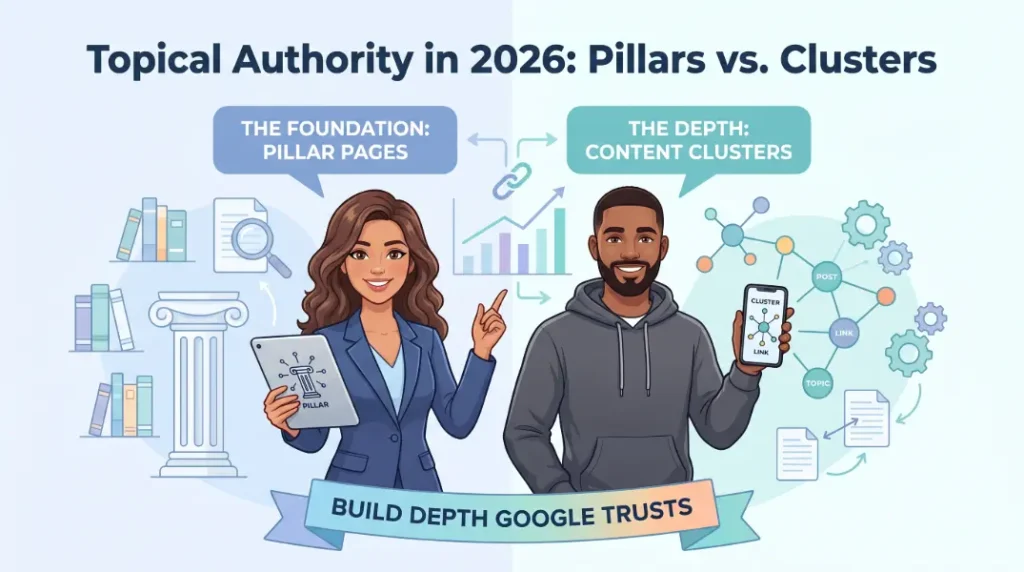
A pillar page is a long-form comprehensive guide on a broad topic; cluster posts are shorter, focused articles that each answer one specific sub-question and all link back to the pillar.
Think of the pillar page as the hub of a bicycle wheel. The cluster posts are the spokes. Remove any spoke, and the wheel still turns. Remove the hub and the whole thing collapses. The hub (pillar) gives context and authority. The spokes (clusters) give coverage and depth.
Here’s how to build the structure from scratch:
- Seed your cluster in Semrush Keyword Strategy Builder. Enter your core topic (e.g., “construction scheduling software”). The tool automatically generates a bubble map of related clusters; each bubble represents a potential sub-topic.
- Identify your pillar keyword. This is typically a high-volume, broad-intent keyword: “construction scheduling” or “how to schedule a construction project.” This becomes your pillar page title.
- Map every intent variation per cluster. For each sub-topic, you need posts covering informational intent (“what is a Gantt chart in construction”), navigational intent (“Gantt chart vs bar chart”), and commercial intent (“best Gantt chart tools for construction managers”). Cover all three, or the cluster is incomplete.
- Assign one post per subtopic, not one post per keyword. Group closely related keywords into a single post. Don’t publish “best construction scheduling app” AND “top construction scheduling software” as separate pages. That’s cannibalization, not coverage.
- Write the pillar page last. Once your cluster posts exist, your pillar page can link to them, and those internal links point to destination pages with real content. Writing the pillar first and pointing to planned posts that don’t exist yet is just a promise Google can’t verify.
According to vrid.ai’s 2026 topical authority guide, sites with 25+ well-linked cluster articles around a pillar saw rankings improve by up to 70% compared to sites with isolated posts on the same keywords.
Failon’s Tip: Run Semrush Keyword Strategy Builder on your seed term and export the cluster to a spreadsheet. Add a column: “Published (Y/N).” Any row that says N is a gap. Prioritize gaps in clusters where you already have 3+ published posts; that’s where completing the cluster moves rankings fastest.
Step 3: How do I interlink my cluster so it actually passes authority?
Every cluster post must link back to the pillar page with keyword-relevant anchor text, and cluster posts should cross-link to related cluster posts using descriptive, specific anchor text.
Generic anchors kill the signal. “Click here” and “read more” tell Google nothing about what the destination page covers. “How to create a construction schedule in 6 steps” tells Google exactly what the linked page is about. Descriptive anchors are how you reinforce the semantic relationship between your pages.
Internal linking, when done well, acts as a recommendation system within your own site. You’re essentially telling Google: “These pages are related. This one covers the topic in depth. Trust the cluster.”
A case study from linkifyplugin.com’s analysis of a 300-article blog found that restructuring internal links using descriptive anchor text increased organic traffic by 43% over six months with no new content published during that period. The content was already there. The links were just pointed in the wrong direction.
Internal linking rules for topical clusters:
- Every cluster post links to the pillar using anchor text that matches or closely paraphrases the pillar’s primary keyword
- Cluster posts cross-link to 2-4 other cluster posts using anchors specific to the destination page’s topic
- The pillar page links to every cluster post. This is the hub; it should reference all spokes
- No orphan cluster posts. If a post has zero inlinks from within the cluster, it’s invisible to the algorithm
One pattern I watch for in audits: a team publishes 15 great cluster posts over six months, but every post is linked from the homepage and almost never from one another. They’ve built 15 separate rooms with no hallways between them. Internal links are the hallways. Google needs to walk through them.
Step 4: How do I keep topical authority from decaying after I build it?
Topical authority isn’t a one-time project; it decays when statistics go stale, competitors fill coverage gaps you leave open, and new search intent variations emerge that your cluster doesn’t address.
A quarterly content review doesn’t need to be a full site audit. It needs to answer four questions:
- Which cluster posts have outdated stats or information? (Check publish dates vs. current data sources)
- Which queries are my cluster pages showing impressions for but no clicks? (GSC: Impressions > 100, CTR < 1% = stale content or wrong intent match)
- What subtopics do my competitors cover that I don’t? (Ahrefs Content Gap: enter your competitors, filter by topics you don’t rank for)
- Are any cluster posts ranking for the same keywords as the pillar? (Cannibalization check, covered in the cannibalization guide on this blog)
Tracking topical coverage in a content map:
Build a simple spreadsheet with these columns:
| Cluster Topic | Post Title | Status | Last Updated | GSC Position | Coverage Gap? |
|---|---|---|---|---|---|
| Construction Scheduling | What is a Gantt chart? | Live | Jan 2026 | 11 | No |
| Construction Scheduling | Gantt chart vs milestone chart | Live | Mar 2026 | 6 | No |
| Construction Scheduling | Best scheduling software for SMBs | Planned | – | – | Yes |
Any row with “Planned” in Status and more than 90 days without a publish date is a gap your competitors will fill before you do.
According to theStacc’s 2026 topical authority impact study, sites that updated cluster content quarterly maintained an average position 2.3x higher on cluster-related queries than sites that published once and left content static.
And there’s one more angle worth flagging: AI citation visibility. ChatGPT, Perplexity, and Google’s AI Overviews prefer to source answers from sites that demonstrate deep, consistent coverage of a topic. A site with 4 posts about “field service management software” has far less chance of being quoted than one with 18 tightly linked, up-to-date posts covering every angle of that topic. Topical authority doesn’t just help you rank in the blue links; it makes you the site LLMs reach for when someone asks the question out loud.
Building a topical cluster and want a second opinion on your structure before you write 20 posts? Connect with me on LinkedIn. I review cluster architectures regularly, and I’m happy to take a look.