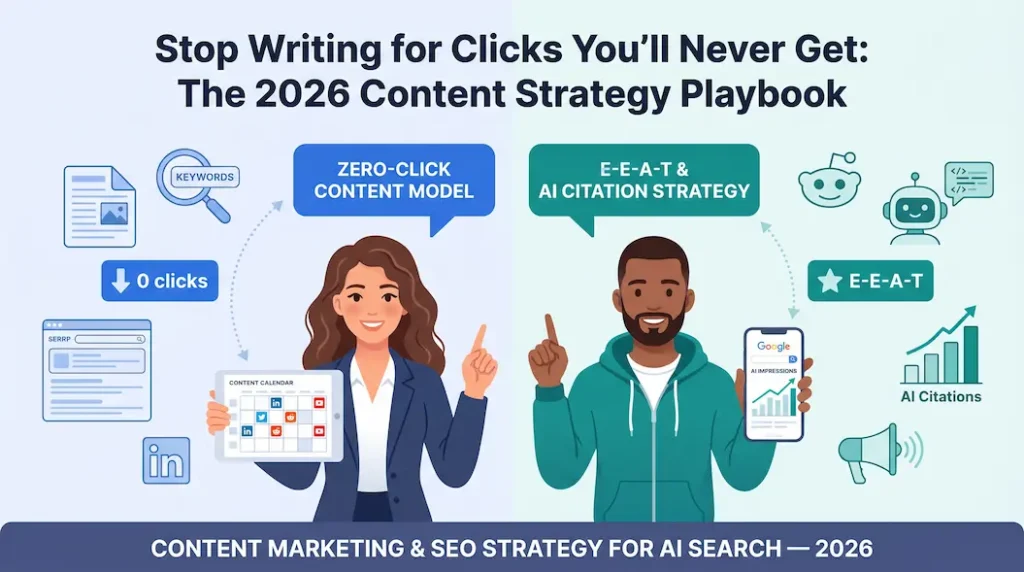
Stop Writing for Clicks You’ll Never Get (The 2026 Content Strategy Playbook By Failon OB)
The content marketing model built on blog posts that rank for informational keywords is structurally broken, and the data proves it. According to SparkToro’s 2026 research, which uses Similarweb clickstream data, 68% of U.S. Google searches now end without a single click to any website. That’s up from 60.45% in 2024, a 7.56-point jump in two years. When AI Overviews appear, that zero-click rate climbs to roughly 80%.
I know… We built entire content calendars around capturing those clicks. Time to rebuild!
What is a zero-click content strategy, and why does it matter now?
A zero-click content strategy means publishing your core ideas on the platform where your audience already is, not just on your own site, hoping they click through.
Think of it this way: your site is the restaurant. The old model was getting people to visit the restaurant. The new model is setting up a booth at every farmers’ market in the city, because that’s where people are already standing. Your site still matters, but it’s one venue among many, not the only one.
The shift happened because Google, and now AI systems like ChatGPT and Perplexity, have gotten very good at answering questions without sending anyone anywhere. For every 1,000 U.S. Google searches, SparkToro’s 2026 data shows only 232 result in a click to the open web. The rest stay inside Google’s ecosystem.
The platforms where your content now needs to live:
- LinkedIn: long-form posts, carousel-style breakdowns, expert commentary
- Reddit: community threads, AMAs, direct answers to niche questions
- YouTube: video answers that appear in AI summaries and search results
- Email newsletters: the one channel Google can’t intercept
This is not about abandoning your site. It’s about accepting that distribution is now a content decision, not an afterthought.
Why is Reddit suddenly ranking above your blog posts?
Reddit grew its #1 ranking share by 54% after the May 2026 core update, and it’s not a glitch; it’s a signal.
SE Ranking’s analysis of 100,000 keywords found Reddit held the top organic result for 13,872 keywords after May, up from 8,993 after March. That’s one platform holding the single most valuable spot on the page for nearly 14,000 searches. In experience-led niches, the numbers are even sharper: Reddit holds 18% of the top-three positions in the Pets category and over 14% in E-Commerce and Retail.
Here’s what I saw first-hand when auditing a real estate client earlier this year. Their neighbourhood guides were well-structured, had solid backlinks, and had ranked comfortably in the top five for two years. After the May update, two of those positions were displaced by Reddit threads, raw, unpolished community discussions from people who actually lived in those neighbourhoods. My client’s guides described the areas accurately. The Reddit threads told you what parking was actually like on a Tuesday night.
That’s the distinction Google is now rewarding: lived experience over structured knowledge.
The reason AI systems pull from Reddit is the same reason Google promotes it: 100 million daily active users generating opinions and experiences at scale is a signal that no single brand’s content strategy can replicate. LLMs trained on the web learned from Reddit. It’s baked in.
What this means for your content strategy is not “start astroturfing Reddit.” Inauthentic participation gets spotted, and the community will bury it. It means showing up honestly in the communities where your expertise is actually useful, answering real questions, citing real data, and letting the community validate you over time.
Does E-E-A-T still matter, or is it just a Google buzzword?
E-E-A-T absolutely still matters, and the May 2026 core update made the first “E” Experience the primary differentiator between content that wins and content that doesn’t.
Google’s E-E-A-T framework evaluates four things about your content:
| Signal | What Google Is Looking For | Best For | How to Show It |
|---|---|---|---|
| Experience | Proof you’ve done the thing | Product reviews, how-tos, case studies | Personal photos, specific outcomes, “I tested this” language |
| Expertise | Depth of subject-matter knowledge | Technical guides, YMYL topics | Credentials, citations, and author bios with verifiable history |
| Authoritativeness | Others recognize you as a go-to source | Industry commentary, news analysis | External citations of your work, brand mentions, PR |
| Trustworthiness | Accurate, honest, unbiased content | All content types | Named authors, correction policies, cited data |
The May 2026 update applied this framework with greater force than any previous update, according to TechSEO’s post-update analysis. Informational and editorial content took the hardest hits, guides, how-tos, listicles, and comparison posts where the author clearly hadn’t used the products or visited the places they were writing about.
Digital Applied’s March 2026 research found that sites that added structured author pages with verifiable credentials saw measurable ranking improvements within weeks of the update. Author bios aren’t decoration. In 2026, they’re ranking infrastructure.
The practical implication: commodity-content, keyword-optimized blog posts written by anyone about anything are losing ground consistently across consecutive core updates. The content winning is the content only you can write: your client data, your test results, your professional observations, your proprietary benchmarks.
How do I build a content strategy that works for both search and AI in 2026?
Build every piece of content as a modular asset, one core idea that can be extracted, quoted, reformatted, and distributed across multiple platforms without requiring a site visit.
This is what I call the Zero-Click Content Stack. Instead of writing a blog post and hoping people find it, you build a core asset and deliberately push its key ideas into the channels where discovery actually happens.
What you’ll need:
- Google Search Console with AI Impression access (available from May 18, 2026 baseline)
- A content calendar that plans distribution formats alongside the core piece
- 30-60 minutes per published article for repurposing
- An active presence on at least one community platform (Reddit, LinkedIn, or both)
The 6-step Zero-Click Content Stack:
- Write the core article: long-form, expert-authored, with original data or first-person experience. This is your canonical source of truth. Minimum 1,500 words. Named author. Cited statistics.
- Extract 3-5 standalone “answer capsules”: self-contained paragraphs of 45-75 words that answer one specific question directly. These are what AI systems quote. No links inside the capsule. No qualifications. Just a clean, direct answer.
- Turn each answer capsule into a LinkedIn post: write it in your own voice, add one observation or data point, and link back to the full article. LinkedIn now drives measurable AI citation signals because LLMs index public LinkedIn content.
- Post one answer in a relevant Reddit thread: find an active thread asking your exact question. Answer it directly and honestly. Do not paste your article. Do not pitch. Just answer. If the answer is genuinely useful, the community votes it up, and that vote is a trust signal.
- Record a 60-second video summary: one key stat, one personal observation, one takeaway. Post to YouTube Shorts and LinkedIn video. Video content is migrating into SERP features that standard rank tracking doesn’t even count yet.
- Send it to your email list: with one original observation not in the article. Email is the only channel with a guaranteed zero-click rate of zero percent. Your subscribers clicked. They’re already there.
POV: Take your best-performing article from the last 12 months and identify the three sentences that most directly answer the article’s core question. Post each one as a standalone LinkedIn update this week. You’ve just started distributing a zero-click content stack with content you already own.
What are most content marketers getting wrong about the 2026 strategy shift?
Most content teams are treating the zero-click problem as a reason to publish less when the evidence says the opposite: you need to publish in more places, not fewer.
I see this constantly. Traffic drops after a core update, and the knee-jerk response is to cut the content calendar. Fewer articles, tighter focus, “let’s nail the top 10 keywords.” That instinct feels right. It’s usually wrong.
The brands maintaining AI citation visibility in 2026 are the ones treating content as a living asset that gets continuously updated and redistributed, not a one-time publication. Search Engine Land’s May 2026 analysis framed the shift clearly: SEO’s primary goal is now recognition, being cited, mentioned, and referred to, not ranking position. That requires volume and presence, not just quality and focus.
According to Semrush’s 2025 zero-click study, 58.5% of U.S. searches conclude entirely within Google’s results page. That stat should prompt you to reframe your measurement model. Impressions, brand mentions, and share of AI voice are now first-class metrics alongside clicks and traffic. If your reporting dashboard doesn’t include them, your content performance looks worse than it actually is.
The brands that get hurt are the ones still measuring content success in clicks only, because clicks are what Google is systematically taking away.
If you’re rethinking your content strategy for the AI search era, I work with e-commerce, real estate, and commercial service brands on exactly this, from content architecture to AI citation setup to distribution planning. Connect with me on LinkedIn and let’s talk.