Google AI Mode Goes Global, Search Will Never Look the Same (What SEOs Should Know)
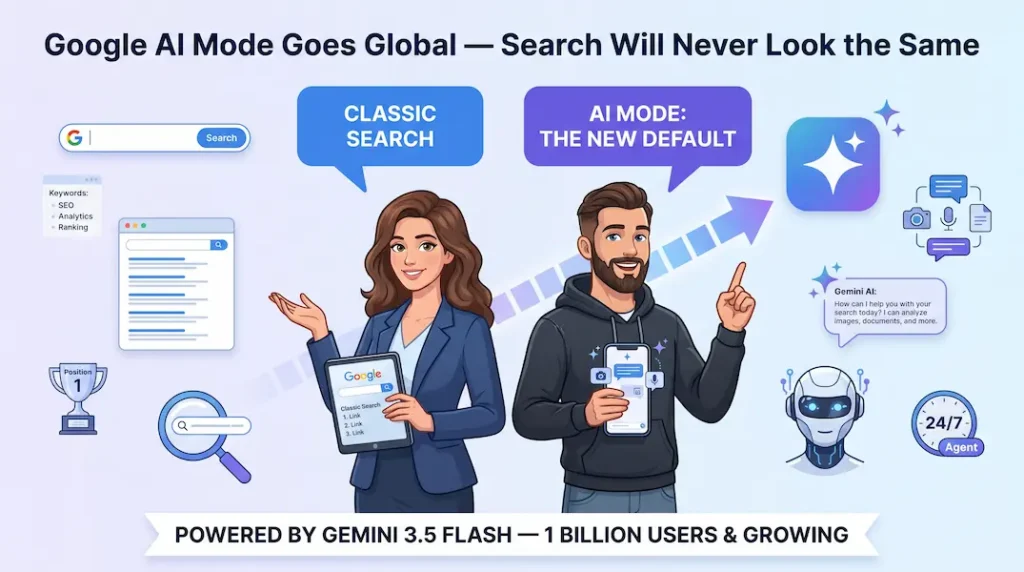
At Google I/O 2026 on May 20, Google declared that Search is now “AI search, through and through,” announcing the biggest change to the search bar in over 25 years. Gemini 3.5 Flash became the default model for AI Mode globally on May 19, 2026, rolling out across 200 countries and 98 languages with no subscription required (confirmed via the official Google Search I/O 2026 blog). AI Mode now has over 1 billion monthly users.
The classic blue-link search bar is not dead. It just got absorbed. Think of it less like a replacement and more like a renovation where the walls are still standing, but the entire floor plan has changed.
What actually changed, and what stayed the same?
The core search bar is now an AI input layer, multimodal, conversational, and capable of accepting text, images, files, videos, and Chrome tabs simultaneously.
What is confirmed and live as of May 19-20, 2026:
- Gemini 3.5 Flash is the new default model for AI Mode globally: replacing the prior Gemini 1.5 Pro default, for all users, no opt-in required (Google DeepMind, May 19, 2026)
- The search box has been redesigned: it dynamically expands for longer conversational queries and accepts multimodal inputs: text, images, files, videos, and Chrome tabs
- AI Mode crossed 1 billion monthly users: confirmed in Google’s I/O 2026 announcement
- Personal Intelligence expanded to ~200 countries and 98 languages: connects Gmail and Google Photos to AI search results, available free (previously paid only in the US)
- Preferred Sources are now a direct AI visibility signal: users’ saved preferred sources influence which content appears in AI Overviews and AI Mode answers, making brand loyalty measurable as a search factor
- AI Search Agents announced: continuously monitor the web and alert users with real-time updates; rolling out to AI Pro and AI Ultra subscribers in summer 2026 (not yet generally available)
What stayed the same:
- Classic blue-link results still exist and are not going away: Google confirmed this explicitly
- Core ranking systems (the same index, the same quality signals) still govern which content AI Mode cites
- Technical SEO fundamentals remain the entry gate: uncrawlable and unindexed pages cannot be cited
- E-E-A-T remains the quality framework; the model changed, but the criteria did not
| Feature | Before I/O 2026 | After I/O 2026 |
|---|---|---|
| Default AI Mode model | Gemini 1.5 Pro | Gemini 3.5 Flash (globally) |
| Search bar input types | Text only | Text, images, files, videos, Chrome tabs |
| AI Mode availability | Limited markets, some paid tiers | 200 countries, 98 languages, free |
| Preferred Sources | US rollout only | Global signal influencing AI answers |
| AI Search Agents | Not available | Rolling out to Pro/Ultra subscribers, summer 2026 |
| Monthly AI Mode users | ~700M (late 2025 estimate) | 1 billion+ confirmed |
Who does this affect, and how badly?
Every site that relies on informational search traffic takes a structural hit, but the damage is not evenly distributed.
Most exposed:
- Informational content sites and publishers: AI Mode answers complex questions natively, reducing the click impulse for informational queries. According to AIGums’ analysis of Google AI Mode (June 2026), 93% of AI Mode queries end without a click compared to 83% for standard AI Overview queries. That is not a typo.
- Sites not currently cited in AI Mode: Semrush’s analysis found that URL overlap between traditional top-10 results and AI Mode sidebar citations is below 30% for many query types. Ranking first does not guarantee AI Mode inclusion.
- Brands without cross-platform presence: AI Mode cites sources based on perceived trust across the web, not just domain authority. Reddit, Quora, and niche community platforms appear frequently. A brand invisible outside its own site is a brand invisible in AI Mode.
- Marketers relying on keyword-level attribution: Personalization at this scale means two users asking identical questions can see different AI answers. Share-of-voice tracking across audience segments is now materially more complex.
Who gains:
- Brands saved as Preferred Sources: users who save your domain influence how often it appears in their AI answers. This is a direct audience-loyalty-to-visibility pipeline that did not exist before
- Niche publishers with deep topical authority: AI Mode pulls from specialized sources for complex queries; generalist sites lose citation share to vertical specialists
- Brands with strong Reddit and community presence: these surfaces are disproportionately cited in AI Mode answers, a pattern that accelerated after the May 2026 core update
Here’s something I noticed first-hand: when I tested AI Mode across supplement and real estate queries after the I/O 2026 rollout, the citations were rarely from the same domains that held position one in standard search. For supplement queries, PubMed citations, named nutritionists, and community forums appeared above major brand sites. For real estate queries, neighbourhood-level content and local authority pages outranked national portals. The citation selection logic is not traditional; it ranks citations based on trust, specificity, and extractability.
Why did Google make this change?
Google’s stated reason is to make search “more helpful for more complex questions,” as confirmed in the official I/O 2026 blog post.
The mechanism is Gemini 3.5 Flash, which Google describes as capable of “multimodal reasoning, longer context handling, and agentic tool use” simultaneously (Google DeepMind, May 2026). The model upgrade makes the new search box technically possible; it can receive a photo, a file, and a text question in a single prompt and reason across all three.
The competitive reason is more transparent than Google usually admits: ChatGPT Search, Perplexity, and Claude all offer conversational, multimodal search interfaces. The I/O 2026 announcements are Google’s most direct response yet to the argument that its search product was becoming outdated. One billion monthly AI Mode users is the data point Google is leading with; it signals that this is not a feature launch but a platform shift.
In my view, the Preferred Sources announcement is the most underreported development from I/O 2026. It means audience loyalty is now a literal search ranking signal. A user who saves your domain sees your content prioritized in their AI answers. For brands with strong newsletter audiences, loyal communities, or high repeat-visitor rates, this is a concrete competitive advantage, and it has nothing to do with traditional SEO tactics. Build your audience, and Google will reward it directly inside AI Mode. That is a genuinely new mechanic.
Marie Haynes, in her May 2026 algo update and AI changes list, noted that Google simultaneously updated its spam policies to flag attempts to “manipulate generative AI responses through inauthentic means” directly alongside the I/O 2026 announcements. The two moves together signal Google is expanding AI’s surface area while simultaneously closing the manipulation pathways.
What are most people getting wrong about this?
The most common misread is treating AI Mode as a separate platform requiring a separate strategy.
It is not. Google confirmed at I/O 2026 and reinforced in its May 15 AI optimization guide that AI Mode uses the same core index, quality systems, and crawl infrastructure as standard search. There is no second AI Mode SEO programme. There is only SEO applied to a surface where the display format is a synthesized answer rather than a list of blue links.
The second misread is panicking about the 93% zero-click rate for AI Mode queries and concluding that all content investment is wasted. The correct read: 93% zero-click means citation value being the named source inside the AI answer is now the primary return on content investment for informational queries. Seer Interactive data confirmed that brands cited in AI Overviews earn 35% more organic clicks and 91% more paid clicks than non-cited competitors. Citation share is the new position one.
The third misread is ignoring the AI Search Agents announcement, which is restricted to Pro and Ultra subscribers this summer. These agents continuously monitor news, blogs, and social media, building a real-time content index for subscribed users. Early adoption in those subscriber tiers will create a citation pattern that influences broader AI behaviour over time. The practitioners who are cited in agent outputs now are building the signal that will matter when agents go mainstream.
So what should I actually do about this?
- Test AI Mode on your top 20 target queries and document who is cited, not who ranks. Go to google.com/search?udm=50 or use the AI Mode tab and search your core queries. Screenshot or document every cited domain. Compare this list against your current top-10 rankings. The gap between where you rank and where you are cited is your AI Mode visibility gap, and it is more actionable than any keyword report right now.
The mistake: assuming your current rankings translate directly to AI Mode citations.
- Audit your content for multimodal extractability. AI Mode now accepts images and files as inputs, which means users may be searching with your competitor’s product photo or a document you wrote. Your content must be structured so that AI can extract a clean, attributed answer from any relevant passage. Answer-first paragraphs, specific named claims, and structured lists improve extractability. The mistake: treating AI Mode as a text-only surface and ignoring the visual and file-based input pathways.
- Build a Preferred Sources strategy, treat it like email list growth. Preferred Sources is an audience signal. Users who trust you enough to save your domain in their Google preferences will see your content prioritized in their AI answers. Grow this by making your brand worth saving: consistent publishing schedules, newsletter sign-ups, direct subscription nudges, and clear brand positioning help users remember and save your domain.
The mistake: ignoring Preferred Sources because they feel like a passive signal outside your control, they are not.
- Establish your brand on at least two community platforms your audience uses. AI Mode disproportionately cites Reddit, Quora, and niche forums, not because Google favours them ideologically, but because they generate authentic first-hand content at scale. Being present where your audience asks questions means being cited when AI Mode answers those questions. For supplement brands: Reddit r/Fitness and product subreddits. For real estate: local community groups and niche property forums.
The mistake: treating community platforms as optional brand-awareness channels rather than citation-eligibility infrastructure.
- Restructure your most important pages for 134-167 word self-contained answer passages. Semrush’s AI Mode citation analysis found that cited passages tend to be 134-167 words, long enough to be substantive, short enough to be extracted cleanly. Each H2 section on your key pages should open with a one- to two-sentence direct answer, followed by a self-contained explanatory paragraph. This format works for both AI Mode citations and featured snippets, one optimization, two outputs.
The mistake: writing long-form content as one continuous essay with no extractable passage structure.
- Monitor AI Search Agent eligibility as subscriber tiers expand. AI Agents launching this summer for Pro and Ultra users will monitor the web continuously for topic-relevant updates. These agents will build citation patterns in early subscriber communities before going mainstream. To be cited by an agent, you need fast-publishing, well-structured content on topics your audience monitors in real time, such as breaking news angles, product updates, and fresh data publications.
The mistake: dismissing AI Agents as a niche, premium feature and missing the early citation-signal window.
- Add AI Mode to your monthly reporting framework now, even without click data. Until Search Console’s Generative AI Performance Report matures (click data expected December 2026 under CMA compliance), your AI Mode visibility is only partially measurable. Use manual SERP testing for your top 20 keywords, track branded AI citations across platforms, and monitor direct traffic and branded search volume as proxy metrics.
The mistake: waiting for perfect reporting tools before starting to track the baseline you build today. The benchmark you build today makes future data meaningful.
If you are figuring out how to position your site for AI Mode, what to measure, where to start, and how to explain it to clients, connect with me on LinkedIn. I am posting breakdowns there regularly.