
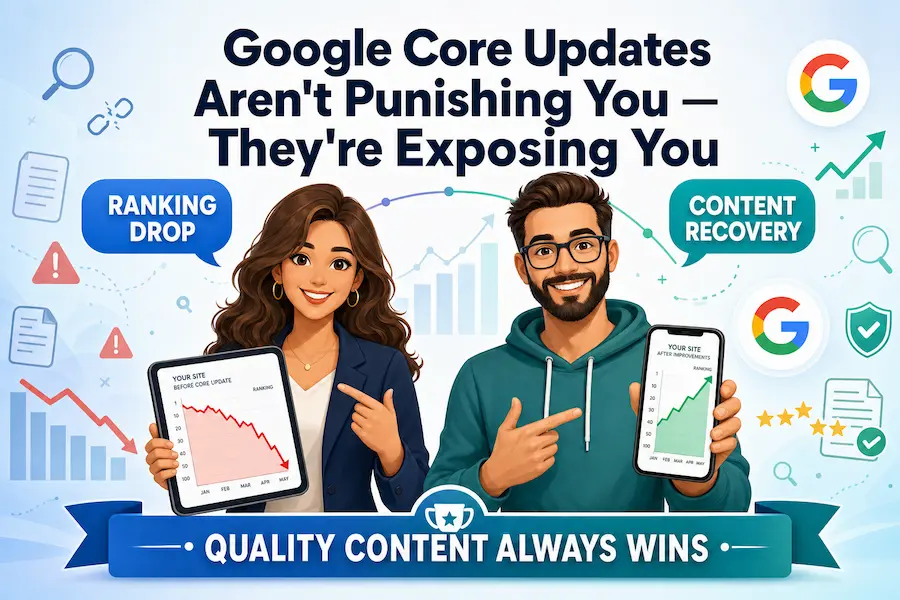
Google Core Updates Aren’t Punishing You; They’re Exposing You
A Google core update is a broad change to Google’s ranking algorithm that recalibrates which content it considers most helpful for any given search. It doesn’t target your site. It doesn’t penalize you. It reassesses everything, and sometimes your content ends up lower because better content now exists. That’s it.
I know that’s not what the SEO Twitter discourse tells you. Every core update drops, and the community erupts: “Google nuked my rankings,” “major algorithm penalty,” and “chaos in the SERPs.” I’ve been in this industry for over a decade and watched us collectively lose our minds over updates that, most of the time, were us getting fairly outranked.
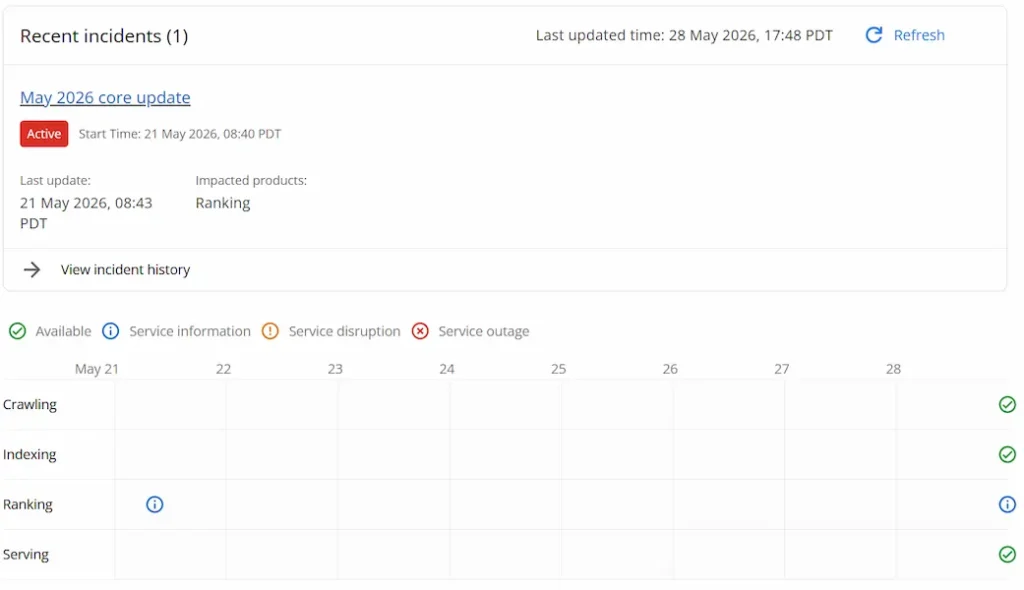
Right now, as I write this, the May 2026 core update is still rolling out; it began on May 21 and could continue until early June. I checked the Google Search Status Dashboard this morning. The “Active” badge is still red. And I’ve already seen three clients’ teams frantically rewriting content, submitting URLs for re-indexing, and second-guessing every page on their site. So let’s slow down and actually talk about what’s happening.
What is a Google core update, really?
A core update is a broad recalibration of Google’s quality signals, not a targeted hit on your website.
Google uses a helpful analogy in its own documentation: imagine you wrote a list of your 20 favourite restaurants in 2019. A few years later, new restaurants have opened, some have changed, and your criteria for “good” have shifted (maybe you care more about dog-friendly patios now). The list changes. The restaurants that dropped off aren’t bad; there are just better options for your current criteria.
That’s a core update. Google isn’t punishing the restaurants that fell off the list. It’s just updating what “great” looks like. Your site dropping from position 4 to position 14 isn’t a penalty. It’s Google saying, compared to what’s out there now, these other pages do a better job for this query.
Here’s what a core update is not:
- A manual action (no human reviewed your site)
- A targeted penalty for something you did wrong
- A site-wide death sentence (page-level and site-wide signals both factor in, independently)
- Permanent (Google explicitly describes rankings as dynamic and non-static)
Google confirmed in its ranking systems documentation that both page-level signals and site-wide signals influence rankings. Strong site-wide authority doesn’t save a weak page, and one underperforming section doesn’t doom your best content. The relationship is more nuanced than most post-update coverage suggests.
Why did my rankings drop after the core update?
Your rankings most likely dropped because your content has quality gaps that the update made visible, not because Google changed the rules overnight.
Here’s the honest truth I’ve come to after auditing dozens of sites post-update: most “core update damage” is actually 12-18 months of content-quality debt that the algorithm has finally caught up to. The update didn’t create the problem. It got better at seeing it.
A data review of 60+ client sites found the same pattern: the sites that recovered fastest were those that acknowledged existing quality gaps rather than blamed the update itself.
I saw this with a real estate rental website I was working with. After the March 2026 core update, three location pages experienced significant drops in traffic. When I dug in, those pages had thin content, generic city descriptions, a few bullet points, and a contact form. They’d been sitting like that for two years. The update didn’t kill them. It finally noticed they weren’t very helpful.
The fix wasn’t a quick rewrite. It was building those pages into genuinely useful local guides with real neighbourhood info, commute details, nearby amenities, and actual local context. That’s a content quality investment, not a technical patch.
Does a core update affect my whole site or just specific pages?
It can affect both, and knowing which one matters for how you respond.
This is where I see SEOs make the biggest diagnostic mistake. They assume everything is connected and rip apart their entire site when only a handful of pages actually dropped.
Here’s a quick way to think about it:
| Scope of Drop | What It Likely Means | What to Do |
|---|---|---|
| A few specific pages dropped | Page-level quality or intent mismatch | Improve those pages specifically |
| A whole topic/category dropped | Topic clusters lack depth or authority | Strengthen the full content cluster |
| The entire site dropped broadly | Site-wide quality signal issue | Audit overall content quality holistically |
| Drop only in Images/News/Video | Channel-specific signal, not core rankings | Investigate that surface separately |
Google’s documentation is explicit: analyze different search types separately. A drop in Google News or Google Images is a different problem from a drop in web search. Mixing them in your Search Console comparison will give you a distorted picture.
POV: Don’t even start this analysis until the update has finished rolling out and you’ve waited a full week after that. Mid-rollout data is noise. Rankings can flip multiple times during the two-week rollout window. The May 2026 update started on May 21, which means the earliest you should pull meaningful comparison data is around June 10–15. Not today.
How do I actually diagnose a core update drop?
Use this four-step process in order before touching a single piece of content.
Most people skip straight to fixing. That’s backwards. Diagnose first.
- Confirm the update has finished rolling out. Check the Google Search Status Dashboard. If the update shows “Active,” stop. Come back when it’s done.
- Wait one full week after rollout completes. Then compare that post-update week against a week before the update started. Don’t compare to the week during the rollout; that data is volatile.
- Triage by drop size:
- Small drop (from position 2 to position 4): Don’t panic. Google explicitly recommends against making drastic changes to content that’s already performing reasonably well.
- Large drop (from position 4 to position 29+): This warrants a deeper self-assessment of content.
- Run the self-assessment on your site as a whole, not just the impacted pages. Google’s self-assessment questions ask whether your content exists to help users or to capture rankings. Be honest. Most sites have both types of content, and the ratio matters.
Do This: In Search Console, filter your Performance report by page. Sort by change in average position. Flag every page that dropped more than 10 positions. That’s your audit list, not your whole site.
What’s the difference between a “quick fix” and an actual fix?
A quick fix addresses the symptom. An actual fix addresses why your content wasn’t helpful enough in the first place.
Google is direct about this in its own documentation: “Avoid doing ‘quick fix’ changes (like removing some page element because you heard it was bad for SEO).” That’s a direct quote. And yet, every post-update cycle, I see the same panicked moves:
- Someone removes author bios because they heard E-E-A-T was the problem
- Someone deletes 40 blog posts because they heard “content pruning” was the fix
- Someone rewrites title tags in bulk because they heard keyword placement was the issue
These are reactions, not solutions. The real question is, why isn’t this page the best answer for this query?
The Helpful Content System, fully integrated into Google’s core ranking algorithm since March 2024, evaluates content that was written for search engines first. That includes pages with heavily keyword-stuffed titles, content updated purely to appear fresh, and sites that scatter articles across unrelated topics, hoping some of them rank.
Deleting content should be a last resort. Google’s own guidance is clear: if you’re thinking about deleting entire sections of your site, that’s a sign those sections were written for Google, not for people. The better move is to rehabilitate that content and make it genuinely useful rather than gut it. Unhelpful content can drag down your good pages, but deletion is the nuclear option, not the first one.
How long does it actually take to recover from a core update?
Realistic recovery takes a minimum of 6-12 weeks from when you make meaningful improvements, not from the date of the update.
Google’s documentation says recovery could take “a few days to several months.” That’s technically accurate and practically useless. Here’s what actually happens:
- 6-12 weeks minimum from when you make genuine quality improvements (not from the update date)
- 2-4 months for full recovery in most cases, typically aligning with the next core update cycle
- 6-12 months for YMYL niches (health, finance, legal). Google moves more cautiously before restoring trust in these categories
The most common mistake I see? Someone makes changes the week after an update, sees no movement for 30 days, concludes the changes “didn’t work,” and starts over with something new. They abandoned the right fix right before it was about to take hold.
Document everything with dates. When you restructured that category page. When you added author credentials. When you rewrote that thin landing page. When recovery eventually shows up in Search Console, you’ll be able to connect it to the actual cause, not a guess.
One more thing Google hints at but doesn’t shout about: smaller, unannounced core updates run continuously. Your improvements don’t have to wait for a major named update to get rewarded. They can surface at any point as Google recrawls and reassesses your content.
Is Search Console giving me the full picture?
Not entirely, and in 2026, this gap matters more than it used to.
Your Search Console data shows your organic ranking positions and the clicks that came from those positions. What it doesn’t show is visibility you may have gained or lost in AI Overviews, which now appear across a meaningful portion of Google searches.
Google’s John Mueller has confirmed that AI Overviews are influenced by core updates. This means a core update can shift not just where you rank organically but also whether you get cited inside an AI Overview answer at all. These are two separate measures of visibility, and right now most sites track only one of them.
What this means practically:
- A ranking drop in Search Console may not tell the whole story if you’re gaining or losing AIO citations at the same time
- Content that directly and authoritatively answers questions is more likely to be cited in AI Overviews. The same signals that help you recover from a core update also improve your AIO citation chances
- Track your AIO citation status alongside your organic positions; treating them as one metric will lead to wrong conclusions
The May 2026 update launched the morning after Google I/O 2026. That timing isn’t coincidental. Google regularly aligns ranking changes with product announcements, and AI Mode and expanded AI Overviews are both accelerating. Core updates in 2026 are about more than Blue-link rankings; they determine who surfaces across every Google product.
I’ve been doing this long enough to have lived through Panda, Penguin, RankBrain, and more core updates than I care to count. Every single time, the sites that recovered fastest were the ones that stopped reacting and started asking, “What does my audience actually need from this page?”
That question doesn’t change between updates. The algorithm just gets better at measuring whether you answered it.
If you want to talk through what a core update diagnosis actually looks like for your site, connect with me on LinkedIn. I’m always up for a no-fluff conversation about what’s actually moving the needle.