Why isn’t my business showing up in the Google Map Pack, and how do I fix it?
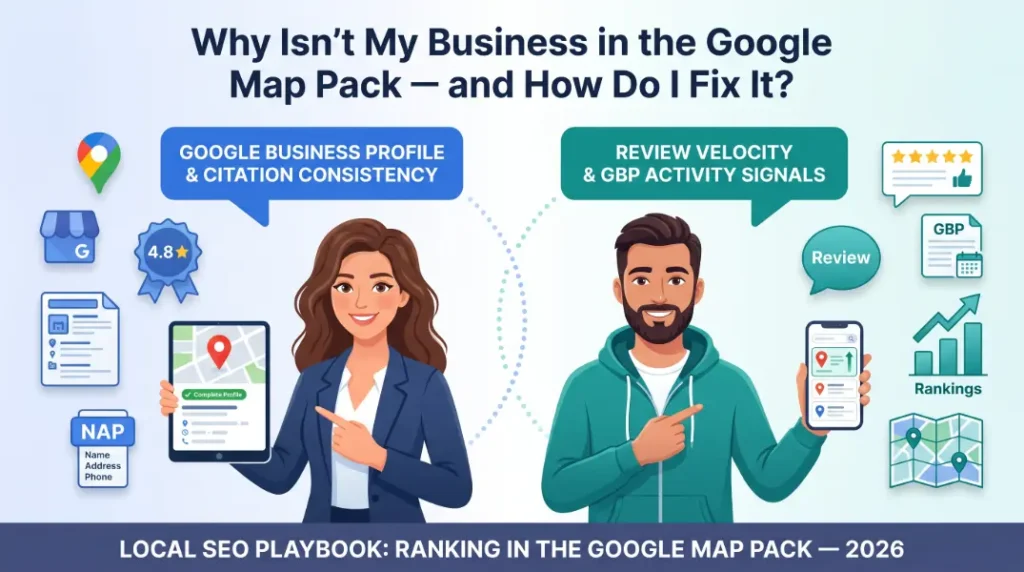
To rank in the Google Map Pack, you need to nail three things: your Google Business Profile (GBP), your online reviews, and your consistency across the web. Get all three right, and you’re competing for one of the three most valuable spots on the local SERP. Miss any one of them, and your neighbour who responds to every review will beat you, even if you’ve been in business longer.
Local search is gloriously unsexy. No viral content strategies. No backlink outreach campaigns. Just clean data, steady reviews, and the discipline to actually show up. I’ve helped real estate brokerages and commercial service clients go from invisible to Map Pack visible by doing exactly that. Let’s walk through it.
What you’ll need before you start
- Access to your Google Business Profile (business.google.com)
- A citation audit tool: BrightLocal, Semrush’s Listing Management, or Moz Local
- A review request system: email, SMS, or a reputation management tool
- A geo-grid rank tracker: Local Falcon or RankRadar (to measure where you’re winning and where you’re not)
- Time: 3-4 hours to set up the foundation; 30-60 minutes per week to maintain
Step 1: Is your GBP primary category actually right?
Your primary category is the single most influential on-profile lever you have. Choosing the wrong one is like opening a bakery and telling Google you’re a hardware store.
According to Sterling Sky’s GBP category research, choosing the right primary category improves Local Pack visibility by an average of 31%. That’s not a marginal tweak. That’s the difference between appearing and not appearing for your core service queries.
The mistake I see most often is businesses picking a broad category because it sounds official. “Lawyer” instead of “Personal Injury Attorney.” “Contractor” instead of “Kitchen Remodeler.” “Restaurant” instead of “Thai Restaurant.” Broad categories put you in competition with every business under that umbrella. Specific categories put you in front of the people actively looking for what you do.
How to pick the right primary category:
- Search your main service query on Google. Look at the three businesses already in the Map Pack. Check their primary categories.
- Match the most specific category that accurately describes your core service. Don’t pick a category you can’t back up; Google uses engagement signals to validate this.
- Add secondary categories for every other service you offer, up to nine. Businesses with three or more categories rank an average of 2.4 positions higher in the Local Pack (Whitespark, 2026).
- Fill every GBP field. Services menu, products, 750-character description, hours, attributes, and photos. Google data shows customers are 70% more likely to visit and 50% more likely to consider purchasing from businesses with a complete Business Profile.
POV: Right now, open a new browser tab, search for your main service + your city, and check the primary categories of the three businesses in the Map Pack. If yours doesn’t match, that’s your first fix.
The mistake I flag on almost every audit is a business that has added keywords to its GBP business name. “Toronto Plumbing – Fast Emergency Plumber” is not a business name; it’s a keyword list wearing a trench coat. GBP’s policy prohibits keyword-stuffed names, and such names are increasingly flagged and suspended. Keep the GBP name exactly as it appears on your signage, invoices, and legal documents. Full stop.
Step 2: Are your NAP details consistent, or is Google getting mixed signals?
NAP inconsistency; mismatched Name, Address, and Phone number across directories confuses Google about whether your business locations are the same entity or different ones.
NAP stands for Name, Address, Phone number. Every time your business is mentioned online, on Yelp, Yellow Pages, your local Chamber of Commerce, your industry association, or a local news article, Google reads that mention and cross-references it against your GBP. When the details match, that’s a trust signal. When they don’t match, it’s noise.
Moz and BrightLocal data show that NAP consistency across platforms improves local rankings by an average of 23%. That’s a meaningful lift from something that costs zero dollars to fix.
Here’s what a NAP inconsistency audit looks like in the real world. When I audited a commercial cleaning company last year, their GBP listed their address as “Suite 200.” Their website said “#200.” Their Yelp listing had no suite number at all. Their Yellow Pages entry still showed an old phone number from before they changed providers. Four different versions of the same business. From Google’s perspective, that’s four different signals pulling in four different directions.
The fix:
- Run a citation audit using BrightLocal, Moz Local, or Semrush’s Listing Management tool
- Export every citation with a discrepancy, even minor ones (St. vs Street, Inc. vs Inc)
- Correct them manually on high-authority directories first: Google, Yelp, Bing Places, Apple Maps, Facebook, Yellow Pages
- For lower-authority directories, use a data aggregator submission (Neustar Localeze, Data Axle) to push consistent data at scale
POV: Google your business name in quotes along with your old phone number or old address. Every result that comes up is a citation that needs to be corrected.
Step 3: Does review velocity actually affect your Map Pack ranking?
Yes, review velocity (how regularly new reviews come in) is now a stronger ranking signal than total review count, according to Whitespark’s 2026 Local Search Ranking Factors survey.
This is the one that surprises local business owners the most. They worked hard to build 150 reviews over five years. A competitor with 40 reviews but three new ones this week is outranking them. How?
Because 73% of consumers only pay attention to reviews from the past month (BrightLocal, 2026). Google knows this. The algorithm reflects it. A steady stream of fresh reviews signals that the business is active, credible, and relevant right now, not three years ago.
According to Whitespark’s 2026 survey, review freshness overtook raw star count as a ranking signal. For UK service trades, Zava Build’s 2026 research found that a velocity of 5-15 new reviews per month can lift local pack positions by 2-10 spots and increase call volume by 20-60%.
Three things that compound review velocity:
- Response rate: Businesses that respond to reviews receive an average of 12% more reviews and a 0.12 higher star rating (ReviewTrackers, 2026). Every response you write is a signal and a prompt for future reviewers.
- Keyword-rich responses: Your responses index in Google. When you reply to a review mentioning “furnace repair in Mississauga,” those words appear in your GBP. Write natural, specific replies, not copy-paste templates.
- The right star target: Northwestern University/Spiegel Research data show that businesses with a perfect 5.0-star rating convert at a 12% lower rate than those with 4.5 stars. A 4.5–4.8 range is the sweet spot. Don’t chase perfection. Chase consistently and recently.
What I do for clients: I set up a post-service review request using a simple two-step SMS flow. Message one thanks them. Message two, sent 48 hours later, asks for a Google review with a direct GBP link. Response rates range from 18% to 28%, depending on the industry. At that rate, even a business with 20-30 customers per month can generate 4-8 new reviews per month without any manipulation.
Step 4: Does posting on GBP weekly actually move the needle?
Weekly GBP posts alone won’t rank you, but they’re a consistent activity signal that keeps your profile fresh and triggers additional GBP impressions.
Let me be honest about this one: GBP posts are not a major direct ranking factor. The correlation between posting frequency and Local Pack rankings is real but modest. Fokal’s 2026 analysis of GBP performance data recommends a minimum of one post per week, and an optimal cadence of two to three per week. Web20 Ranker’s controlled posting test showed ranking improvements with consistent weekly posting, not daily or monthly.
Here’s what posts actually do:
- Keep the profile visually active: a profile with a recent post from three days ago looks more credible than one with a post from 2023
- Trigger additional Map Pack impressions on relevant search terms when you use service-area and service keyword combinations in post copy
- Feed the GBP Q&A section: posts that answer common questions pre-empt queries and reduce the chance of competitors’ customers asking negative questions
Format for posts that actually work:
| Post Type | Best For | Include |
|---|---|---|
| Offer post | Promotions, seasonal deals | Clear CTA, expiry date, service keyword and city |
| Update post | New services, staff news, and hours changes | NAP-consistent address reference |
| Event post | Open houses, workshops, community events | Date/time, location, registration link |
| Photo post | Before/afters, project completions, team | Geo-tagged photos with descriptive filenames |
On geo-tagged photos: when you upload photos to GBP, name the files descriptively before uploading, toronto-kitchen-renovation-before.jpg, not IMG_4821.jpg. Embed the GPS coordinates using your phone’s camera or a metadata tool. This reinforces your service area and location relevance signals.
Should I use service-area and service combinations in my GBP posts?
Yes, weaving your top service and location keywords naturally into post copy reinforces your relevance signals for those specific queries.
Not “Toronto plumbing Toronto plumber emergency plumber Toronto.” But “We just wrapped a same-day emergency water heater replacement in Etobicoke. If your unit is over 10 years old, here’s what to watch for.” That sentence contains Etobicoke, water heater replacement, and emergency, all naturally. That’s the right level.
Does embedding a Google Map on my website help local rankings?
Embedding a Google Map on your Contact or Location page, combined with LocalBusiness schema, provides a geographic confirmation signal that reinforces your address data.
The LocalBusiness schema (structured data markup on your website) tells search engines, in machine-readable language, what the business name, address, phone number, opening hours, and service area are. It’s the website-side partner to your GBP. Businesses with the LocalBusiness schema consistently have cleaner citation environments because their canonical entity information is clearly declared.
Add it to your Contact page, homepage footer, and any location-specific landing pages. Validate it at the schema.org validator or Google’s Rich Results Test before publishing.
What are most local businesses getting wrong about the Map Pack in 2026?
Most local businesses are investing in things that barely move the needle, like citation quantity, rather than the two things that move it most: category accuracy and review velocity.
BrightLocal’s 2026 Local Marketing Industry Survey found that 76% of local marketers consider GBP management the most valuable local SEO service, but only 35% of SMBs even have a Google Business Profile, let alone an optimized one. That gap is the opportunity.
The Local Pack appears in 93% of local searches (Moz SERP Features, 2026). Businesses in the Map Pack receive 126% more traffic than businesses ranking only in organic results (SOCi, 2026). The prize is not abstract. It’s phone calls.
Here’s the thing: AI search is now layering on top of this. BrightLocal’s 2026 data show that 45% of consumers use ChatGPT or other generative AI tools for local business recommendations, but achieving visibility in AI-driven local recommendations is 30 times harder than ranking in Google’s local pack (SOCi Local Visibility Index, 2026). The same signals that earn you a Map Pack position. Reviews, completeness, entity clarity, and citations are the same signals that earn you an AI recommendation. Getting your GBP right now is table stakes for both surfaces.
If you’re working on local SEO for a service-area business and want a second set of eyes on your GBP setup, citation profile, or review strategy, connect with me on LinkedIn. Local SEO is one of my favourite things to audit because the wins are fast and measurable.