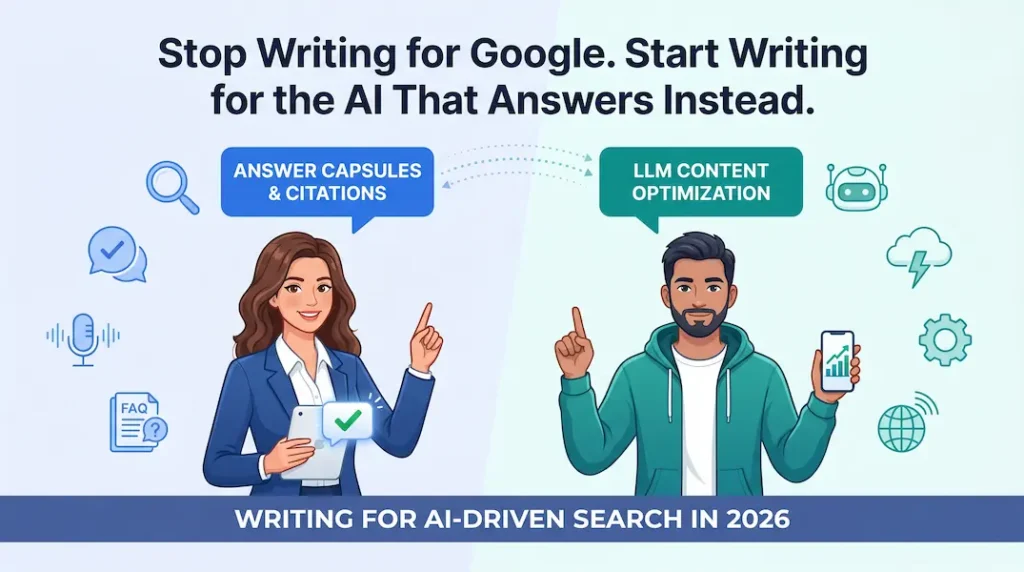
Stop Writing for Google. Start Writing for the AI That Answers Instead.
Getting cited by ChatGPT comes down to one thing: writing content that an AI can lift, quote, and use without needing to read the rest of your page. ChatGPT doesn’t rank pages. It extracts answers. And if your content isn’t structured to be extracted, you’re invisible no matter how good your SEO is.
I’ve been doing SEO for over a decade. I’ve watched rankings come and go, algorithms flip the board, and content strategies get completely rewritten. But I’ve never seen a shift as clean as this one: the brands getting cited by ChatGPT aren’t the ones with the most backlinks. They’re the ones who write the clearest answers. That’s either exciting or terrifying, depending on how your current content looks.
Why does ChatGPT cite some content and ignore the rest?
ChatGPT cites content it can extract, cleanly short, self-contained answers that don’t require surrounding context to make sense.
Think of it this way. ChatGPT isn’t reading your whole article. It’s skimming for the paragraph that it can drop into a conversation without editing. If your answer needs three paragraphs of setup before it gets to the point, the model moves on. If it lands directly in a tight 20–30 word explanation, it gets quoted.
According to a study of nearly two million sessions published in Search Engine Land, answer capsules, concise, self-contained answer blocks placed directly under a question-based heading, were present in 72.4% of all cited pages. That’s not a correlation. That’s a pattern.
ChatGPT also serves over 200 million weekly active users (OpenAI, 2025). When those users ask for recommendations, explanations, or comparisons, the model needs clean material to work with. Your job is to give it that material and make it impossible to skip.
How do you build “answer capsules” that ChatGPT actually quotes?
An answer capsule is a 40–70 word block placed directly under a question-based heading that answers the question completely, no preamble, no links, no filler.
It’s the difference between a menu that describes the vibe of the food versus one that tells you what’s actually in the dish. LLMs want the ingredients, not the atmosphere.
Here’s the format:
- Write a question-based H2 or H3: “How do I get cited by ChatGPT?” not “ChatGPT Citations”
- Open with a direct answer: first sentence, under 30 words, states the answer plainly
- Expand in 2–4 short sentences: add one stat, one example, or one mechanism
- Stop. Don’t bridge into the next section inside the capsule
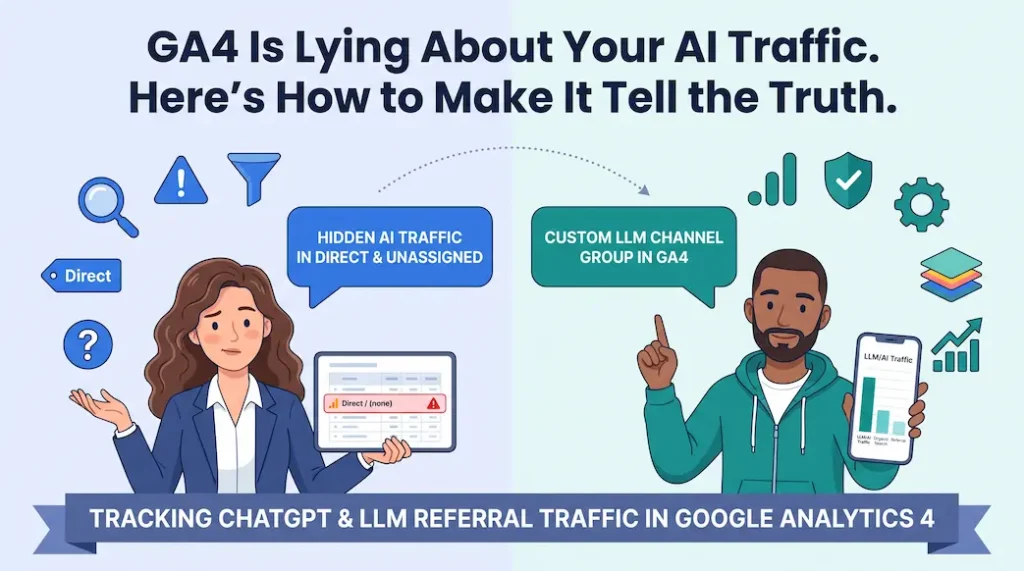
Here’s a real example from my own content audit work. A commercial cleaning client had 14 service pages. Every page opened with a paragraph about how long the company had been in business. Not a single page opened with an answer to the most likely question a visitor (or an AI) would have. After restructuring each page to open with a direct answer capsule, AI referral traffic tracked via custom channel groups in GA4 appeared within six weeks, where it had previously been zero.
According to data from ALM Corp (2026), 44% of all AI citations come from the first third of the content. If your answer is buried, it will not be found.
POV: Take your top-traffic page right now. Look at the first 100 words. Does it answer anything, or does it introduce itself? Rewrite those first 100 words as a direct answer to the most likely question a visitor has. Done in under five minutes.
Does leading with original data actually change citation rates?
Yes, pages with original, first-party data earn 4.1x as many AI citations as pages without it (Authority Tech/HumanAI, 2026).
This is the stat I keep quoting to clients who tell me they don’t have any data to share. You almost always do. You just haven’t packaged it yet.
Original data doesn’t mean a Stanford research paper. It means:
- Survey findings: even a 50-response survey among your customers counts
- In-house benchmarks: “We audited 200 product pages and found X”
- Client results: anonymised or named with permission
- Proprietary frameworks: your named process, checklist, or scoring model
- Operational data: response times, conversion rates, before/after comparisons
Content featuring original statistics and proprietary research achieves 30–40% higher visibility in LLM responses than general industry commentary (Averi AI, 2025). LLMs are designed to provide verifiable, attributable answers. When your content contains a number no one else has, you become the source, not just one of many voices.
Princeton research found that adding specific statistics boosts citation performance by over 5.5% compared to single optimization tactics alone. That may sound small, but stacked across a site of 50+ pages, it compounds fast.
How much original data should a page contain?
Aim for 3–5 data points per 1,000 words, at least one of which is first-party or original.
The rest can be cited with industry stats from trusted or similar sources. But make sure at least one number on the page is yours. That’s the one LLMs will attribute back.
Format matters here, too. A stat buried in a paragraph is harder to extract than a stat in a short, standalone sentence. Write each data point as a self-contained, quotable statement:
The Do: “Pages with answer capsules are cited in 72.4% of AI citations, compared to pages without them.” (Search Engine Land, 2025)
The Don’t: “There are many reasons why structured content performs better in various AI systems across different query types.”
One is extractable. One is noise.
Should you remove links from your answer capsules?
Yes, 91% of the answer capsules ChatGPT cites contain no links at all (Search Engine Land/Adam Gnuse study, 2025).
This is the finding that surprises people most. We’ve spent years obsessing over internal linking. Now we’re being told to pull links out of our best content?
Yes. And here’s why it makes sense once you think like an LLM.
A hyperlink inside an answer capsule sends a signal: the full answer lives elsewhere. LLMs are looking for content that is self-contained, a complete thought they can quote without needing to follow a trail. When you add a link mid-capsule, you’re essentially pointing the AI away from your answer.
| Capsule Element | Include or Remove? | Why |
|---|---|---|
| Direct answer sentence | Include | Core extraction target |
| One supporting stat | Include | Adds authority and citeability |
| Internal links | Remove | Signals answer is incomplete |
| External links | Remove | Dilutes the capsule as a standalone unit |
| Brand/author attribution | Include | Strengthens entity recognition |
| Jargon without definition | Remove | AI skips unclear content |
Put your links in the body copy below the capsule. That’s where they belong. The capsule is the extraction zone. Keep it clean.
How do you write sentences that ChatGPT actually quotes?
Write every key point as a standalone sentence, one that could be dropped into a ChatGPT answer without any surrounding context and still make complete sense.
These are called quotable sentences, citation hooks, or LLM anchors, depending on who you ask. I call them the difference between content that gets cited and content that gets skimmed.
How do I write quotable, self-contained sentences?
A quotable sentence names a subject explicitly, includes a specific claim or number, and ends without needing a follow-up sentence to complete the thought.
Here’s the test I use: read the sentence in isolation. Does it tell you who, what, and so what without needing any surrounding paragraphs? If yes, it’s quotable. If not, tighten it.
Practical rules:
- Name the subject every time. Never use “it,” “this,” or “the platform.” Always say “ChatGPT,” “schema markup,” “the FAQPage type.”
- Include a number where possible. Specific beats vague. “3x more” beats “much more.”
- One claim per sentence. Don’t compound two ideas with “and”; split them.
- Keep it under 25 words. Longer sentences fragment when extracted.
Aim for 5+ standalone quotable sentences per page. Spread them across sections, not all bunched at the top.
What is a TL;DR, and why should every article have one?
A TL;DR is a 3-5 sentence summary placed at the top of an article that tells the reader and the AI exactly what the page covers before they read a word of the body.
It’s not a teaser. It’s not a hook. It’s a direct answer to: “What will I learn here?”
According to Writesonic’s 2026 content structure research, answer-first formatting, including TL;DR blocks, increases the likelihood of citations for the full page, not just the summary section. LLMs use the TL;DR to gauge what the page is about, then look for the specific capsules that support it.
Format your TL;DR as a tight bullet list:
- What the article covers in one sentence
- The single most important takeaway with a number, if possible
- What the reader will be able to do after finishing
Done right, a TL;DR is also the most likely single block on the page to be extracted as a quick answer. It’s the last thing to write and the first thing to get right.
What is the actual payoff, and why does any of this matter?
Traffic from ChatGPT citations converts at 16% compared to 1.8% for Google organic search (Seer Interactive case study, 2025).
Let that land. Not a small difference. Not a rounding error. Nearly 9x the conversion rate.
Search Engine Land reported that ChatGPT ecommerce traffic converts 31% higher than non-branded organic search (Visibility Labs data, 2026). Authority Tech found LLM referral traffic converting at approximately 18% across multiple independent datasets.
The pattern is consistent: people who arrive from a ChatGPT citation are already pre-qualified. The AI told them you were the answer. They showed up to confirm it. That’s a very different visitor from someone who clicked result #4 on a Google SERP while still in browse mode.
Yet only 16% of brands systematically track their AI search performance (Erlin data, 2026). Which means 84% don’t know whether they’re being cited, how often, or for which queries.
Start there. Set up custom channel groups in GA4 for chatgpt.com, perplexity.ai, gemini.google.com, and claude.ai. At a minimum, you’ll see the referral volume. From there, reverse-engineer which pages are earning citations and replicate the structure across the rest of your site.
The SEO playbook hasn’t been thrown out. But a new layer has been added on top of it. Brands that figure out both traditional ranking signals and LLM-based extraction patterns are going to be very hard to compete with.
If you found this useful and want to talk through how your site stacks up for AI citation readiness, connect with me on LinkedIn. I’m happy to take a look.